What Is My Birthstone? Find Your Stone by Birth Month
Your birthstone by birth month, answered directly: all 12 months with primary and alternate stones, colors, and meanings
Yueounb Editorial
Jewelry Expert
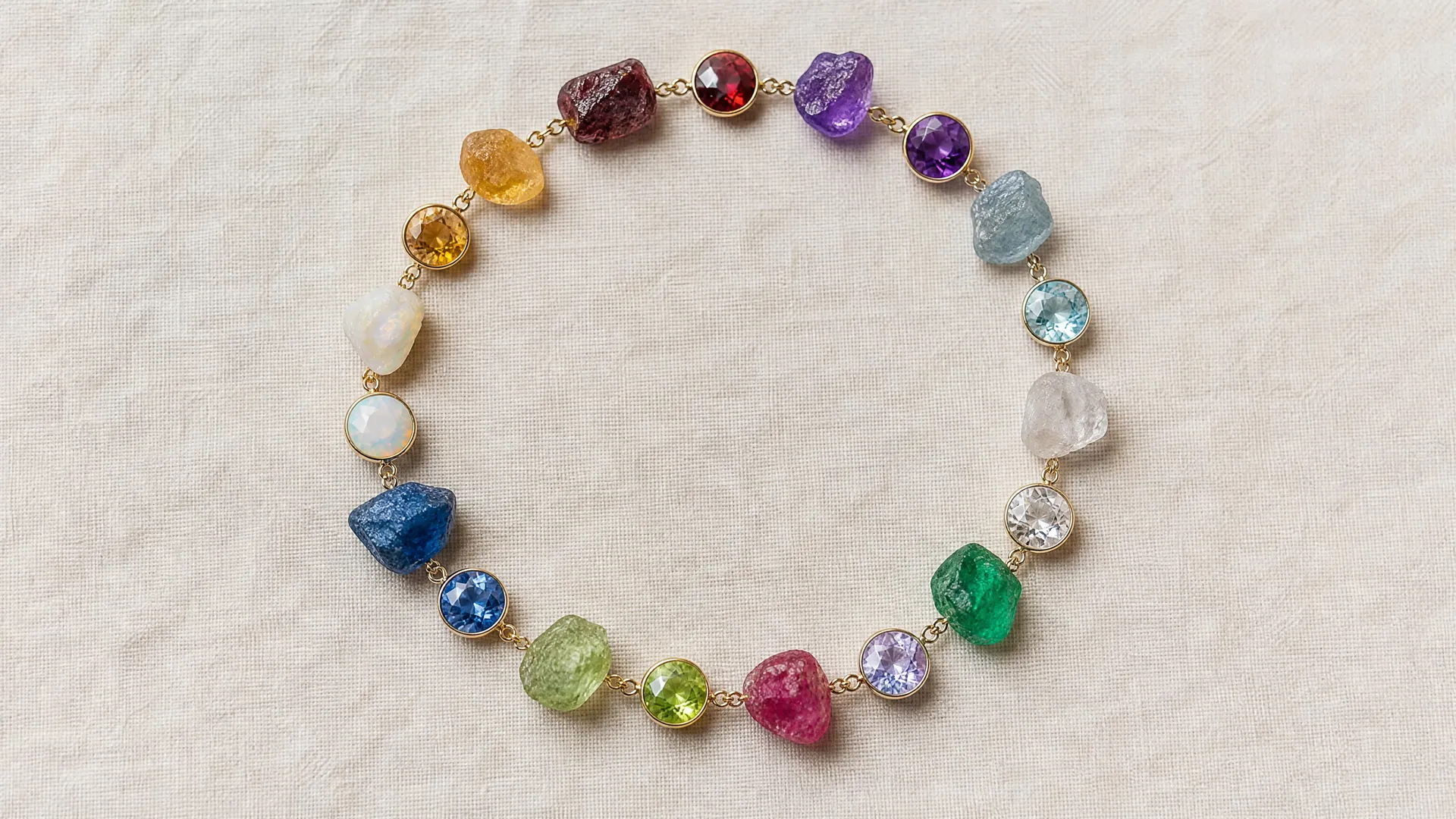
Quick Answer: Your birthstone is set by your birth month, not your zodiac sign. The modern list: January garnet, February amethyst, March aquamarine, April diamond, May emerald, June pearl or moonstone, July ruby, August peridot, September sapphire, October opal, November citrine, December turquoise or zircon. The list was standardized in 1912 and updated in 1952 and 2002 — five months now carry two or three official stones, and both picks are correct.
How to find your birthstone in ten seconds. If you were born in January your birthstone is garnet; February, amethyst; March, aquamarine; April, diamond; May, emerald; June, pearl or moonstone; July, ruby; August, peridot; September, sapphire; October, opal or tourmaline; November, citrine or topaz; December, turquoise, zircon or tanzanite. Only the month matters — the day of the month never changes your birthstone. Milestones ask a different question: the 60th birthday gemstone guide names the stone for the big six-oh, and the men’s-desk version of this whole topic lives in our birthstone jewelry for men guide. Your birthstone answers a second question too — which anniversary it celebrates: diamond is the stone of the 60th and ruby of the 40th, and the full anniversary list by year maps every milestone; the anniversary jewelry guide then matches each milestone to actual pieces. The complete month-by-month reference — every stone’s color, hardness, and care in one place — is our birthstones by month guide.
Month by month, quick answers. January garnet: deep red, the traveler protection stone. February amethyst: royal purple, the clarity stone. March aquamarine: pale seawater blue, the courage stone. April diamond: white, the unbreakable stone — clear quartz and white topaz give the same icy look on a budget. May emerald: grass green, the love stone. June pearl and moonstone: moonlight white with a blue-sheen alternative. July ruby: red, the passion stone and the hardest colored gem. August peridot: lime green, born in volcanoes. September sapphire: royal blue, the wisdom stone. October opal: flashing rainbow, the imagination stone. November citrine: golden sun, the abundance stone. December turquoise: robin-egg blue, the oldest gem humans ever wore. Each month also has its own deep-dive page; the August birthstone guide, for example, compares peridot and spinel in full, and February’s amethyst gets the same close-up in what is the birthstone for February.
Born on a month boundary — month or zodiac? Birthstones run strictly by calendar month. Zodiac signs span two months, so a Capricorn born December 28 wears December turquoise while a Capricorn born January 3 wears January garnet. The month list above is the standardized one; zodiac stones are a separate, older tradition that varies more between sources.
Traditional versus modern lists. The modern standard was fixed in 1912 by the American National Retail Jewellers Association, then lightly updated in 1952 (adding alexandrite for June, citrine for November, zircon for December) and 2002 (adding tanzanite for December). When a month shows two or three stones, the older is the traditional pick and the newer is the modern pick — both are officially correct, so choose the color you prefer.
Using your birthstone once you have found it. The three classic moves: wear your own month as an everyday signature piece; stack or combine the birth months of your children as a mother piece; or gift the exact month stone to the person born in it — the reason birthstone jewelry peaks every January and December in the United States. Style-specific shopping is easier with a shortlist: our best birthstone earrings guide ranks the year’s most wearable picks, and gift ideas for grandma beyond jewelry covers the non-jewelry route for the hardest generation to shop for.
Do not like your color? Every month has an official alternative in a different mood: June babies who dislike white can take color-change alexandrite, November splits between golden citrine and yellow topaz, December offers turquoise, zircon or deep-blue tanzanite, and October splits between rainbow opal and pink tourmaline. You never have to settle for a stone that is not you.
The fastest way to find yours: open the month picker on our Birthstones hub. Each month page lists the primary and alternate stones, the meaning, the Mohs hardness for daily wear, and the handcrafted pieces we set for that month — necklaces, rings, earrings and bracelets, one artisan per piece.
Frequently asked.
What is my birthstone if I was born in June?
June has three official stones: pearl (traditional), moonstone, and alexandrite (modern). Pearl and moonstone share the moonlight-white look; alexandrite is the rare color-change option that reads green in daylight and red under lamps.
What is my birthstone if I was born in December?
December has three official stones: turquoise (traditional robin-egg blue), zircon, and tanzanite (added in 2002, deep blue-violet). Blue topaz is the popular budget look-alike.
Is my birthstone determined by month or zodiac sign?
By calendar month. Zodiac signs span two months, so two people with the same sign can have different birthstones. Month-based lists are the standardized modern tradition used by jewelers.
What is the rarest birthstone?
Alexandrite, the modern June stone, is the rarest mainstream birthstone — fine color-change material is rarer than diamond by some estimates. Red beryl and painite are rarer still but are not on the birthstone list.
Why do some months have two or three birthstones?
Because the official list was updated after it was standardized in 1912: the 1952 revision added alexandrite for June, citrine for November, and zircon for December; tanzanite joined December in 2002 and spinel joined August in 2016. New stones were added alongside the traditional ones rather than replacing them — so when a month shows two or three, the older is the traditional pick and the newer is the modern pick, and both are officially correct.
How do I clean birthstone jewelry safely?
Warm water, mild soap, soft brush — safe for nearly every stone. Exceptions: opal, pearl, turquoise, emerald want a barely damp cloth. Never toothpaste, vinegar, bleach.
Related Articles
A Brief History of Birthstones
From the twelve tribes of Israel to the 1912 standard that rules the modern list — the 3,500-year origin story of why we wear our birth month.
Read MoreThe Ultimate Birthstone Cleaning Guide
Keep every piece in your collection gleaming. Step-by-step methods for gold, silver, and delicate birthstones — no harsh chemicals needed.
Read MoreBirthstone Energy: A Complete Crystal Healing Guide
From root chakra grounding to crown chakra clarity, discover how each birthstone carries healing energy. Learn to activate your crystal for meditation, sleep, and daily intention.
Read More