Best Birthstone Earrings: Which Stones Actually Hold Up, and How to Choose
If you want birthstone earrings that survive daily wear, pick a stone with a Mohs hardness of 8 or above: diamond (April), corundum as sapphire (September) an
Yueounb Editorial
Gemologist
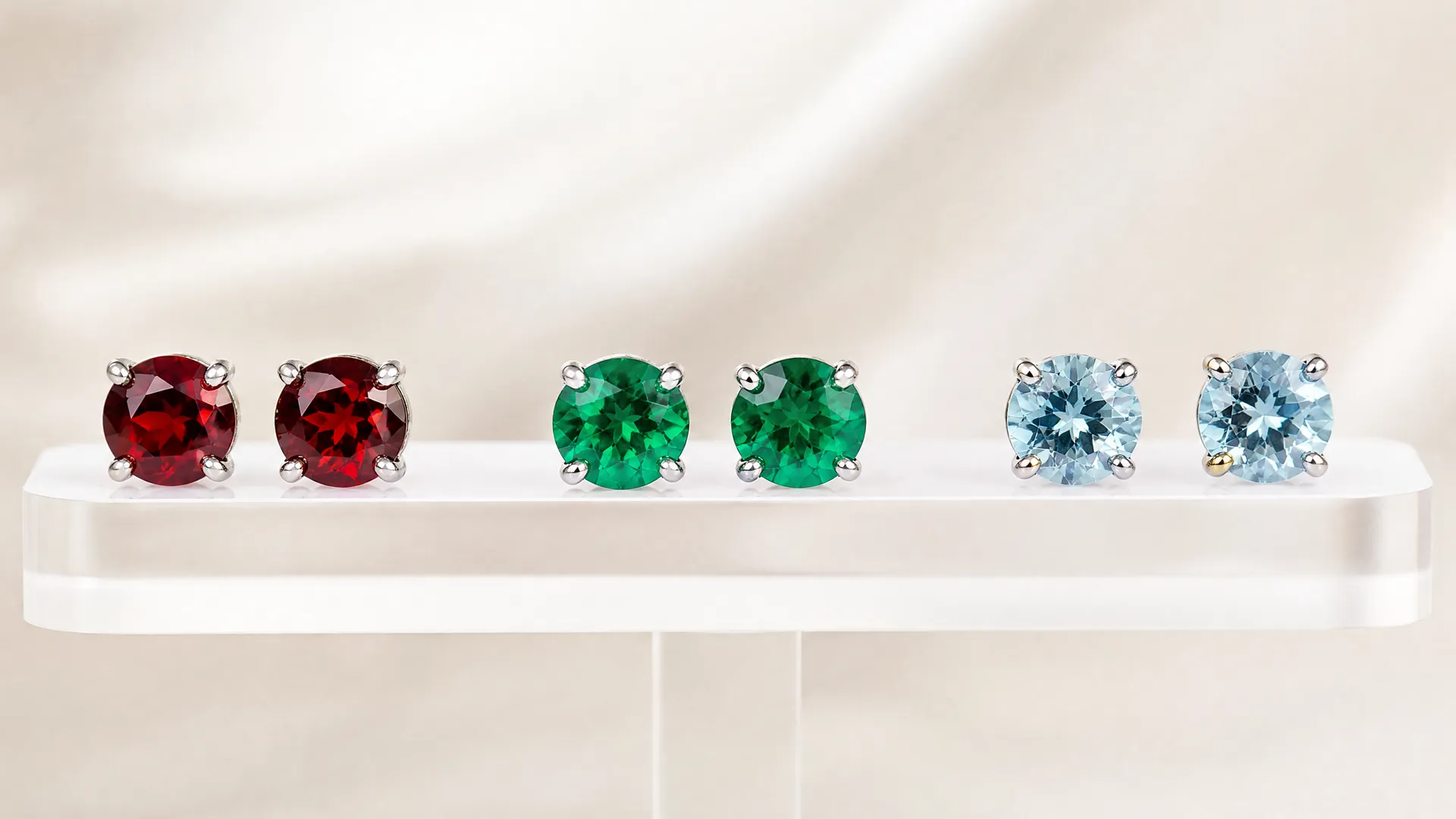
If you want birthstone earrings that survive daily wear, pick a stone with a Mohs hardness of 8 or above: diamond (April), corundum as sapphire (September) and ruby (July), and topaz (November) are the safest choices. Emerald (May), opal (October), and pearls (June) are beautiful but fragile — they belong in occasional-wear settings with protective designs like bezels or halo settings. For a balance of durability, price, and color, September's sapphire and November's topaz consistently deliver the best value in earrings.
Quick Answer: Best Birthstone Earrings by Priority.
| Your priority | Best pick | Why |
| --- | --- | --- |
| Maximum durability (daily wear) | Sapphire (September), ruby (July), diamond (April) | Corundum rates 9 on Mohs, diamond 10 — both resist scratching from household dust |
| Best value under $200 | Topaz (November), garnet (January) | Both are hard (8 and 7–7.5), abundant, and untreated color is widely available |
| Most flattering on most wearers | Round and oval studs, 5–7 mm | Universally proportioned; suits nearly every face shape |
| Fragile stones done right | Bezel-set emerald or opal, occasional wear | Bezel edges shield the girdle, where chips typically start |
Why Earrings Are the Most Forgiving — and Most Punishing — Birthstone Format.
Earrings occupy a strange position in jewelry durability. On one hand, they take less direct abuse than rings: your hands hit doors, countertops, and gym equipment all day, while your ears mostly don't. On the other hand, earrings are the piece you're most likely to never take off — slept in, showered in, forgotten for months. That pattern changes the math.
The real enemy isn't a single hard knock. It's household dust, which contains quartz particles. Quartz rates 7 on the Mohs scale, so any gemstone softer than 7 — opal (5.5–6.5), turquoise (5–6), pearl (2.5–4.5) — will slowly accumulate micro-scratches from ordinary dust exposure if worn continuously. Hardness, though, is only one of three factors that matter. Toughness (resistance to breaking and chipping) and stability (resistance to heat, light, and chemicals) complete the picture.
Emerald (May, 7.5–8 Mohs) is hard enough, but its characteristic inclusions — jardin — make it inherently brittle. It chips at the girdle. Most commercial emeralds are also fracture-filled with cedarwood oil or resins, a treatment you should expect disclosed by any reputable seller. Ultrasonic cleaning can damage filled emeralds. - Topaz (November, 8 Mohs) is hard but has distinct cleavage — a directional plane where a single blow can split the stone. A topaz stud dropped on tile can break; worn in an ear, it's well protected. - Sapphire (September, 9 Mohs, no significant cleavage, excellent stability) is nearly ideal for earrings. Heat treatment is common and permanent; it doesn't require special care.
This is why the traditional "hardest = best" advice is incomplete. For earrings specifically, the ranking I'd give clients after a decade of writing about gemstone wearability is: corundum (sapphire/ruby) > diamond > spinel > topaz/garnet > amethyst/citrine > emerald > opal/pearl/turquoise.
The Honest Tier List: Every Month Ranked for Earring Wear.
Not every birth month gets an equal deal in earrings. Here's the unvarnished assessment, month by month, grouped by how I'd actually recommend wearing them:
Tier 1 — Wear them forever, care-free. April (diamond, 10 Mohs), September (sapphire, 9), July (ruby, 9), and August's alternative stone spinel (8, no cleavage, tougher than topaz). These four handle daily wear, sleeping, showers, and neglect. The caveat is price for diamond and ruby; blue sapphire and especially spinel offer the same durability at a fraction of the cost.
Tier 2 — Durable with basic awareness. November (topaz, 8), January (garnet, 7–7.5), March (aquamarine, 7.5–8), June's alexandrite option (8.5), December's zircon option (6.5–7.5, but brittle — handle with more care), February (amethyst, 7), and November's citrine (7). These stones sit at or just above the quartz threshold. For daily-forever wear, 7.5+ is the number I'd hold to; amethyst and citrine at exactly 7 will slowly dull after years of hard daily wear. Note that most citrine on the market is heat-treated amethyst, and much aquamarine is heat-treated to reduce green tones — both treatments are stable and permanent, but honest sellers disclose them.
Tier 3 — Beautiful, but design around the stone. May (emerald, brittle from inclusions), October (opal, 5.5–6.5, plus up to 10% water content — it can craze in very dry conditions and is damaged by most solvents), June's pearl (soft, organic, dissolved by acids including perspiration and perfume), December's turquoise (porous, often stabilized or dyed — ask about treatment), and March's alternative bloodstone or December's tanzanite (6.5, pronounced cleavage — genuinely risky for everyday studs).
If your birthstone falls in Tier 3, you have two good options: choose a protective setting (bezel, halo, or drop settings that keep the stone off your skin and away from chemical exposure), or select a different stone for the same month. Most months have alternatives — spinel and peridot for August, alexandrite or moonstone for June, tourmaline for October (7–7.5, a genuine upgrade over opal for earrings). Our monthly guides cover each stone's alternatives in detail; start with October birthstones or June birthstones if you're working around a fragile gem.
Which Styles Actually Look Best: Face Shape and Everyday Reality.
The style catalog belongs to our existing birthstone earrings complete guide, so here I'll give you the verdict-level version — what actually works, based on classic styling principles rather than trends.
Round and oval studs (5–7 mm) flatter almost everyone. If you're buying blind — a gift, or you simply don't want to overthink it — this is the answer. Oval cuts also tend to face up larger than rounds of the same carat weight, which matters for expensive stones like sapphire and ruby.
Face shape adjustments, briefly: Long faces benefit from wider shapes — buttons, clusters, short drops — which add horizontal line. Round faces get length from longer drops and linear dangles. Square jaws soften with rounded, teardrop, or hoop forms. Heart-shaped faces suit shapes that widen at the bottom: teardrops and chandeliers.
Lifestyle should override face shape. A nurse or anyone wearing headphones all day should avoid long dangles that catch on scrubs and cables — a 6 mm bezel-set stud in gold is the correct answer regardless of face shape. If you wear earrings to the gym, the same applies. If you rotate jewelry often and want one dramatic pair for events, fragility stops mattering and an opal or emerald drop becomes a reasonable choice.
Practical setting notes that jewelers won't always volunteer: friction backs fail; for studs you plan to wear permanently, ask for screw backs or locking backs. Gold (10K–18K) and platinum both work; the metal choice matters less than the setting geometry. And for stones under 5 mm, cut quality matters more than clarity — a poorly cut small stone looks like glass regardless of grade.
Under $150. Natural garnet, amethyst, citrine, and peridot in sterling silver or 10K gold studs. These are genuine gemstones at honest prices because they're abundant. Blue topaz (almost always irradiated then heat-treated — a standard, permanent, disclosed industry practice) gives you a rich blue at a fraction of aquamarine's price. At this tier, spend on setting security (screw backs) rather than chasing carat weight.
$150–$600. This is the sweet spot for most buyers. You can get natural blue topaz or aquamarine in substantial sizes, good-quality spinel in the 4–6 mm range, and — the standout value — heat-treated blue sapphire studs around 4–5 mm in 14K gold. Sapphire at this price won't be fine Ceylon color, but it delivers Tier 1 durability that nothing else in the bracket matches. Lab-grown options also live here: lab-created sapphire or alexandrite is chemically identical to natural and typically costs far less, which is a legitimate choice if you prioritize size and durability over rarity. Reputable sellers disclose lab origin clearly; treat any "natural sapphire" priced like lab-grown with suspicion.
$600 and up. Fine-color sapphire, ruby, alexandrite, emerald, or diamond. At this level, buy from sellers who provide treatment disclosure in writing (unheated vs. heated sapphire can differ enormously in price) and, for stones over roughly 1 carat, a grading report from a recognized lab such as GIA or Gübelin for the center stones. For emerald specifically, ask what the filling material is — minor oiling is standard and accepted; heavy resin filling materially affects value and durability.
One honest budget note: matched earring pairs cost more than two single stones because the cutter and dealer must match color and cut across two stones — especially hard with sapphire and ruby, where color varies dramatically within the same parcel. Don't be surprised that a pair runs 20–30% more than double a single-stone price.
Buying Checklist and Care for the Pair You Choose.
Before purchasing, confirm five things: (1) stone identity — natural, lab-grown, or simulant, in writing; (2) treatment disclosure, especially for emerald (oil/resin), blue topaz (irradiation), tanzanite (heat), and turquoise (stabilization); (3) hardness tier appropriate to your wearing habit; (4) secure backs on studs; (5) a return window of at least 14–30 days, because color in person sometimes disappoints.
For care: wipe Tier 1–2 stones with a soft damp cloth and mild soap; never ultrasonic-clean emerald, opal, tanzanite, or any fracture-filled stone. Pearls go on last (after perfume and hairspray) and come off first, wiped after wearing. And if you're buying earrings as an anniversary gift rather than a birthday one, the gemstone-by-year traditions open up alternatives — sapphire and ruby, for example, appear at several milestone years covered in our anniversary gemstone guides.
Frequently asked.
What are the safest birthstone earrings for daily wear?
The studs — small, bezel- or basket-set, in stones at 7 Mohs or better: amethyst, garnet, aquamarine, topaz, citrine, sapphire. Earrings are already the lowest-impact jewelry location, and studs add snag-proofing on top: nothing dangles, nothing catches, and the stone sits flat against the lobe. The months that need format care: June pearl and October opal, whose soft stones still wear fine as studs but should skip hoops-and-dangles formats.
Hoop or stud birthstone earrings for a gift?
Read her current earrings: if she owns and wears hoops, the charm-hoop format with her month's stone is the upgrade that joins her rotation; if her daily is studs, a bezel birthstone stud or pavé star is the safer bet. The honest tiebreaker: hoops suit oval and longer faces, studs flatter everyone — when genuinely unsure, studs win on universality, and hoops win on distinctiveness.
Related Articles
A Brief History of Birthstones
From the twelve tribes of Israel to the 1912 standard that rules the modern list — the 3,500-year origin story of why we wear our birth month.
Read MoreThe Ultimate Birthstone Cleaning Guide
Keep every piece in your collection gleaming. Step-by-step methods for gold, silver, and delicate birthstones — no harsh chemicals needed.
Read MoreBirthstone Energy: A Complete Crystal Healing Guide
From root chakra grounding to crown chakra clarity, discover how each birthstone carries healing energy. Learn to activate your crystal for meditation, sleep, and daily intention.
Read More