What Jewelry to Get for Your Anniversary: A Year-by-Year, Piece-by-Piece Guide
Choosing anniversary jewelry starts with two questions: which year are you celebrating, and how does your partner actually wear jewelry? The traditional anniv
Yueounb Editorial
Gemologist
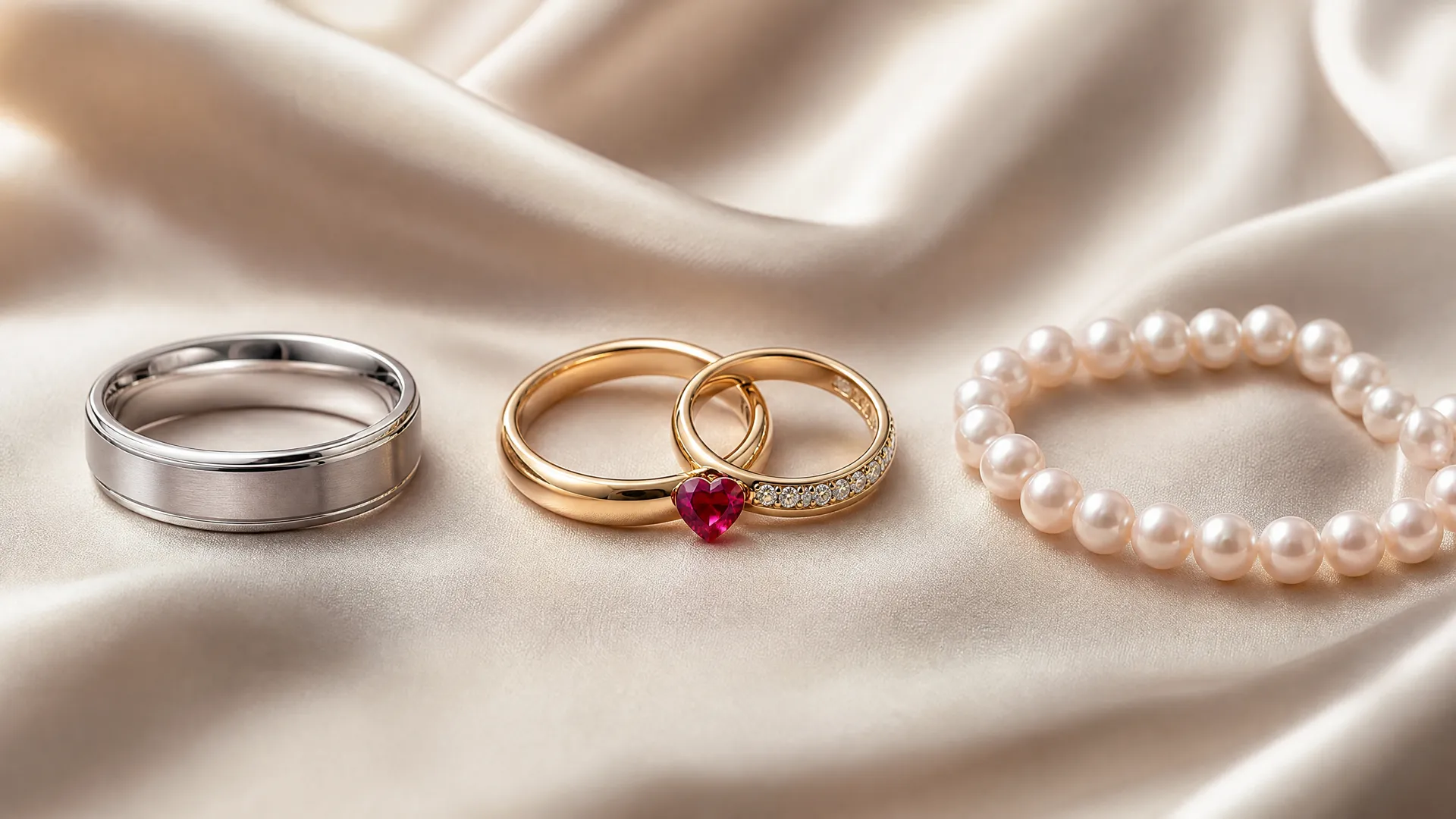
Choosing anniversary jewelry starts with two questions: which year are you celebrating, and how does your partner actually wear jewelry? The traditional anniversary list gives you a stone per year — sapphire for the 5th, ruby for the 15th, emerald for the 20th, silver for the 25th, gold for the 50th — but the jewelry *type* (ring, necklace, earrings, bracelet) should match your partner's habits, not the calendar alone. A good rule: milestone years (5, 10, 15, 20, 25, 40, 50) call for the traditional stone; in-between years reward personal meaning over price.
| Anniversary | Traditional Material/Stone | Best Jewelry Type |
| --- | --- | --- |
| 1st–4th | Gold, garnet, pearl, topaz | Everyday pendant or stackable band |
| 5th | Sapphire | Sapphire ring or halo pendant |
| 10th | Diamond | Diamond studs or eternity band |
| 15th | Ruby | Ruby ring or drop earrings |
| 20th | Emerald | Emerald pendant or statement ring |
| 25th | Silver | Silver-toned piece or diamond accent band |
| 50th | Gold | Gold band, bold necklace, or redesigned heirloom |
The anniversary gift list most American retailers reference traces back to Victorian-era conventions later formalized by Emily Post (1922) and expanded by the American National Retail Jeweler Association in 1937 — that's why "paper" and "tin" sit next to sapphires and diamonds. The list is a starting point, not a contract. What matters practically:
Milestone years carry expectation. The 25th (silver) and 50th (gold) are socially loaded; showing up with a generic gift reads as thoughtless. Our anniversary gemstones by year breakdowns go deeper on each. - In-between years are where creativity wins. A 7th-anniversary onyx ring chosen because she wears black every day beats a "correct" gift that sits in a drawer.
One honest note: the "modern list" (e.g., diamond for the 10th instead of aluminum/tin) exists largely because jewelers promoted it. That doesn't make it wrong — diamond is genuinely the durable, sensible choice for a piece worn daily — just know what you're buying into.
The mistake most guides make is treating the stone as the whole decision. The jewelry type matters just as much for wearability:
Rings — best for years 5, 10, 15, 20. Note sizing: borrow a ring your partner wears on the correct finger and have a jeweler measure it. Hardness-wise, sapphire and ruby (both corundum, Mohs 9) and diamond (Mohs 10) handle daily ring wear well — though hardness measures scratch resistance, not shatter resistance. All three can chip on a hard blow, and thin band styles concentrate that risk.
Earrings and pendants — best for softer or more fragile stones. Emerald (Mohs 7.5–8) is heavily included in most specimens, which reduces its structural integrity; a pendant or earring setting protects it far better than a ring that gets knocked against countertops. Same logic applies to pearls (Mohs 2.5–4.5, organic, damaged by acids and perfume) — pearl anniversary jewelry belongs at the neck and ears, not the hand.
Bracelets and bands — the stacking approach suits earlier anniversaries (years 1–4), where you build toward a bigger milestone piece later. Many couples deliberately start a "milestone band" stack: one band per major year, which turns year 10 and 20 purchases into a visible history.
For the full stone-per-year reference, see our anniversary gemstones guide covering every major milestone.
Match the Piece to Your Partner, Not the Occasion.
1. Do they wear rings daily? If your partner removes rings to wash hands, garden, or type, a large stone ring is a poor bet — choose earrings or a pendant instead. 2. Metal color? Check their existing jewelry. Mixing yellow gold and silver-toned stacks is fashionable now, but if everything they own is yellow gold, a platinum piece will sit unworn. 3. Lifestyle exposure? Gym-goers, nurses, and frequent hand-washers destroy ring settings faster. Treated stones need extra caution: most rubies and sapphires on the market are heat-treated (stable, permanent, and industry-accepted — fine for daily wear), but dyed or fracture-filled stones should be disclosed at purchase and treated gently.
Honest disclosure rule: always ask the seller whether a colored stone is treated and how. Untreated sapphires command a significant premium; heat-treated ones are not "fake" — but you should know which you're paying for, and a reputable seller states it on the invoice.
A growing number of couples use anniversary jewelry to mark a vow renewal, and the logic shifts: the piece is *commemorative*, not compensatory. Common choices:
Redesigning the original wedding set — resetting the original diamonds into a new band or pendant, often for a 25th or 50th. This is emotionally powerful and often more affordable than new stones, but choose a bench jeweler with reset experience; prong work on older stones can reveal pre-existing chips. - Matching bands — a pair of anniversary bands exchanged during the ceremony, engraved with the renewal date. - The stone they never got — many couples married young with modest rings; a 20th-anniversary emerald or 30th-anniversary pearl milestone piece finally delivers the original dream. Say that in the card. It lands.
For vow renewals, prioritize symbolism over carat weight. A smaller, well-cut, honestly-graded stone with a meaningful engraving outperforms a bigger stone with a vague story.
You don't need diamond-tier budgets at every milestone. Rough expectations for responsibly sourced pieces (prices vary with stone quality and metal weight — treat these as planning figures, for current market ranges):
Sterling silver pieces: tens to low hundreds - 14k gold with modest accent stones: a few hundred to ~$1,000 - Fine ruby/emerald/sapphire center stones: $1,000–$5,000+ depending heavily on treatment status and origin - Redesigning existing heirloom stones: often labor-only cost, a few hundred dollars For rings that mark time itself, the eternity ring guide decodes the full-circle format, and the wedding band guide covers matching bands as a joint decision
The one place not to economize: settings. A well-made setting protects the stone you'll celebrate again at the next milestone.
Confirm the anniversary year's traditional stone, then decide if it suits your partner (softness, color, wearability) - Verify treatment disclosure for any colored stone - Match metal color to their existing collection - Insure anything over a few hundred dollars; riders on homeowners/renters policies are usually inexpensive - Get the engraving right — dates and initials triple-checked before the order is placed For milestone years, the matched line of a tennis bracelet remains the most-worn anniversary format in the West, and the full buying method lives in our tennis bracelet guide.
Frequently asked.
Which anniversary years matter most for jewelry gifts?
The milestone ladder that jewelers actually stock for: the 1st (gold), 5th (sapphire), 10th (diamond), 15th (ruby), 20th (emerald), 25th (silver), 30th (pearl), 40th (ruby again), 50th (gold), and 60th (diamond). The heavy three are 25/50/60 — the public Jubilees where a gift that ignores the year's stone is noticed. Between milestones, birthstone jewelry carries the years gracefully; the calendar only demands its specific stones at the milestones.
What is the single best anniversary jewelry format under $100?
The two-stone pendant — her stone and yours, or the couple's two stones — at beaded or minimalist price points. It personalizes without custom work (our ready-to-wear two-stone formats need no personalization order), survives daily wear, and scales honestly: the same design exists at $60 and $260, so the upgrade path at the next anniversary is built in. Stack bands with the wedding date inside are the co-winner — the engraving does the emotional work at no jewelry premium.
Related Articles
A Brief History of Birthstones
From the twelve tribes of Israel to the 1912 standard that rules the modern list — the 3,500-year origin story of why we wear our birth month.
Read MoreThe Ultimate Birthstone Cleaning Guide
Keep every piece in your collection gleaming. Step-by-step methods for gold, silver, and delicate birthstones — no harsh chemicals needed.
Read MoreBirthstone Energy: A Complete Crystal Healing Guide
From root chakra grounding to crown chakra clarity, discover how each birthstone carries healing energy. Learn to activate your crystal for meditation, sleep, and daily intention.
Read More