Real vs Fake Amethyst: Glass, Dye, and Lab-Grown, Explained
Amethyst fakery comes in three layers — glass and dyed impostors a loupe can catch at home, lab-grown quartz only a laboratory can prove, and treatments that
Yueounb Editorial
Jewelry Expert
Whether your amethyst is 'real' depends on which of three different questions you are actually asking. If you mean is this purple stone amethyst at all — or glass, dyed howlite, or dyed quartzite wearing its color — a ten-power loupe settles it at home: round bubbles and swirl lines mean glass, dye pooled in cracks means tinted impostor. If you mean is it natural rather than lab-grown, honesty requires a harder answer: synthetic amethyst is the same mineral atom for atom, and no home test on earth can prove the difference — only a gem laboratory can. And if you mean is it untreated, the answer is not in the stone but in the paperwork: heating and dyeing are legal precisely to the degree they are disclosed. This guide walks each layer and tells you plainly what each test proves, and what it cannot.
Quick Answer: Which question are you asking? |Your real question|The fast check|What it proves| |Is it amethyst, not glass or dyed howlite?|Loupe: bubbles/swirls = glass; dye in cracks = tinted fake; clean scratch on window glass (Mohs 7)|Conclusive at home| |Is it natural, not lab-grown?|Straight, perfectly parallel color bands under the loupe = suspicious|Suspicion only — proof takes a lab| |Is it untreated natural color?|Ask for treatment disclosure in writing|A paper trail, not an eyepiece verdict| One-sentence rule: bubbles and dye are verdicts you can reach today; lab-grown quartz is a verdict only a laboratory reaches.
Amethyst breaks the usual logic of gemstone fakery, because the genuine article is cheap. Faking an expensive stone pays for tooling; faking amethyst barely does, so the large crystals and rough specimens on mineral shelves are almost never counterfeit — the economics do not work. The fraud concentrates where volume lives: marketplace bead strands, where buyers on gem forums have cut open 'natural amethyst' to find dyed quartzite, dyed howlite, even dyed jade; and inexpensive pendants, where hydrothermally grown quartz — physically identical, manufactured in months — quietly stands in for stone that took millennia. That inverts the price instinct that protects buyers of other gems: with garnet, under fifteen dollars is the alarm bell; with amethyst, a fake can sit comfortably at thirty, because synthetic quartz costs pennies to grow at any price point.
Layer one: the impostors, and the sixty-second catches. Glass remains the most common purple fake in costume jewelry and the easiest to condemn. Under a ten-power loupe (a phone macro camera is eighty percent as good), glass shows round gas bubbles and curved swirl lines from molding; real amethyst contains neither. Hardness confirms it: quartz sits at Mohs 7 and drags a clean scratch across window glass (5.5), while glass-on-glass skids and powders. Use a discreet edge, never a display facet.
Dyed impostors need a different eye, because quartzite and howlite are stones, not glass — they pass the scratch test legitimately. Their confession is where the color lives. Natural amethyst carries its purple in internal growth bands that run through the whole crystal; dye sits on surfaces and seeps into every flaw, so under magnification the color concentrates violently in cracks, pits, and around bead drill holes while the interior stays washed out. An acetone-dampened cotton swab pressed on an inconspicuous spot picks up transferred violet on dyed material. Soft impostors self-identify, too: fluorite (Mohs 4) and calcite (3) scratch far too easily for quartz.
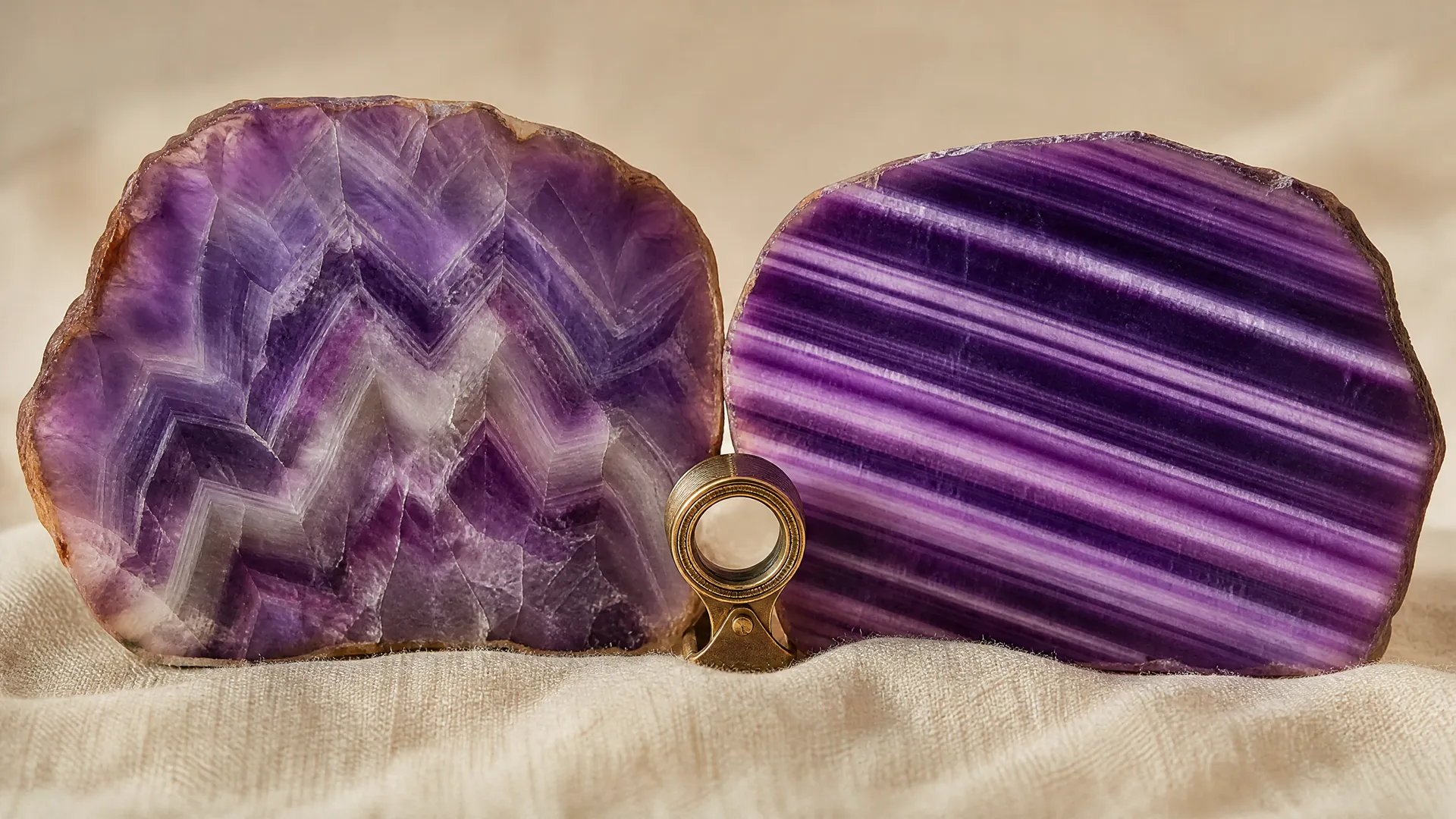
Layer two: the lab-grown twin, and why honesty matters here. Hydrothermal amethyst has been grown in factories since the mid-twentieth century; it is not glass, not resin, not a simulant — it is quartz, with the same hardness, density, and chemistry as stone mined in Brazil and Uruguay. Every household test passes it. What gemologists use instead, in order of practicality: color-zoning geometry, because natural amethyst follows its rhombohedral crystal faces in angular, chevron-like zones, while much synthetic material bands perfectly straight and parallel, as if printed; Brazil-law twinning, visible between crossed polarizing filters and the subject of GIA's classic separation procedure — present in most natural amethyst, absent in most synthetic, though a seed cut from twinned natural rough can carry the pattern into a grown crystal, which is why even this sign stays presumptive; and infrared spectroscopy, where the 3500 cm⁻¹ absorption region separates the two in a properly equipped lab. Translation for a buyer: if natural origin genuinely matters to you, the realistic paths are a seller who tests their rough and says so, or a lab report — home heroics will not get you there.
Layer three: treated, which is a different thing than fake. Most amethyst reaches the market genuinely untreated — the purple grew in the ground. The two treatments worth knowing: heat, which in the 400-500°C range turns amethyst yellow (a large share of commercial citrine is exactly this, heated Brazilian amethyst) or lightens overly dark stones toward the marketable lilac sold as Rose de France; and dye injection, which pushes color into pale or cracked material and shows the same crack-hugging signature as any dyed impostor. Heating is stable, accepted, and under FTC guides must be disclosed when it affects value; undisclosed dye is simply a lie. One question protects you at the counter: 'Is this untreated, natural-color amethyst?' — asked once, kept in writing.
What natural amethyst actually looks like — because its honesty is often mistaken for flaw. Natural stones are rarely one even purple from every angle: they hold angular zones of deeper and paler violet, sometimes a colorless stretch near the crystal's base, occasionally fingerprint-like inclusions or rusty goethite threads. Buyers see chevron striping and fear defect or fakery; it is the opposite — the growth record of a real crystal. The distinction compresses to one line: nature writes in angles, machines write in straight lines.
The price picture, stated plainly. Faceted natural amethyst in normal jewelry grades retails roughly $10-50 per carat in the current market, with commercial and bead material far below that, and fine deep Uruguayan or historic 'Siberian-color' material above it. Notice what this means: amethyst fraud is not a luxury problem, it is a trinket problem. You are rarely defending thousands of dollars; you are defending the promise that the February birthstone against your skin is the stone the calendar says it is — which, for the one month that claims royal purple, is worth the thirty seconds of a loupe.
A buying protocol that matches the layers. For bead strands from marketplaces: loupe the drill holes, swab for dye, assume nothing. For pendants and rings at souvenir prices: assume lab-grown quartz unless the seller states tested natural — which is a perfectly good stone to wear, honestly labeled. For a February gift meant to mean something: buy from a jeweler who names the material's character — the depth of Uruguayan violet, the airiness of Rose de France — and answers treatment questions in writing. Every Yueounb amethyst piece follows that protocol before it is set.
February's stone earned its seriousness early: the Greek amethystos means 'not drunk' — the ancient wager that a cup of amethyst kept the drinker clear-headed, and the reason bishops' rings still carry it as the stone of sober judgment. A gem with that biography deserves the one question most buyers never ask: real, which kind of real, and who says so. When yours passes, keep it that way with our amethyst cleaning guide; to see how its purple sits in the full calendar of twelve colors, the birthstone colors guide is the companion read.
One more field test worth knowing: weight. Real amethyst is quartz — noticeably denser than the glass imitations sold at souvenir prices. Hold the stone in your palm; glass feels light and warms fast against skin, while quartz stays cool longer and has the heft of a real mineral. Combined with the banding check and the price test, that is three tells no fake passes.
Frequently asked.
Can a scratch test tell if my amethyst is real?
Partially. Amethyst is quartz at Mohs 7 and scratches window glass cleanly — this catches glass, fluorite, and calcite impostors on the spot. But lab-grown amethyst is also quartz at Mohs 7 and passes the same test, so a scratch proves "real mineral," never "natural origin."
Is lab-grown amethyst fake?
Not in the way glass is fake — it is genuine quartz, chemically and physically identical, grown in a hydrothermal factory instead of the ground. The issue is disclosure and value: synthetic material costs far less than natural and must be sold as synthetic. If you know and the price agrees, it is an honest stone; sold as natural, it is a lie.
My amethyst has white and purple stripes — is that a fake sign?
Usually the opposite. Angular, chevron-like color zoning is the growth record of a natural crystal and is one of the signs gemologists look for. Straight, perfectly parallel, uniform banding is the pattern that raises synthetic suspicion; bubbles or dye in cracks are the impostor signs.
How much should real amethyst cost?
Faceted natural amethyst in normal jewelry grades runs roughly $10-50 per carat at retail, bead-grade material much less, and fine deep violet (Uruguayan or Siberian-color) above that. Because genuine amethyst is affordable, price protects you less than with other gems — a fake can carry any price tag, so the loupe and the seller’s written disclosure matter more than the number.
Related Articles
A Brief History of Birthstones
From the twelve tribes of Israel to the 1912 standard that rules the modern list — the 3,500-year origin story of why we wear our birth month.
Read MoreThe Ultimate Birthstone Cleaning Guide
Keep every piece in your collection gleaming. Step-by-step methods for gold, silver, and delicate birthstones — no harsh chemicals needed.
Read MoreBirthstone Energy: A Complete Crystal Healing Guide
From root chakra grounding to crown chakra clarity, discover how each birthstone carries healing energy. Learn to activate your crystal for meditation, sleep, and daily intention.
Read More