How to Clean Gemstone Jewelry at Home: What Is Actually Safe
The safe method is five minutes with mild dish soap and warm water — and the most dangerous products in your house are the ones that look harmless: vinegar
Yueounb Editorial
Gemologist
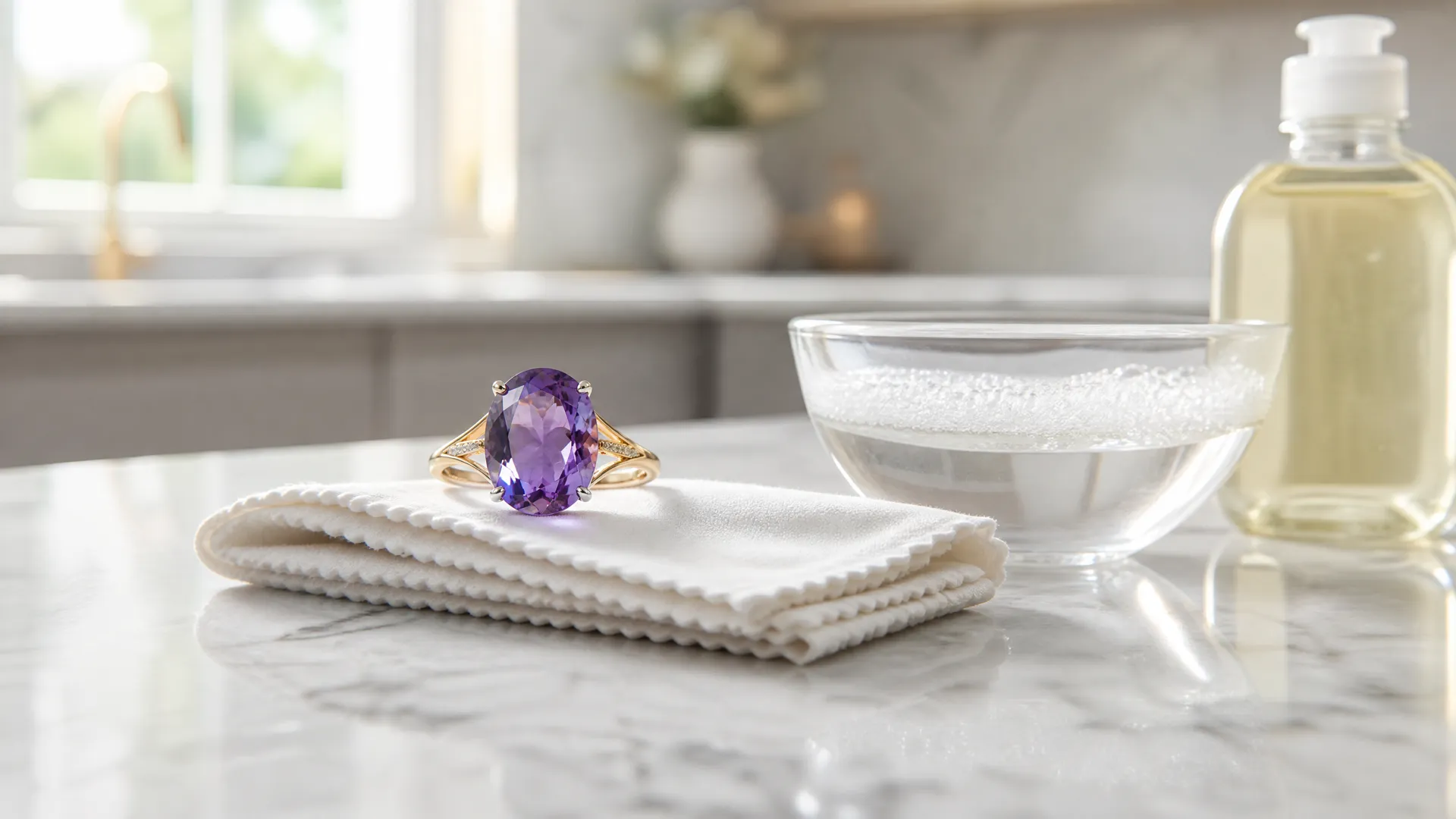
The safest way to clean gemstone jewelry at home is five minutes and two ingredients: warm water and a drop of mild dish soap, with a soft brush — the method the GIA calls the baseline for nearly every gemstone. The danger begins with substitution, because the most dangerous cleaning products in your house are the ones that look harmless: vinegar begins etching pearls on contact (a pearl left in it for a day or two genuinely dissolves), toothpaste is an abrasive the GIA names as a scratch source, and baking soda is quietly ruinous on any set stone. This guide is the household-items verdict list: every common item, judged safe, depends-on-the-stone, or never, with the chemistry that makes each verdict stick — because the reason is what you remember at the sink, long after the list.
Quick Answer: Warm water, a drop of mild dish soap, a soft brush, a rinse, a lint-free dry — safe for nearly every gem. Which household items you can substitute — the verdict list: |Item|Verdict|The one-line reason| |Mild dish soap + warm water|SAFE for nearly every gem|The GIA's own baseline method| |Baking soda|DEPENDS — bare silver only|Mild abrasive; dulls set stones and polished mounts| |White vinegar|NEVER near pearls, lapis, malachite, calcite|Acid dissolves carbonate minerals — pearl included| |Rubbing alcohol|DEPENDS — hard gems, solid metal only|Softens pearl glues, opal layers, plating, emerald oil| |Hand sanitizer|Same verdict as alcohol|Alcohol residue builds a dull film wear after wear| |Toothpaste|NEVER, no exceptions|GIA-named scratch source; silica abrasives reach Mohs 5-6| |Lemon juice|NEVER near the same stones as vinegar|Citric acid — same chemistry, fresher smell| |Windex / ammonia cleaners|DEPENDS — bare diamond or plain gold only|Ammonia damages porous gems and treated stones| |Hydrogen peroxide|DEPENDS — hard gems in solid metal only|Attacks organic gems and coatings| |Boiling water / hot soak|NEVER|Thermal shock cracks filled and heat-sensitive stones| |Glasses cloth / microfiber|SAFE — after rinsing|Dry dust carries quartz (Mohs 7) — fine sandpaper on soft stones| |Home ultrasonic machine|DEPENDS — strict never-list applies|Vibration attacks fillings, organic gems, heat-sensitive stones| The never-list for ultrasonic machines: emerald, opal, pearl, turquoise, tanzanite, moonstone, amber, coral, topaz, peridot, and any fracture-filled stone.
Four ways household items attack jewelry, in plain chemistry. Acid: anything in the vinegar-citrus family reacts with carbonate minerals — pearl nacre and calcite (calcium carbonate), malachite (a copper carbonate), rhodochrosite (a manganese carbonate), and the calcite matrix of much lapis — etching them on contact and, given a day or two, doing far worse. Abrasion: particles harder than the surface they touch will scratch it — toothpaste's cleaning silica abrasives can reach Mohs 5-6, harder than gold or silver, while household dust itself carries quartz at Mohs 7, harder than opal, turquoise, or pearl. Solvent action: alcohol can soften some glues and epoxies — which is what holds pearl studs together and opal doublets in one piece — and strips the oil that fills most emeralds' fissures. Vibration and heat: an ultrasonic machine's cavitation and a hot soak both work on filled fissures, laminations, and organic gems from directions a cloth never reaches. Every verdict below is one of these four mechanisms wearing a kitchen label.
Dish soap: safe for almost everything, and the exceptions prove the rule. The GIA's baseline for nearly all colored gemstones is warm water, a few drops of mild dish soap — skip the heavy-duty degreaser formulas — a soft brush, a rinse, and a lint-free dry. Soak ten to twenty minutes for rings and bracelets; brush gently around and under the setting; rinse in a bowl, not over a drain. The exceptions are the stones that dislike even this much liquid: pearls (wipe with a barely damp cloth instead — a quick pass of warm soapy water is tolerable, soaking is not), opal (damp cloth only, it holds water and can crack), and turquoise (dry cloth, it absorbs everything). A mild hand soap works the same as dish soap for the same reasons. For the full routines by jewelry type — ring, necklace, earrings, bracelet — our type-by-type cleaning guide carries the procedures and the sixteen-stone chart.
Baking soda: only for bare silver, never on a set stone. Baking soda is a mild abrasive — that is its entire cleaning mechanism — and an abrasive does not distinguish tarnish from polish, or silver from the stone set in it. On bare sterling chains and unadorned silver it works (our ultimate cleaning guide covers the paste method), but on any piece with a gemstone, a plated finish, or a delicate mount, it hazes surfaces, catches in settings, and slowly grinds the shine off both metal and stone. The paste-to-water gradient people ask about — no; dilution softens the abrasion but the mechanism is the mistake, not the strength.
White vinegar and lemon juice: the acid family, and its victim list. The chemistry is simple enough to memorize: acids react with carbonate minerals, and several beloved jewelry materials are carbonates — pearl nacre, calcite, malachite, rhodochrosite, and the matrix of much lapis. The etching starts on contact; the folk image of a pearl vanishing in vinegar is real but slow — Cleopatra's legend took an evening, and chemistry takes a day or two for a whole pearl. Gem-A's care guidance extends the family: acids also discolor these stones even in dilute kitchen form. Vinegar's cleaning reputation comes from descaling kettles — which is exactly the reaction you are inviting when a pearl strand meets it. The safe use of vinegar in jewelry care is none, with one narrow exception outside this article's scope: solid gold-only pieces without any stones tolerate a brief dip, and there are better tools even for those.
Rubbing alcohol, hand sanitizer, and the solvents: fine for hard gems and solid metal, ruinous for five specific victims. On solid gold, platinum, and un-plated sterling, and on the hard trio of diamond, ruby, and sapphire, a wipe with seventy-percent isopropyl is a legitimate quick refresh — it cuts skin oil without water. The victims: pearls, whose drill-hole glue and surface both suffer; opals, whose doublet and triplet layers are laminated with adhesive alcohol can soften; plated pieces, where it accelerates wear on the plating; emeralds, whose fissure oil it strips; and anything with foil backing, for the same glue logic — our vintage crystal guide covers that world. Hand sanitizer deserves its own sentence: its alcohol residue builds a dull film on jewelry worn through application after application — take rings off, or accept the haze.
Toothpaste: a hard no, and the numbers are worse than the folk version. The GIA names toothpaste alongside metal-polishing abrasives as a documented cause of scratching that no professional can undo, because a scratch is removed by removing everything around it. And the abrasives are harder than most people assume: the hydrated silica in modern toothpastes can reach Mohs 5-6 — above gold, silver, and every soft stone, and enough to haze a rhodium plating in a session. The folk remedy survives because it produces visible brightness once — the abrasive's one good pass — and the damage compounds invisibly after. The toothbrush is the redeemable half of the bathroom suggestion: a soft brush is exactly the right tool, used with soap and water, never with the paste it came with.
The glasses cloth and the home ultrasonic machine. A microfiber or glasses cloth does the job the GIA actually prescribes — a lint-free dry — with one rule: rinse before wiping. Household dust carries quartz at Mohs 7, and dragging dry dust across an opal, a pearl, or a turquoise is fine sandpaper on a small budget; the wipe that follows a rinse is perfectly safe. As for the home ultrasonic machine: it is the one household device whose verdict depends entirely on the stone, and the never-list is absolute — emerald (fissure fillings), opal, pearl, turquoise, tanzanite, moonstone, amber, coral, topaz, peridot, and any fracture-filled stone including treated diamonds. What survives the tank: solid metal bands and untreated diamond, ruby, and sapphire. The full never-list with the reasons, plus the borderline cases, is maintained in our type-by-type cleaning guide — when in doubt, the soap-and-bowl method loses nothing.
When to stop and see a professional. If a piece needs more than the five-minute routine — heavy tarnish on a bare silver chain, a stone that rattles, an emerald gone dull, settings older than your memory of them — that is not a kitchen problem; it is a jeweler's bench problem, and many will clean a piece free while you wait. The stone-specific deep routines live in their own guides — amethyst and opal among them — and the turquoise, alexandrite, and vintage-crystal pages complete the set.
The two-minute universal routine: a bowl of lukewarm water with one drop of dish soap, a soft toothbrush, gentle circles along the settings, rinse, and pat dry with a lint-free cloth. That routine safely cleans every birthstone except opal and pearl — those two get a damp cloth only, never a soak. Ultrasonic cleaners are for the hard-and-tough quartet only: diamond, sapphire, ruby, and quartz family. Everything else, the brush and the bowl are the entire program.
Frequently asked.
Can I clean gemstone jewelry with toothpaste?
No — never, for any stone or metal. The GIA names toothpaste alongside metal polish as a documented cause of scratching, and its silica abrasives can reach Mohs 5-6, harder than gold or silver. It looks bright once, then compounds invisible damage. Warm water, a drop of mild dish soap, and a soft brush clean better and cost nothing.
Is vinegar safe for cleaning jewelry?
Only for solid gold pieces with no stones, and there are better options even there. Vinegar's acid reacts with carbonate minerals — pearl nacre, calcite, malachite, and much lapis matrix — etching them on contact, and a pearl left in vinegar for a day or two genuinely dissolves. Pearls and vinegar in particular are a one-way reaction.
Can I use rubbing alcohol to clean my jewelry?
For solid gold or platinum settings with diamond, ruby, or sapphire: yes, a quick wipe is fine. For pearls, opals, plated pieces, emeralds, or foil-backed stones: no — alcohol can soften the glues that hold them together and strips emerald's fissure oil. Hand sanitizer leaves the same dull film by accumulation.
Is a home ultrasonic cleaner safe for gemstone jewelry?
Only for solid metal bands and untreated diamond, ruby, or sapphire. The never-list is absolute: emerald, opal, pearl, turquoise, tanzanite, moonstone, amber, coral, topaz, peridot, and any fracture-filled stone — vibration attacks fillings, laminations, and organic gems. When treatment status is unknown, hand-washing loses nothing.
How often should I clean gemstone jewelry?
A practical cadence, not a laboratory one: wipe every piece with a soft cloth after each wear, and give rings and bracelets the full five-minute soak every two to three weeks of regular wear, necklaces monthly, earrings weekly — the posts that sit inside skin deserve the most. Pieces worn daily for months benefit from an annual professional check that cleans and inspects settings at once.
Can I boil my jewelry to clean it?
No. Boiling water and long hot soaks deliver thermal shock — a stone with fissures, fillings, or internal water (emerald, opal) can crack from the sudden change, and heat softens the glues in pearls and assembled stones. Warm — not hot — water with mild soap achieves everything boiling promises, without the lottery.
Related Articles
A Brief History of Birthstones
From the twelve tribes of Israel to the 1912 standard that rules the modern list — the 3,500-year origin story of why we wear our birth month.
Read MoreThe Ultimate Birthstone Cleaning Guide
Keep every piece in your collection gleaming. Step-by-step methods for gold, silver, and delicate birthstones — no harsh chemicals needed.
Read MoreBirthstone Energy: A Complete Crystal Healing Guide
From root chakra grounding to crown chakra clarity, discover how each birthstone carries healing energy. Learn to activate your crystal for meditation, sleep, and daily intention.
Read More