How to Clean a Vintage Crystal Necklace Without Ruining the Foil
Vintage crystal necklaces look washable and are not: water behind a foil-backed rhinestone oxidizes the backing and clouds the stone permanently. The dry-first method, the material check that decides everything, and why Swarovski's modern advice doesn't apply to a grandmother's piece.
Yueounb Editorial
Jewelry Expert
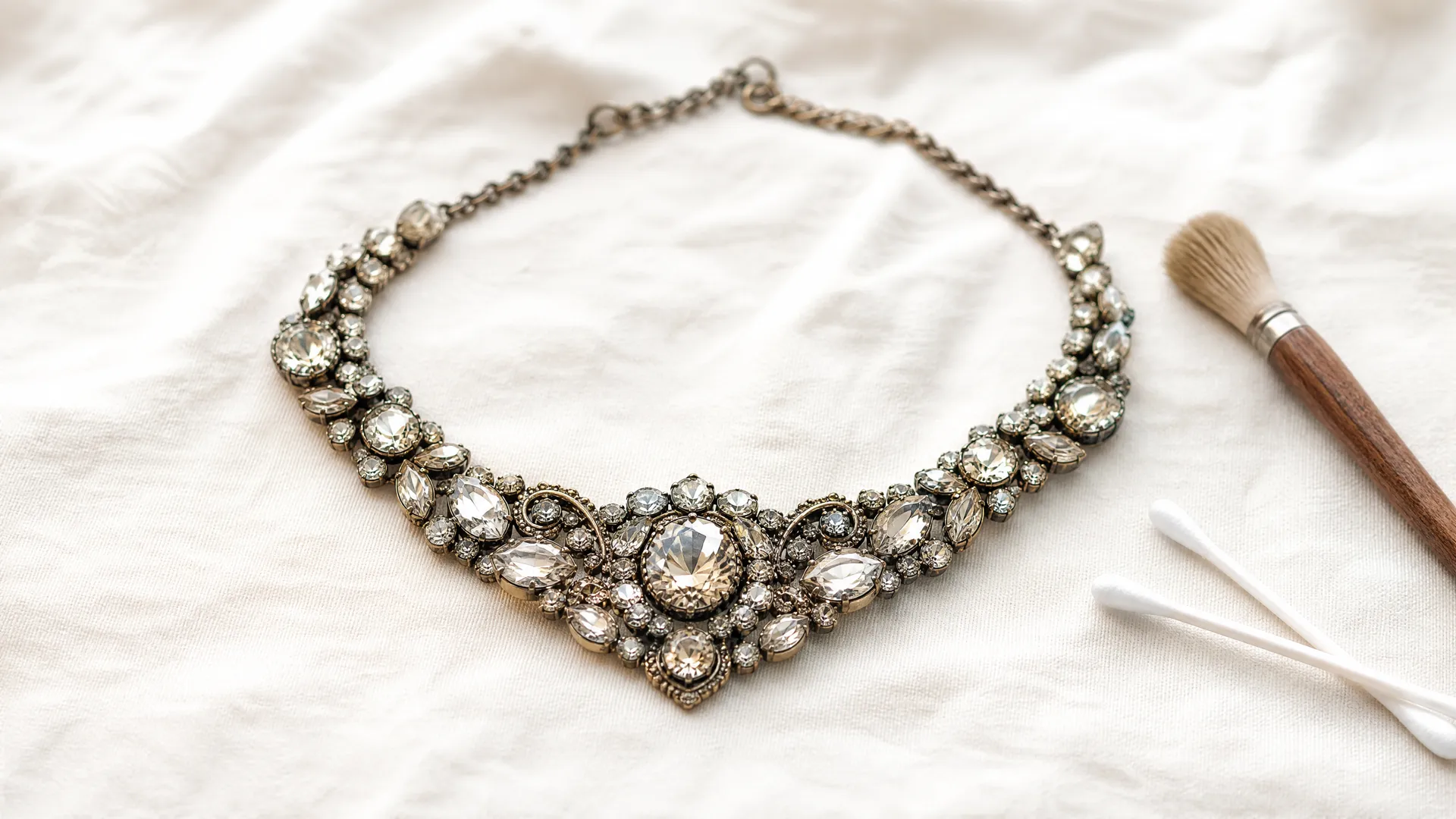
The fastest way to ruin a vintage crystal necklace is to clean it the way modern jewelry guides say to clean jewelry. An heirloom rhinestone strand from the 1950s and a new crystal pendant from a mall counter share a word — crystal — and almost nothing else. The vintage piece very likely carries foil-backed stones, and foil has one mortal enemy: water, which creeps behind the stone, oxidizes the mirrored backing, and leaves the stone permanently cloudy. Nothing you do afterward un-clouds it. So this guide starts with a two-minute material check and then never lets liquid near the wrong piece.
Quick Answer: Clean a vintage crystal necklace dry — never soak it. Wipe each stone with a soft lint-free cloth, detail around the settings with a dry soft brush or cotton swab, and for stubborn grime use a cloth barely dampened with lukewarm water, then dry at once. Water behind a foil-backed stone blackens the foil permanently. Store cool, dry, away from sunlight; anti-tarnish strips help.
First, identify what you actually own. Vintage crystal jewelry comes in three materials, and they clean differently. Lead crystal — the cut glass of classic Swarovski-era pieces — is glass through and through, chemically stable, safe to wipe with a barely damp cloth. Rhinestones are usually lead glass too, but mass-produced and often foil-backed — a mirrored coating on the back of the stone that creates the depth and sparkle. And that foil is the vulnerable layer: it was never engineered to meet liquid. The quick test is visual: look at the stone from the side or the back (a jeweler's loupe or phone macro helps). If you see a mirror-like metallic layer behind the glass — silver, gold, or slightly aged — treat the whole piece as foil-backed and dry-clean only. If the stones are clear through and through with plain settings, you have slightly more freedom, though dry methods remain the safest default for anything vintage.
The safe method, in order of force. Step one, dry wipe: a soft lint-free cloth over each stone's face and the chain, which alone removes most of the film that dulls a piece in storage. Step two, dry detailing: a soft brush (baby-toothbrush softness) around each setting to lift dust from the bezel edges, and a dry cotton swab into the small gaps where stones meet metal. Step three, only if grime survives both: dampen a cloth corner with lukewarm water until it is barely damp — not wet — and work one stone at a time, keeping moisture on the crown and away from the setting's edge; follow immediately with the dry corner. For grease on non-foil metal links only, a swab barely dampened with rubbing alcohol is the collectors' workaround; keep it off the stones entirely. Glass cleaner, if you must, is sprayed onto the cloth, never onto the piece — and skip alcohol-added formulas. When you are done, lay the necklace flat to air fully before storing; trapped humidity is how a cleaning session becomes a tarnish session.
Why the famous advice doesn't apply: the Swarovski trap. Search this topic and you will find Swarovski's own guidance saying crystal jewelry can be rinsed in water for up to a couple of minutes. That instruction is written for modern, unfoiled crystal — and it gets quoted, endlessly, onto vintage forums where it does real damage. Grandmother's era crystals are likelier foil-backed, and their gluing and settings are decades old. The same principle separates the whole vintage world from the modern one: on an heirloom, water is a judgment call you make per piece, after the foil check — not a default.
One modern cousin deserves its own paragraph: the crystal bead necklace. Beads of modern, unfoiled crystal — the kind strung on cord or wire rather than set in metal — clean differently from every vintage rule above, because the constraint is not the stone but the stringing. Lay the strand flat and wipe each bead with a soft cloth barely dampened with lukewarm soapy water, wipe again with a clean damp cloth, and dry at once; never soak a beaded necklace — water swells thread, seeps into glued knots, and corrodes beading wire at the crimps — and never put one in an ultrasonic machine. Dust in the drill holes lifts with a dry soft brush worked back and forth while the strand lies flat; a wooden toothpick, never a metal pin, for packed-in residue. For natural-crystal beads such as amethyst or clear quartz, warmer routines are fine and the drill-hole rules survive from the beaded world; for glass crystal beads with any coating, damp-cloth only. Identifying which crystal you own is the whole method.
Vintage crystal care quick reference |Do|Don't| |Dry lint-free cloth first|Soak or dip the piece| |Soft brush around settings|Ultrasonic or steam machines| |Barely damp cloth on stubborn spots, one stone at a time|Spray cleaner directly on the jewelry| |Air dry flat, fully, before storing|Store in bathrooms, attics, or sunlight| |Anti-tarnish strips in the box, changed every 3–6 months|Airtight plastic bags on humid days| |One piece per pouch, separated|Let pieces scratch each other in one drawer|
If the foil is already damaged, know what can and cannot be undone. A stone whose backing has blackened or clouded from old water damage cannot be cleaned back — the damage is between the foil and the glass, where no cloth reaches. The honest options are replacement (matching vintage stones exist but take hunting), professional restoration (specialists can re-foil or re-set stones, worth it on valuable pieces), or acceptance — a slightly aged stone on a genuinely old strand reads as patina to everyone but you. Prevention is the whole game, and prevention is easy: dry methods, dry storage, and the material check before anything else. For the natural-stone side of careful cleaning — opals, turquoise, and other pieces water can hurt — our opal care guide and turquoise care guide cover those worlds; the full modern-jewelry routine by piece type lives in our birthstone jewelry cleaning guide.
Frequently asked.
How do I know if my vintage stones are foil-backed?
Look at a stone from the side or back under good light or a phone macro lens: a mirror-like metallic layer behind the glass — silver, gold, or darkened with age — means foil backing. No metallic layer and clear-through stones mean unfoiled crystal, which tolerates careful barely-damp cleaning.
Can I use Windex or glass cleaner on vintage crystal?
Only with extreme care, and never sprayed on the piece: spray the cloth instead, use an alcohol-free formula, and keep it off foil-backed stones entirely. On any vintage necklace, dry methods clean nearly as well with none of the risk.
Can damaged foil be restored?
Not by cleaning — the oxidation sits behind the stone where nothing reaches it. A vintage-jewelry specialist can sometimes re-foil or replace individual stones, which is worth pricing on valuable pieces; otherwise a slightly aged stone is simply patina.
How should I store a vintage crystal necklace?
Cool, dry, and dark — conservation guidance for mixed collections suggests roughly 35–65% relative humidity. Keep it out of bathrooms and attics, store pieces separated so nothing scratches, and tuck in anti-tarnish strips refreshed every three to six months.
Can I soak my beaded crystal necklace to clean it?
No — the beads are not the risk, the stringing is. Soaking swells cotton and silk thread, seeps into glued knots, and can corrode beading wire at the crimps, so a strand that goes into the bath wet can come out ready to break. Wipe bead by bead with a barely damp cloth and lay the strand flat to dry fully before storing.
Can I wear my crystal necklace in the shower?
Better not. Soaps and hot water leave film on natural crystals and glass crystal alike, chlorine attacks metal chains and clasps, and repeated soaking is fatal if the piece is vintage foil-backed or strung on thread. Put a crystal necklace on after dressing and take it off first — it will need cleaning about ten times less often.
What is the difference between cleaning crystal and cleaning gemstones?
Nothing, if your crystal is a natural gemstone like quartz or amethyst — warm soapy water and a soft brush are correct. Everything changes if crystal means glass, as in crystal glass or rhinestone: coatings and foil backings make water and alcohol risky, so dry or barely damp methods rule. Identify which crystal you own before choosing a method.
Related Articles
A Brief History of Birthstones
From the twelve tribes of Israel to the 1912 standard that rules the modern list — the 3,500-year origin story of why we wear our birth month.
Read MoreThe Ultimate Birthstone Cleaning Guide
Keep every piece in your collection gleaming. Step-by-step methods for gold, silver, and delicate birthstones — no harsh chemicals needed.
Read MoreBirthstone Energy: A Complete Crystal Healing Guide
From root chakra grounding to crown chakra clarity, discover how each birthstone carries healing energy. Learn to activate your crystal for meditation, sleep, and daily intention.
Read More