How to Clean a Birthstone Ring, Gemstone Necklace, and More
Dirt hides in different places on a ring, a necklace, and a pair of earrings, so the cleaning method should follow the piece, not just the stone.
Yueounb Editorial
Jewelry Expert
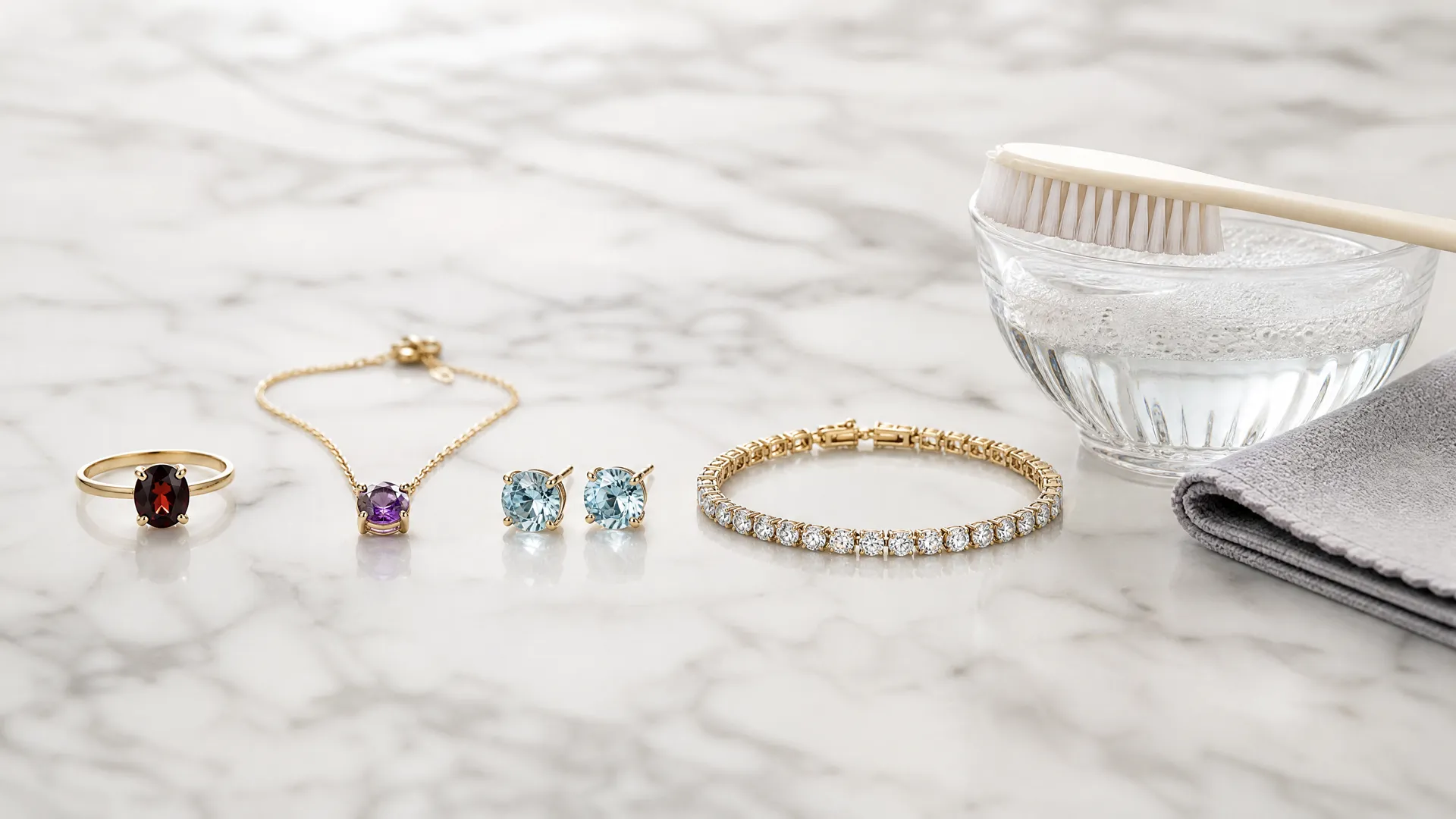
To clean a birthstone ring — or a necklace, earrings, or bracelet — soak it 15 to 20 minutes in warm water with a drop of mild dish soap, brush gently under and around the stone with a soft-bristled brush, rinse in a second bowl of clean water, and pat dry with a lint-free cloth. That four-step routine is the GIA's baseline method and it is safe for nearly every birthstone in nearly every setting. What changes from piece to piece is not the chemistry but the mechanics: where the dirt hides, which tool reaches it, and what needs inspecting along the way. This guide is organized by the piece you own rather than the stone inside it — rings, necklaces, earrings, bracelets — then covers the two questions every owner eventually asks: what the machines can and cannot do, and which stones must never meet them.
Quick Answer: Soak 15–20 minutes in warm water + one drop of mild dish soap, brush under the stone with a soft brush, rinse in a second bowl, pat dry — safe for nearly every birthstone. Match the technique to the piece: |Piece|Where the dirt is|Technique|Hands-on time| |Ring|Under the girdle and behind the prongs|Soak 15–20 min, brush at an angle from below|5 min| |Necklace|Between chain links, on the clasp, behind the pendant plate|Unclasp, soak 10–15 min, brush link by link|8 min| |Earrings|On posts and wires, inside the backs|Swab and brush the parts that touch skin|3 min| |Bracelet|In the clasp and every moving link|Soak 10–15 min, work the clasp under water, brush every link|8 min| Never: toothpaste, chlorine bleach, ammonia — and no home ultrasonic machine for opal, turquoise, pearl, emerald, tanzanite, moonstone, topaz, or peridot.
Rings: the trap that cleans from underneath. A ring packs its grime where nobody looks — between the stone's girdle (its widest edge) and the setting's shoulders, and under the prongs — which is why a ring can look clean from above and photograph dull. Fill a bowl — not a sink — with warm water and a drop of mild soap, and let the ring soak fifteen to twenty minutes; the warm water loosens the oil film that holds grime against the pavilion, the faceted underside between girdle and culet. After the soak, work a soft-bristled brush — a baby toothbrush or a dedicated jewelry brush, never the one from the bathroom cup — around and under the setting at an angle, so the bristles reach the junction where each prong meets the stone. That junction is where lotion and lint pack hardest. For grease that survives soap, a cotton swab dipped in rubbing alcohol will dissolve it; it is a technique bench jewelers use on well-worn pieces. Rinse in a second bowl of clean water, pat — do not rub — with a lint-free cloth, and let it air dry fully before it goes back in the box. Two cautions from the GIA that apply twice over for older rings: be gentle around any setting you suspect is fragile, because the point of the exercise is not to loosen a stone, and work over a surface that catches the ring if you drop it — a strainer or a bowl is insurance a sink drain is not.
Necklaces: the chain is half the job. Unclasp the necklace first — a closed clasp is where the most stubborn film hides, and cleaning it shut just seals the grime in. Lay the strand loosely coiled in the soap bowl for ten to fifteen minutes, then run the soft brush along the chain with the links flat against your fingertip so each link gets brushed from both sides rather than dragged. Chain styles with surfaces that hide against each other — rope, snake, box chain — hold film between their plates, and that is the grey line that makes a necklace look tired while its pendant still sparkles. Brush the pendant's back plate as thoroughly as its face, since the plate sits against skin all day; for bezel-set pendants run the bristles around the bezel's inner rim where it meets the stone. Rinse the full length in clean water, lay the strand flat on a towel to dry — hanging a wet chain can stretch delicate styles over time — and give the clasp ten extra seconds of brush work before you close it again.
Earrings: clean for hygiene, not just sparkle. The parts of an earring that need the most attention are the parts that never show: the post or hook that sits inside the piercing and the butterfly back that slides onto it. Both collect skin oil and debris in a warm, enclosed space — which is why a pair of earrings can smell faintly metallic while looking perfectly clean. After the standard soak, take a cotton swab to the post from tip to shoulder, open the butterfly backs and swab their inner channel, then brush the stone or setting as you would a ring. One refinement worth knowing: many piercing-care guides suggest skipping alcohol-based cleaners on the skin side if your ears are sensitive or freshly pierced, so let the warm-soap-and-swab method do that work instead. Dry posts completely before storing; a damp post closed into a jewelry box is how tarnish gets a head start.
Bracelets: the workhorse gets the full routine. Bracelets accumulate everything a ring does plus everything a chain does, and they do it while being knocked against the world. Clean them the combined way: soak the full piece ten to fifteen minutes, brush the links or stations one by one as with a necklace, then give the clasp its own mini-session — open and close it under the soapy water a few times and brush both halves, because the hinge and the latch trap lotion and grit with every wear. While the piece is wet and in your hand, run the inspection that bracelets deserve most: look for links that have stretched or kinked, check that each stone still sits tight in its setting, and confirm the clasp clicks shut with the same authority it had new. A bracelet is the piece most likely to be lost rather than damaged, and a tired clasp is the reason. Tennis-style bracelets with individual stone settings deserve a brush pass over every station rather than a general wipe.
Everyday exposure, settled in one place. The questions that follow cleaning are usually about wearing: shower, pool, dishes. For most birthstones a shower is tolerable and a swimming pool is not — chlorine is a bleach that attacks both metal settings and several stones, and hot tubs add heat on top. Dishes and cleaning house call for removal less for the water than for the chemicals: detergent, bleach sprays, and ammonia are on every gem's avoid list. Opal, turquoise, pearl, and emerald are the four that want removal before any of it, water included. As for store-bought cleaners: wipes and dips are formulated for hard stones in sturdy settings, and the label's word gemstone is not a guarantee — the same cautions that apply to ultrasonic machines apply to anything strong enough to dissolve grime chemically. When in doubt, the bowl method costs nothing and risks nothing.
Silver gemstone jewelry: why it turns black, and the fix that does not touch the stone. The dark film on a silver setting is silver sulfide, the product of silver reacting with sulfur compounds in air and sweat — and unlike rust it is not damage but a chemical layer that can be converted back to metallic silver without removing any metal. For silver that carries a gemstone, the tool list is short and the order matters:
| Silver method | How it works | Safe with a set stone? |
| Polishing cloth | Dry cloth with microscopic abrasives, works only where you rub | Yes — the safest option |
| Chemical silver dip | Liquid dissolves tarnish everywhere it touches | No — reaches behind settings, permanently discolors porous stones |
| Foil + baking soda bath | Electrochemical conversion, full immersion | Plain chains only — immersion is wrong for any set stone |
| Toothpaste | Abrasives meant for teeth | Never — the GIA flags it as a scratch source |
| Jewelers' reference lists of what a dip can permanently damage — pearls, coral, amber, turquoise, opal, moonstone, malachite, shell — reads like a birthstone calendar. |
Ultrasonic and steam cleaners: what the machines actually risk. An ultrasonic machine cleans by cavitation — microscopic bubbles collapsing against the surface — and that action is hard on three kinds of birthstone. Stones whose surface-reaching fractures have been filled, like most emeralds (oiled or resin-filled) and fracture-filled diamonds, can lose their filler and their polish in one cycle. Organic and porous stones — pearl, coral, amber, jet, shell — absorb the fluid and the heat. And stones sensitive to heat or vibration by nature, which on the GIA's caution list includes tanzanite, moonstone, topaz, opal, turquoise, and several others, can crack along internal features you cannot see. Steam cleaners narrow the safe list further; the conservative bench standard is diamond and corundum — ruby and sapphire — and little else, and any filled or oiled stone should never see steam, because heat makes the fissure fillings sweat out. The trade itself disagrees at the margins — one widely circulated bench reference clears amethyst, aquamarine, citrine, and garnet for ultrasonic, while a stricter school allows only diamond, ruby, sapphire, alexandrite, and spinel — and the GIA parts ways with the loose charts on tourmaline, which it says should stay out of the tank entirely. That disagreement is the practical answer: if the professional references do not agree on your stone, a bowl of warm soapy water agrees with everyone. The GIA's own closing line on the subject is the one to keep — if you are uncertain about a stone's durability, skip the machine and let a jeweler who can inspect the stone under magnification make the call. One more risk no list mentions: the vibration that cleans so well can also work a marginal prong loose, which is why even safe stones in older settings belong at the jeweler's bench rather than the home tank.
The birthstone cleaning chart |Birthstone|Mohs|Ultrasonic|Steam|First-choice clean| |Diamond|10|Safe unless fracture-filled|Safe|Soak and brush, or professional ultrasonic| |Ruby, Sapphire|9|Usually safe; never star or filled stones|Safe|Soak and brush| |Alexandrite|8.5|Usually safe (rarely treated)|Usually safe|Soak and brush| |Topaz|8|No — cleaves easily|No|Soak and brush, warm not hot water| |Aquamarine|7.5–8|Usually safe|With care|Soak and brush| |Emerald|7.5–8|Never — fissure fillings|Never|Wipe with a barely damp cloth| |Amethyst, Citrine|7|Usually safe if fracture-free|Caution|Soak and brush| |Tourmaline|7–7.5|No — GIA advises against|No|Soak and brush| |Garnet|6.5–7.5|Usually safe|Caution|Soak and brush| |Peridot|6.5–7|Not recommended|No|Soak and brush, gently| |Zircon|6–7.5|Usually safe, but brittle — avoid if chipped|No|Soak and brush| |Tanzanite|6.5–7|Never|Never|Soak and brush, warm not hot water| |Moonstone|6–6.5|Never — cleavage and heat|Never|Wipe with a barely damp cloth| |Opal|5.5–6.5|Never — water content|Never|Wipe with a barely damp cloth| |Turquoise|5–6|Never — porous|Never|Dry cloth only| |Pearl|2.5–4.5|Never — organic|Never|Damp cloth, dry immediately|
When to stop and see a professional. Hand the piece over instead of cleaning it if a stone rattles or spins in its setting, if a prong has a visible flat spot or catches thread, or if the piece is an older or estate setting you do not know the history of — the GIA's gentle-handling warning exists because a fragile setting can be finished by an enthusiastic brush. Stones known or suspected to be fracture-filled belong at the bench too, as does anything you cannot identify on the chart above. And even with no problems, an annual professional check — cleaning plus prong and clasp inspection under magnification — is worth making a habit; many jewelers will clean a piece for free while you wait, which makes it the cheapest insurance in the trade, catching the loose stone while it is still a tightened prong rather than a loss.
How this guide fits the rest of our care library. This piece is organized by the jewelry you own; our stone-by-stone guides are organized by what the jewelry is made of: the deep routines for amethyst, turquoise, and opal, the hardness-tier overview in the ultimate birthstone cleaning guide, and for the calendar's rare color-change stone, our alexandrite ring care guide. Five minutes of warm water and a soft brush, on the right schedule for the piece, is the whole secret; the chart above is there for the day you inherit something the schedule forgot.
Frequently asked.
Can I use toothpaste to clean birthstone jewelry?
No. Toothpaste is an abrasive — the GIA groups it with metal polishes as a cause of scratching — and it dulls both polished metal and softer stones like opal, turquoise, and pearl permanently. Warm water, a drop of mild dish soap, and a soft brush clean better and cost nothing.
How often should I clean birthstone jewelry?
A practical cadence, not a GIA standard: wipe every piece with a soft cloth after each wear, give rings and bracelets a full soak-and-brush every two to three weeks of regular wear, necklaces monthly, and earrings weekly — the post that sits inside your skin deserves the most frequent care of all.
Is ultrasonic cleaning safe for amethyst?
Usually, yes — amethyst is quartz at Mohs 7, and bench references commonly clear it for ultrasonic cleaning. The exceptions matter: an amethyst with visible fractures or internal inclusions should stay with hand-cleaning, because cavitation works along any weakness. If you do not know your stone's interior, the soak-and-brush method carries no risk.
How do I clean opal, pearl, or turquoise birthstone jewelry?
Wipe them with a barely damp, lint-free cloth and dry immediately — never soak opal, pearl, or turquoise, and never put them in an ultrasonic or steam cleaner. Opal holds water and can crack, pearl is organic and soft, turquoise is porous and absorbs liquids permanently. Each has a dedicated guide with the full routine.
How do I clean tarnished silver around a gemstone without damaging the stone?
Use a jeweler's dry polishing cloth on the metal only, keeping it off the stone. Never use chemical silver dips on set jewelry — they reach behind the stone and permanently discolor porous gems like turquoise, opal, and pearl — and never the foil-and-baking-soda bath, which fully immerses the piece. For heavy tarnish on a valuable piece, a jeweler can polish the setting with the stone protected.
How do I clean a ring when I do not know what the stone is?
Use the gentlest method that is safe for every stone: a barely damp, lint-free cloth wipe, or at most a two-minute lukewarm soapy soak followed by a soft brush. Never use ultrasonic machines, steam, bleach, ammonia, or toothpaste on an unidentified stone — porous gems like emerald, opal, and turquoise are permanently damaged by methods that diamond shrugs off.
Can I clean a gemstone ring with baking soda or vinegar?
Neither. Baking soda is an abrasive that leaves fine scratches on softer stones and polished metal, and vinegar is an acid that can attack fracture fillings in emerald and treated stones. Warm water, one drop of mild dish soap, and a soft brush clean better and risk nothing on nearly every stone.
How do you clean a gemstone ring specifically?
Soak the ring in warm water with a drop of mild dish soap for a minute, then brush the stone and setting gently with a soft toothbrush for 30–60 seconds, rinse under warm running water, and pat dry. Skip ultrasonic cleaners for emerald, opal, pearl, and any fracture-filled or heavily treated stone — warm soapy water is the safe universal method.
Can you clean gold and gemstone jewelry together?
Yes — solid 14k or 18k gold set with durable stones (sapphire, ruby, garnet, amethyst, citrine) can share one bowl of warm soapy water and the same soft-brush routine. Keep pearls, opals, emeralds, and plated or vermeil finishes separate: they need dry wiping or their own gentler method.
Related Articles
A Brief History of Birthstones
From the twelve tribes of Israel to the 1912 standard that rules the modern list — the 3,500-year origin story of why we wear our birth month.
Read MoreThe Ultimate Birthstone Cleaning Guide
Keep every piece in your collection gleaming. Step-by-step methods for gold, silver, and delicate birthstones — no harsh chemicals needed.
Read MoreBirthstone Energy: A Complete Crystal Healing Guide
From root chakra grounding to crown chakra clarity, discover how each birthstone carries healing energy. Learn to activate your crystal for meditation, sleep, and daily intention.
Read More