What Is a Birthstone Ring? Meaning, Finger & Cost Explained
A birthstone ring differs from a regular gemstone ring in one thing: the calendar decides the stone. Ready to graduate from reading to wearing? The [genuine birthstone rings](/birthstone-rings) collection is the full catalog
Yueounb Editorial
Jewelry Expert
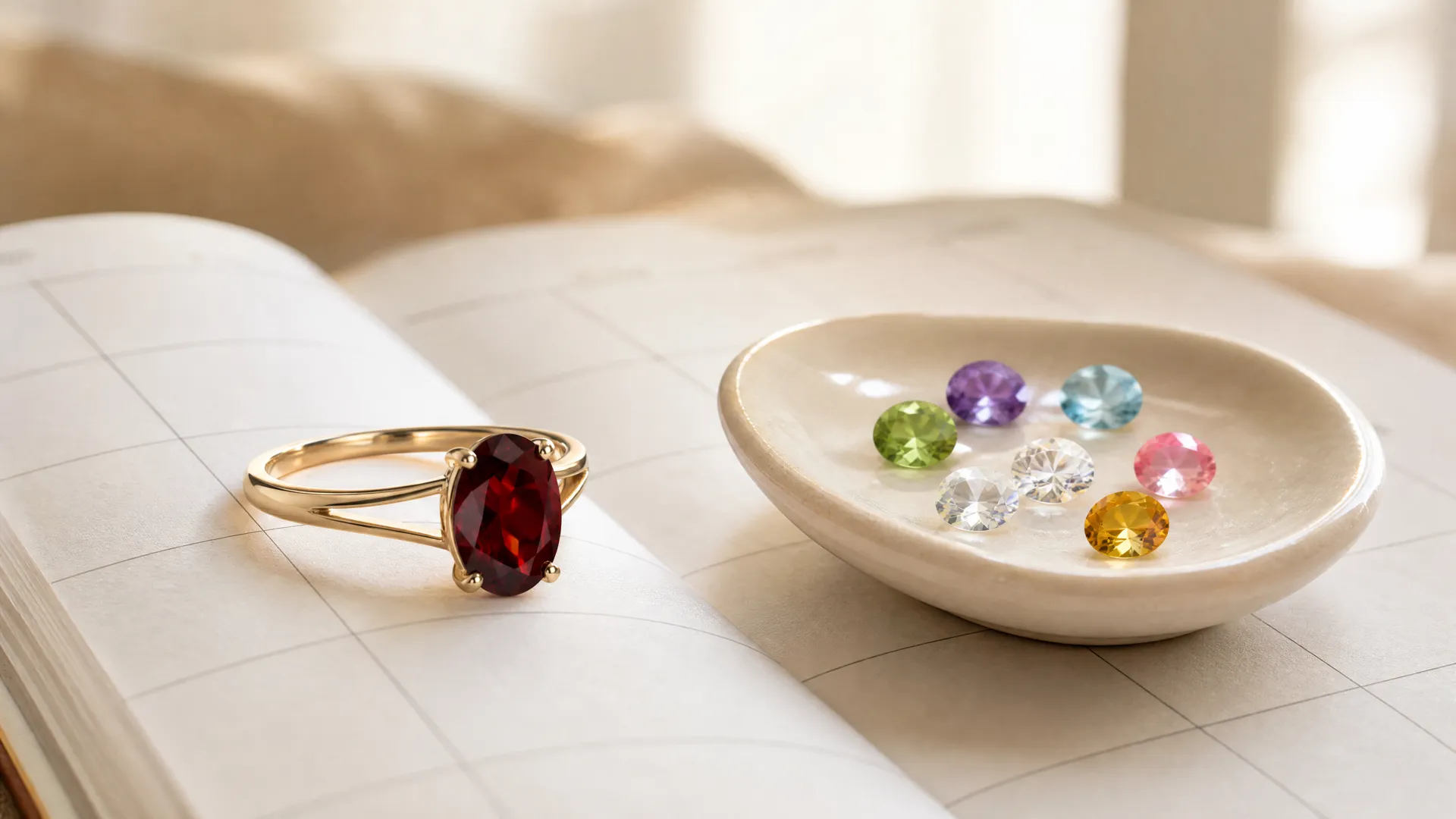
A birthstone ring is a ring whose gemstone is chosen by the calendar rather than by taste: the stone corresponds to a birth month — January garnet, February amethyst, September sapphire — instead of being picked purely for color or price. That single difference does a lot of work. A regular gemstone ring says something about your style; a birthstone ring says something about a person — usually you, often a child, sometimes a partner, sometimes someone remembered. This guide answers the five questions every birthstone-ring buyer actually asks: what it is (and how it differs from the gemstone rings beside it in the case), whose stone it should carry, which hand and finger it goes on, whether it can survive daily wear, and what an honest one costs.
Quick Answer: A birthstone ring sets the gemstone by birth month, not by taste — the calendar chooses the stone. |Your question|The direct answer| |What makes it different|The stone is assigned by a birth month, giving it a person, not just a color| |Whose stone should it carry|Yours as a signature; your children's as a mother's ring; a partner's as a pair; a lost person's as a memorial — all four are established practice| |Which hand|No traditional rule exists; the right hand is a modern fashion convention that avoids clashing with a wedding set| |Which finger|Any; middle finger is the comfort pick, index the statement pick| |Everyday wear|Depends on the stone: diamond, sapphire, ruby yes; opal, pearl, emerald need remove-first habits| |Entry price|$50-200 for sterling silver with a genuine stone; $275-500 in gold|
Whose birthstone should the ring represent? Four answers, all of them established. The first is the signature piece: your own month, worn as a daily identity ring. The second is the mother's ring — one stone per child, a format the trade's usual account credits to around 1959, when the John C. Nordt company is said to have created the first, riding a Mother's Day that had been national since 1914; it remains among the most-requested configurations in the trade. The third is the pair: two stones in one ring, or matching rings exchanging months — his stone on her hand, hers on his. The fourth is the memorial ring: a stone for someone gone, often engraved with a date or handwriting, a quiet format most major jewelers now carry as a named collection. And the question underneath all four — can you wear a stone that is not yours? — has a clean answer: the tradition's oldest form was wearing all twelve stones in rotation, so wearing someone else's month is not a violation but the original idea; you are honoring the person, not borrowing their luck.
Which hand and finger? Here most guides repeat a rule that deserves an honest audit: birthstone rings are often said to belong on the right hand. That is not an ancient tradition — it is a modern practical convention. The left hand's fourth finger is reserved in most Western countries for the wedding set (the old vena amoris story pointed love's vein there), so fashion and non-commitment rings drifted right to avoid the confusion; meanwhile much of Eastern Europe, Scandinavia, and Orthodox tradition wears wedding rings on the right hand to begin with. The honest summary: there is no wrong hand, the right-hand habit is a sensible modern etiquette rather than lore, and the only real rule is the practical one — keep the birthstone ring away from the finger that means something else if you do not want the question asked. As for fingers: the middle finger is the comfort choice for balance, the index finger the statement position, the pinky the low-maintenance spot, and traditions that assign meanings to each exist but carry no enforcement.
Can you wear it every day? That is a stone question, not a ring question, and the Mohs scale draws the line. Daily-wear confidence belongs to diamond, sapphire, ruby, and alexandrite — hard, tough, chemically indifferent to a working week. Amethyst, citrine, and garnet at Mohs 7-ish wear well but slowly scuff (household dust carries quartz at 7). Opal, pearl, turquoise, and emerald want remove-first habits — gym, dishes, garden — and a bezel setting buys them an extra tier of protection. Our full durability verdicts, including the topaz lesson and the stones that never go in an ultrasonic machine, live in the best stone for jewelry guide; the daily-care routines live in the type-by-type cleaning guide.
What an honest one costs. The entry tier is real: at current online retail, $50-200 buys sterling silver with a genuine birthstone in most months (for rings; necklaces start lower) — the affordable stones are genuinely affordable, which is the quiet advantage of the category. The $275-500 tier moves to 10k and 14k gold and adds multi-stone mother formats; the $1,200-plus tier is where fine sapphires, rubies, and custom heirloom work begin; prices move with the gold market. Two budget truths from the trade: buy the metal honestly (plated silver sold as gold-tone ages badly), and match the stone's price to its reputation (a big flawless emerald at a friendly price is not a bargain, it is a question). For the styles themselves — bezel versus prong, halo versus solitaire — our birthstone ring style guide walks every setting; for what happens after you buy it, the companion piece is how to wear a birthstone ring. One practical companion before ordering any ring, birthstone or not, is getting the size right the first time, so we keep the complete ring size chart and measuring methods here. One symbol motif deserves its own chapter — the star ring guide covers the oldest sign in jewelry.
The buying version of the question — which stone, which setting, at what budget — is answered in our birthstone ring guide: the durability table for ring duty, the settings that protect each hardness tier, and the budgets that are honest at every stone. This page holds the concept; that one holds the receipt.
The buying version of this question — which stone, which setting, at what budget — is answered in our gemstone ring guide: the durability table for ring duty, the settings that protect each hardness tier, and the budgets honest at every stone. For the styles side (solitaire, halo, three-stone, stack), the ring styles and settings guide walks each format.
Frequently asked.
What finger do you wear a birthstone ring on?
There is no traditional rule. The right hand is the common modern convention — a practical habit that avoids overlapping a wedding set on the left fourth finger, not ancient lore — and any finger works: middle for comfort, index for statement. The only real guideline is avoiding the finger that already means something, unless you enjoy the question.
Can you wear someone else's birthstone?
Yes — the custom's oldest form was rotating through all twelve stones monthly, so months have never been exclusive. Wearing a child's, partner's, or late person's stone is an established practice: jewelers frame it as honoring the person rather than borrowing anything. The bad-luck version is a modern superstition with no historical basis.
Can I wear my birthstone ring every day?
Depends on the stone. Diamond, sapphire, ruby, and alexandrite take daily wear without complaint; amethyst, citrine, and garnet wear well with a soft-cloth habit; opal, pearl, turquoise, and emerald need remove-first routines for gym, dishes, and garden. A bezel setting upgrades any fragile stone's daily-wear case.
Can a birthstone ring be an engagement or promise ring?
Yes — birthstone engagement rings are an established alternative to diamond, and sapphire (September) is the trade's classic pick for durability; a partner's-month stone doubles naturally as a promise ring. The only engineering caveat is hardness: an everyday-worn engagement stone should come from the durable tier — sapphire, ruby, spinel, diamond.
How much is a birthstone ring?
$50-200 buys sterling silver with a genuine stone — the honest entry tier for most months. The $275-500 range covers 10k-14k gold and multi-stone mother's formats; fine sapphire, ruby, and custom heirloom work begins around $1,200, moving with the gold market. Beware two signs at any tier: plated metal sold as gold-tone, and a big flawless emerald at an emerald-free price.
What are the best birthstone ring styles for moms?
The multi-stone mother's ring — one gem per child in birth order — is the classic, and the stackable band is its modern cousin: start with her own month, add a slim band per child over the years. Choose bezel settings and durable stones (or stones in the 6.5–8 range) because her hands are working hands.
Related Articles
A Brief History of Birthstones
From the twelve tribes of Israel to the 1912 standard that rules the modern list — the 3,500-year origin story of why we wear our birth month.
Read MoreThe Ultimate Birthstone Cleaning Guide
Keep every piece in your collection gleaming. Step-by-step methods for gold, silver, and delicate birthstones — no harsh chemicals needed.
Read MoreBirthstone Energy: A Complete Crystal Healing Guide
From root chakra grounding to crown chakra clarity, discover how each birthstone carries healing energy. Learn to activate your crystal for meditation, sleep, and daily intention.
Read More