Opal Guide: The Physics of Play-of-Color and Why October Got Lucky
Opal's rainbow is not pigment but diffraction — billions of silica spheres acting as a natural diffraction grating. The science, the grades, and October's luckiest stone.
Yueounb Editorial
Gemology Researcher
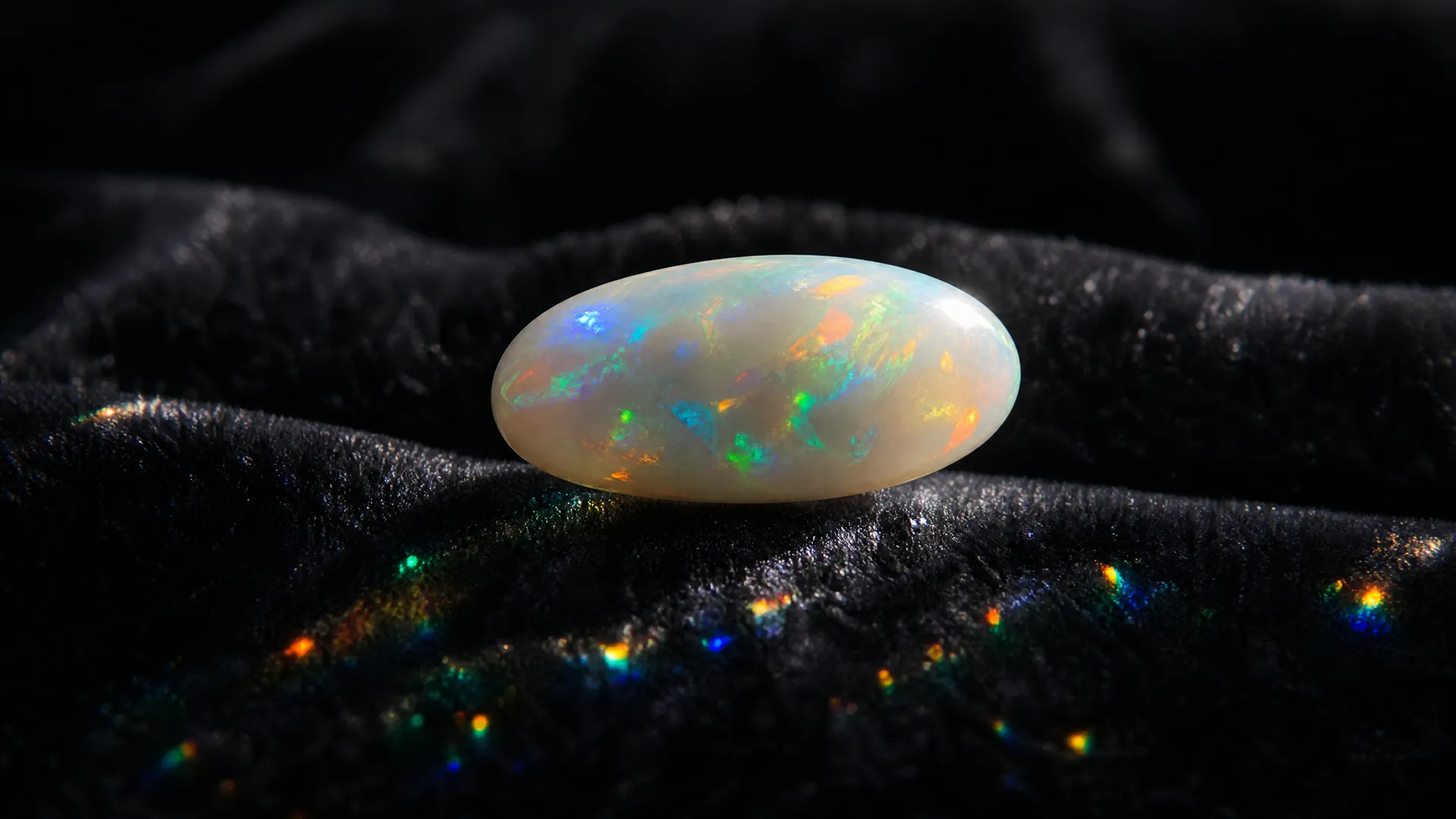
Opal is the only gemstone whose beauty is physics you can explain over dinner: its play-of-color comes from billions of microscopic silica spheres stacked in orderly rows, packed tight enough to diffract light — the same mechanism that makes soap bubbles shimmer and CD undersides rainbow. The stone contains 3-10% water trapped in its structure; the color is light interference, not pigment. Nothing else in the gem world works this way.
Quick Answer: Types and Grades - **White opal:** pale body, pastel play — the classic, friendliest price - **Black opal:** dark body makes the colors detonate — the collector top (Lightning Ridge, Australia) - **Crystal/water opal:** transparent body, color floating inside - **Fire opal:** Mexican orange body — sometimes without play-of-color, bought for its own glow - **The golden rule:** buy the play, not the carats — color coverage and pattern drive all value
The history has a smear to clean up: an 1890s novel (Sir Walter Scott's Anne of Geierstein) gave opal an unlucky reputation that the market spent a century undoing — before that, Rome considered it the luckiest stone (the gem of all gems, Pliny wrote, containing the colors of every other). The superstition survives in folklore only; October buyers inherit the pre-novel truth: opal plus tourmaline, the month's two official stones.
Buying notes are pattern-first: harlequin (blocky patches), pinfire (dense specks), broadflash (sheets of color) each have their collectors, but the rule across all is color from every angle and a pattern you enjoy at arm's length. Durability honesty: opal runs 5.5-6.5 with water content — it dislikes extreme dryness (desk-jewelry in heated rooms can craze over years) and hard knocks; earrings and pendants, worn often, are its best life. The October birthstone page holds the month's full story, our opal hoops are the format where the stone's drift-on-movement quality pays off most, and care specifics are in how to clean opal without damaging.
Wearing logic last: opal's light moves as you move — which is why it photographs alive and why static display cases undersell it. It pairs best solo or with quiet metal pieces; against other colored gems it competes rather than layers. One opal, worn where light reaches it, is a complete jewelry decision — and still the only gemstone whose entire value you can verify with your own eyes, unaided, in store lighting.
Frequently asked.
Why does opal change color as it moves?,
Diffraction. Opal's silica spheres are stacked at the scale of light wavelengths, acting as a natural diffraction grating — the same physics as a soap bubble or a CD's rainbow. Different angles present different sphere rows, splitting white light into moving spectral colors. It is structure, not pigment, which is why the play never fades.
Does opal bring bad luck?,
No — the superstition traces largely to one 1829 novel in which an opal changes with its wearer's fortunes, and the diamond market amplified it for commercial reasons. For most of history the opposite held: Rome called opal the luckiest of gems, and today it shares October with tourmaline on the official birthstone list.
Can opal be worn every day?,
With respect rather than fear. At Mohs 5.5-6.5 with water content, opal's enemies are hard knocks and extreme dryness — earrings and pendants survive daily wear far better than rings. Worn normally and stored away from radiators and direct sun, a good opal lasts generations; decades-old pieces are standard in estate collections.
What is the difference between white and black opal?,
Body color, and everything that follows from it: dark-bodied black opal makes its play-of-color read dramatically brighter against the background, so it is the collector premium (Lightning Ridge, Australia). White opal's pale body softens the same colors into pastels at friendlier prices. The play-of-color physics is identical — the stage lighting differs.
Is opal or tourmaline the October birthstone?,
Both — October is one of the multistone months. Opal is the original traditional choice; pink tourmaline was added in 1912 as the modern alternate. Opal carries the light-show, tourmaline the color-range breadth (it runs the full spectrum in one mineral); October babies genuinely get to choose.
Related Articles
A Brief History of Birthstones
From the twelve tribes of Israel to the 1912 standard that rules the modern list — the 3,500-year origin story of why we wear our birth month.
Read MoreThe Ultimate Birthstone Cleaning Guide
Keep every piece in your collection gleaming. Step-by-step methods for gold, silver, and delicate birthstones — no harsh chemicals needed.
Read MoreBirthstone Energy: A Complete Crystal Healing Guide
From root chakra grounding to crown chakra clarity, discover how each birthstone carries healing energy. Learn to activate your crystal for meditation, sleep, and daily intention.
Read More