Birthstone Gifts for Daughter: An Honest Age-by-Age Buying Guide
A birthstone gift for your daughter works best when the stone matches her birth month, her age, and how she'll actually wear it. The age-by-age logic, treatment questions, and where the budget matters.
Yueounb Editorial
Gemologist
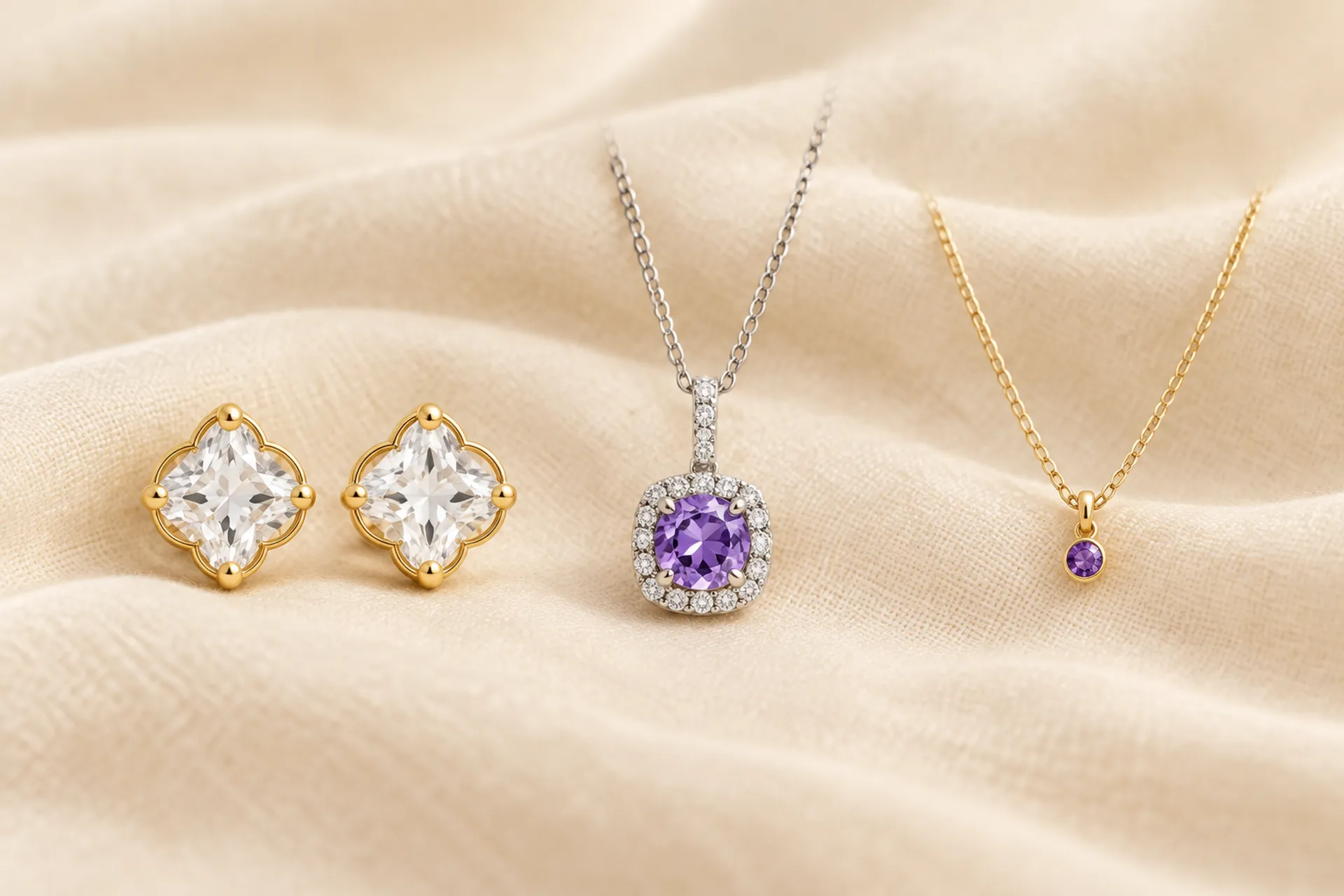
A birthstone gift for your daughter works best when the stone matches her birth month, her age, and how she'll actually wear it. For children under 10, prioritize hardness 8+ stones (sapphire, ruby, spinel, cubic zirconia alternatives) in sturdy settings like studs or pendants on adjustable chains. For tweens and teens, stacking rings and birthstone-initial combos fit both style and budget ($30–$150 for genuine stones, $150–$600 for fine jewelry). For milestone birthdays—13th, 16th, 18th, 21st—fine metal and natural untreated stones become worth the upgrade. Below is a practical, mineralogy-informed guide to choosing well at every stage. Per-stone facts and grading notes live in GIA's Gem Encyclopedia.
Quick Answer: Birthstone Gifts by Daughter's Age
| Age | Recommended Format | Typical Budget | Key Consideration |
| --- | --- | --- | --- |
| 0–5 years | Baby's first birthstone pendant (keepsake, worn later) or charm for mom's bracelet | $40–$120 | Buy keepsake quality; child shouldn't wear necklaces unsupervised |
| 6–12 years | Stud earrings or dainty pendant, 14K gold or durable gold vermeil | $50–$200 | Hardness and setting security matter more than stone rarity |
| 13–18 years | Stacking ring, birthstone necklace, initial + stone combo | $80–$400 | Style-driven; consider lab-grown options for larger stones |
| 18+ / milestones | Fine pendant, tennis or signet style, natural untreated stone | $300–$1,500+ | Document treatment status; heirloom-grade durability |
Which Stone Should You Start With?
Before deciding between a necklace, ring, or earrings, look honestly at your daughter's birthstone. Not all birthstones tolerate daily wear by an active child equally, and the jewelry industry often glosses over this.
Evaluate three factors, not just hardness:
- Hardness (Mohs scale) — resistance to scratching For hardness by stone, the International Gem Society's Mohs chart is the standard quick reference. - Toughness — resistance to chipping and cracking - Stability — resistance to heat, light, and chemicals
Sapphire (September) and ruby (July), both corundum at Mohs 9 with excellent toughness, are the gold standard for durable birthstone gifts. Amethyst (February, Mohs 7) and citrine (November, Mohs 7) are reasonably durable but can fade with prolonged sun exposure. Emerald (May, Mohs 7.5–8) has poor toughness due to natural inclusions ("jardin") and routinely receives oiling treatments — worth knowing before buying for a rough-and-tumble 8-year-old. Opal (October, Mohs 5.5–6.5) contains 3–21% water and can crack (craze) under dry conditions; it's a beautiful 21st-birthday stone but a risky playground stone.
Practical translation: for younger daughters with softer birthstones, choose protective settings (bezel over prong) and formats that take less abuse (pendant over ring).
You can explore each month's full stone profile on our month pages, such as /birthstones/april or /birthstones/september.
What Does She Actually Want at Each Age?
The most common failure mode in birthstone gifting isn't quality — it's mismatch between the gift and the wearer's life stage.
Ages 0–5: Buy for the memory, not for wearing. Pediatric safety guidance generally advises against necklaces on infants and toddlers (choking/strangulation risk). The smart play is a keepsake pendant or a birthstone charm the child receives at an older age, or a matching "mother-daughter" set where mom wears both stones.
Ages 6–12: Earrings and pendants win. Stud earrings in 14K gold with a bezel-set stone survive best. Avoid rings in fine metals at this age — fingers grow, and resized children's rings often cost more to resize than to replace.
Ages 13–18: Style enters the room. A 13th birthday birthstone ring carries symbolic weight in many families as a "coming of age" piece. Teens favor layering chains, initial-and-stone combos, and stacking rings. Lab-grown options (especially for emerald, sapphire, and ruby) let you give a larger, visually superior stone at the same price as a smaller natural one — and disclosure should be explicit either way.
Ages 18+ and milestone birthdays: Fine metal (14K–18K), natural stones with documented treatment status, and classic formats (solitaire pendant, signet ring) that survive trend cycles. An 18th or 21st birthday birthstone piece is often the first "real jewelry" a daughter owns and keeps for decades.
What Should You Ask About Treatments?
Ask any seller one direct question: has this stone been treated, and how? Common birthstone treatments you should know about:
- Heat treatment — routine and generally stable for sapphire, ruby, tanzanite, and aquamarine. Widely accepted in the trade; should still be disclosed. - Irradiation — used to produce blue topaz (December's modern stone). Stable and common, but worth knowing the color isn't natural. - Dyeing — common in lower-priced "howlite turquoisite" and some pearls. Dyes can fade or bleed. - Oiling — standard for emerald; almost all commercial emeralds are oiled. Minor oiling is accepted; heavy filling is not. - Coating and composite stones — "mystic topaz" coatings can scratch off; composite opal triplets are legitimate but should be priced accordingly.
None of these treatments make a stone "fake," but untreated stones command premiums, and a gift meant to last 30 years should have its treatment status stated in writing. If a listing can't answer, buy elsewhere. For the long-term durability angle, also consider our anniversary gemstone guides — for example, /anniversary-gemstones/25 covers sterling silver longevity questions that apply equally to heirloom-minded birthstone purchases.
Where Should the Money Actually Go?
Being honest about price structure: in the $30–$80 tier, you're mostly buying silver or gold vermeil mounts with small genuine stones, synthetic stones, or glass simulants — perfectly acceptable for young children who lose things. In the $150–$400 tier, you get 14K gold, genuine stones of modest carat weight, and better setting work. Above $600, you're paying for stone quality (color saturation, clarity, cut) and untreated status.
Where to economize: chain gauge (replaceable), brand packaging. Where not to: setting security (earring backs, pendant bails), metal purity for daily wear (14K over plated), and stone security for children's pieces.
Practical Buying Checklist
1. Match the stone to the birth month, then to the wearer's habits — not the other way around. 2. For children: bezel settings, screw-back earrings, 14K gold or better for pierced ears. 3. Get treatment disclosure in writing (heat, dye, irradiation, oiling). 4. For rings on growing hands, budget for one resize or choose adjustable bands. 5. Lab-grown is a legitimate choice for teens — just make sure it's labeled, and price it as such. 6. Keep the appraisal or receipt with treatment notes in the gift box; it matters decades later.
Frequently asked.
What is the best birthstone gift for a young daughter?
For girls aged 6–12, stud earrings or a small bezel-set pendant in 14K gold are the safest choices. They survive activity better than rings, and gold (rather than plated metals) reduces skin reactions. If her birthstone is soft or brittle — opal, emerald, pearl — a pendant protects the stone better than a ring or bracelet would.
Are lab-grown birthstones appropriate for daughters' gifts?
Yes, and often smartly so. Lab-grown sapphires, rubies, and emeralds are chemically identical to natural stones and let you give a larger, cleaner stone within budget — ideal for teens who want visual impact. The only requirement is honest labeling: a lab-grown stone should always be sold as lab-grown, which affects resale value but not beauty or durability.
How much should I spend on a birthstone gift for my daughter?
Roughly $50–$150 for children's daily-wear pieces (silver or 14K gold with small genuine stones), $150–$400 for teen fine jewelry, and $500+ for milestone 16th, 18th, or 21st birthday pieces meant to last a lifetime. Spend on setting quality and metal purity first; upgrade stone size only after those are secured.
Which birthstones are most durable for everyday wear by kids?
Sapphire (September) and ruby (July) — both Mohs 9 with excellent toughness — are the most durable birthstones. Next come topaz and aquamarine (Mohs 8), though topaz has perfect cleavage and can chip on impact. The least kid-proof are opal (brittle, heat-sensitive), pearl (soft at Mohs 2.5–4.5, damaged by acids and perfume), and emerald (poor toughness from inclusions).
Related Articles
A Brief History of Birthstones
From the twelve tribes of Israel to the 1912 standard that rules the modern list — the 3,500-year origin story of why we wear our birth month.
Read MoreThe Ultimate Birthstone Cleaning Guide
Keep every piece in your collection gleaming. Step-by-step methods for gold, silver, and delicate birthstones — no harsh chemicals needed.
Read MoreBirthstone Energy: A Complete Crystal Healing Guide
From root chakra grounding to crown chakra clarity, discover how each birthstone carries healing energy. Learn to activate your crystal for meditation, sleep, and daily intention.
Read More