Turquoise Healing Properties: The Ancient Protective Stone
Turquoise has been worn for protection for 5,000 years — Egyptian tombs, Persian palaces, Native American silver.
Yueounb Editorial
Jewelry Expert
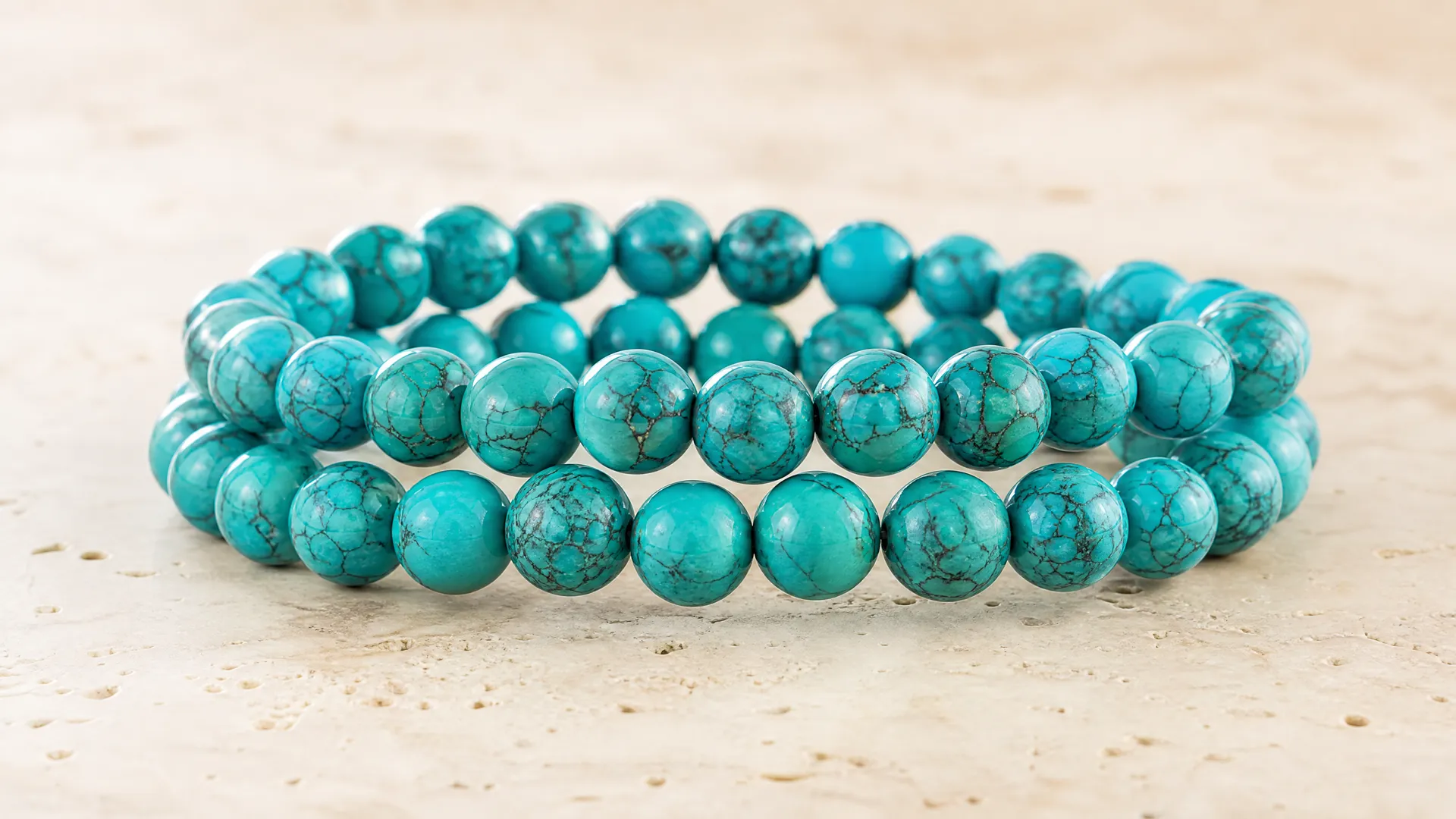
Turquoise is the oldest gemstone humans continuously wore for protection and healing — 5,000 years of unbroken tradition from Egyptian royal tombs (the oldest jewelry on earth is a turquoise bracelet) through Persian palace domes to Native American silver. Its traditional meanings are protection during travel, healing of the whole body, and good fortune; December babies wear it as their birthstone.
| Property | Fact |
| Mineral | Hydrated phosphate of copper and aluminum |
| Mohs hardness | 5-6 — soft; needs protective settings |
| Color | Robin-egg blue to green (more iron = greener) |
| Origin | Iran (Nishapur, the classic), Southwest US, China |
| Porosity | Porous — absorbs oils, perfumes, skin acids |
| Treatments | Stabilized (resin-infused), reconstituted, dyed — natural untreated is the premium |
What each tradition actually claimed. Ancient Egypt: turquoise wrist bracelets and scarabs for protection in the afterlife — Tutankhamun tomb was lined with it. Persia: the sky-stone, pinned on turbans and bridles to ward off the evil eye; the word turquoise itself comes from pierre tourques, the Turkish stone, on the trade route that carried Persian turquoise to Europe. Native American traditions of the Southwest: the sky fallen to earth, used in ceremony and trade for over a thousand years. Victorian Europe: protection from falling — from horses first, later metaphorically.
The healing properties, stated as tradition. Crystal practitioners list turquoise as a whole-body balancing stone — the master healer of the modern metaphysical canon — used for throat and lung complaints (it sits at the throat chakra), detox, and calm in travel. The honest framing: no clinical study supports stone-emitted healing, and the tradition itself never claimed medicine in the modern sense — it claimed protection, fortune, and meaning, which is exactly what turquoise delivered for fifty centuries and still delivers.
The science side that IS true: color as copper chemistry. The robin-egg blue is copper; greener shades carry more iron. The stone forms in arid climates where copper-rich water meets aluminum rock — which is why the great sources are deserts: Nishapur in Iran, the American Southwest, the Sinai. That chemistry is also why turquoise needs care: porous and soft, it absorbs cosmetics and skin oils and slowly greens with age — the patina that vintage collectors prize and new-buyers mistake for damage.
Buying real turquoise — the three-tier market, honestly. Natural untreated turquoise is rare and priced accordingly ($40-200-plus per carat for fine Nishapur or Sleeping Beauty blue, which closed in 2012 and lives on as the collector benchmark). Stabilized turquoise — real stone infused with resin for durability — is the honest middle tier and perfectly good jewelry. Reconstituted (powder + binder) and dyed howlite sold as turquoise is the fake tier. Tests: real turquoise is cool and gritty-warm to bite (do not), howlite fakes are too uniform, and price under $15 for a large bead means treated or imitation, full stop.
Caring for it like the ancients did not: remove before swimming (chlorine), showering (soap films into pores), and workouts (acids). Wipe with a soft dry cloth. Store alone — its Mohs 5-6 loses to everything. A turquoise piece treated this way outlives its owner, which is the entire 5,000-year point.
Frequently asked.
What are the healing properties of turquoise?
In tradition: protection — especially travel and the evil eye — plus whole-body healing and good fortune, across Egyptian, Persian, and Native American use spanning 5,000 years. In evidence: no clinical study shows healing energy; the documented value is symbolic and ritual, worn as a talisman of protection the way it always has been.
How can I tell real turquoise from fake?
Price first — under $15 for a large bead means stabilized, reconstituted, or dyed howlite. Real turquoise shows natural matrix variation, not uniform color; fakes are too even. Fine natural turquoise runs $40-200-plus per carat, with treated-but-real stabilized stone as the honest middle tier.
Why is my turquoise turning green?
Chemistry, not damage: porous turquoise absorbs skin oils, cosmetics, and acids, shifting the copper blue toward green. Persians and vintage collectors consider the patina character. To slow it, remove the stone before swimming, showering, and workouts.
Related Articles
A Brief History of Birthstones
From the twelve tribes of Israel to the 1912 standard that rules the modern list — the 3,500-year origin story of why we wear our birth month.
Read MoreThe Ultimate Birthstone Cleaning Guide
Keep every piece in your collection gleaming. Step-by-step methods for gold, silver, and delicate birthstones — no harsh chemicals needed.
Read MoreBirthstone Energy: A Complete Crystal Healing Guide
From root chakra grounding to crown chakra clarity, discover how each birthstone carries healing energy. Learn to activate your crystal for meditation, sleep, and daily intention.
Read More