Opal Meaning: Symbolism, History, and Why It Is Not Unlucky
The most misunderstood birthstone. Discover the truth about opal symbolism, its ancient reverence, and why the unlucky myth is completely false.
Yueounb Editorial
Jewelry Expert
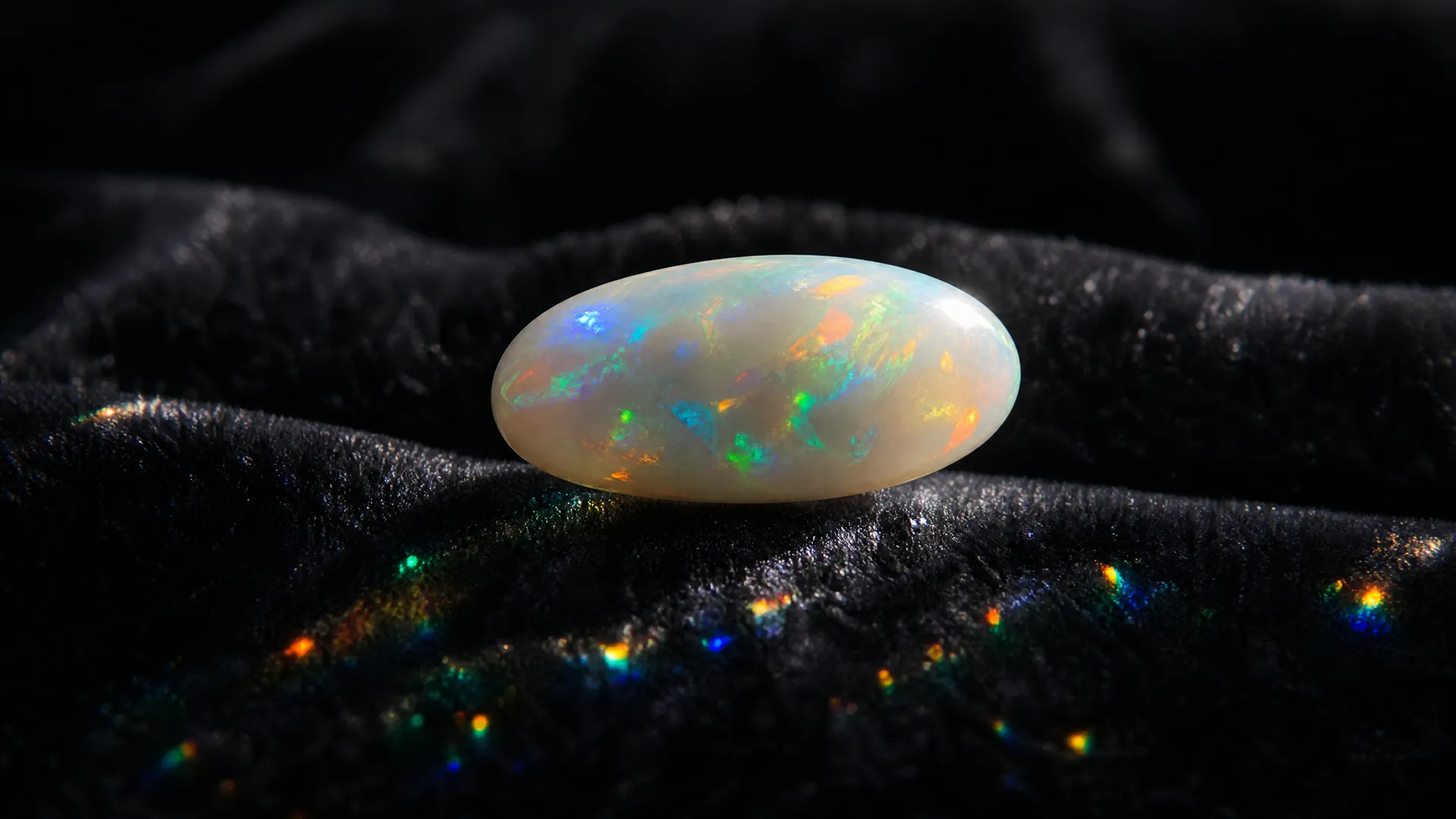
Opal symbolizes creativity, hope, and purity — the October birthstone whose play-of-color was read by the Romans as lightning captured in stone. Wearing an opal traditionally marks the wearer as imaginative and original; the stone remains the jewelry world great rebuttal to the superstition that once — briefly and commercially — called it unlucky.
What opal actually is, physically: hydrated silica, millions of silica spheres stacked in a lattice that diffracts light into moving flashes of blue, green, orange, and red — play-of-color, the official term. It contains up to 20 percent water, measures 5.5-6.5 on the Mohs scale, and Australia supplies roughly 95 percent of the world gem opal, with Ethiopia and Mexico supplying the rest.
| Opal type | Body color | What it says | Price tier |
| White opal | Milky white | The classic October look | Moderate |
| Black opal | Dark blue-gray | The rarest, most vivid flash | Highest |
| Boulder opal | On ironstone host | Wild, natural stripes | High |
| Fire opal | Orange-yellow | Warm, Mexican, often no flash | Moderate |
| Crystal opal | Transparent | Deep, clear color play | High |
The ancient reverence, documented. Rome called it opalus — precious stone — and Pliny wrote that it held the colors of every other gem together. Greece named it opallios, to see a change, and linked it to prophecy. In the East it stood for hope and loyalty; for most of history opal ranked WITH diamond and ruby as a royal stone — Cleopatra is said to have worn one, and a Roman senator resigned his post to buy one famous stone.
Where the unlucky myth came from — a 60-year marketing scar. In 1829 Sir Walter Scott published Anne of Geierstein, whose heroine wears an enchanted opal and dies when holy water strikes it; readers took the fiction as folklore. Then in the late 1800s, as the story is told in the trade, diamond merchants facing Australian opal competition spread the bad-luck rumor to protect sales. Queen Victoria deliberately killed it — she wore opals publicly and gifted them to her daughters. The superstition has been dead among dealers for a century; it survives only as a quiz question.
What wearing an opal represents today: creativity and originality first (the rainbow-in-one-stone reading), hope second (the Eastern tradition), and October birth-month third. Crystal practitioners use it for inspiration and emotional expression — tradition and symbolism, honestly framed, not medicine.
Owning one honestly: opal is softer than most gems (Mohs 5.5-6.5), so it prefers pendants and earrings to daily rings, bezel settings to prongs, and a cool dry box to a sunny windowsill. With that care it lasts generations — Victorian opals are still worn daily. Our full care method is in the opal cleaning guide.
Frequently asked.
What does wearing an opal symbolize?
Creativity, hope, and originality — the Romans saw lightning captured in stone, the Greeks linked it to prophecy and change, and it remains the October birthstone for imaginative wearers. Modern tradition reads its rainbow play-of-color as full-spectrum creativity.
Is opal really unlucky?
No — the superstition traces to an 1829 Sir Walter Scott novel and a late-1800s rumor spread while diamond sellers faced Australian opal competition. Queen Victoria deliberately ended it by wearing opals publicly. Among dealers it has been dead for a century.
Is opal the October birthstone?
Yes — opal is the modern October birthstone, with tourmaline as the alternate (the traditional list stone). October is one of the few months offering a multicolor stone and a solid-color option.
Related Articles
A Brief History of Birthstones
From the twelve tribes of Israel to the 1912 standard that rules the modern list — the 3,500-year origin story of why we wear our birth month.
Read MoreThe Ultimate Birthstone Cleaning Guide
Keep every piece in your collection gleaming. Step-by-step methods for gold, silver, and delicate birthstones — no harsh chemicals needed.
Read MoreBirthstone Energy: A Complete Crystal Healing Guide
From root chakra grounding to crown chakra clarity, discover how each birthstone carries healing energy. Learn to activate your crystal for meditation, sleep, and daily intention.
Read More