What Is the Luckiest Birthstone? A Real Verdict, Not a List
Citrine holds the strongest wealth-luck claim as the Merchant's Stone, peridot the strongest protection claim, and your own birthstone is the pick psychology comes closest to endorsing. Twelve months of luck folklore with its origins, the opal slander story, and why lucky stones really do work.
Yueounb Editorial
Jewelry Expert
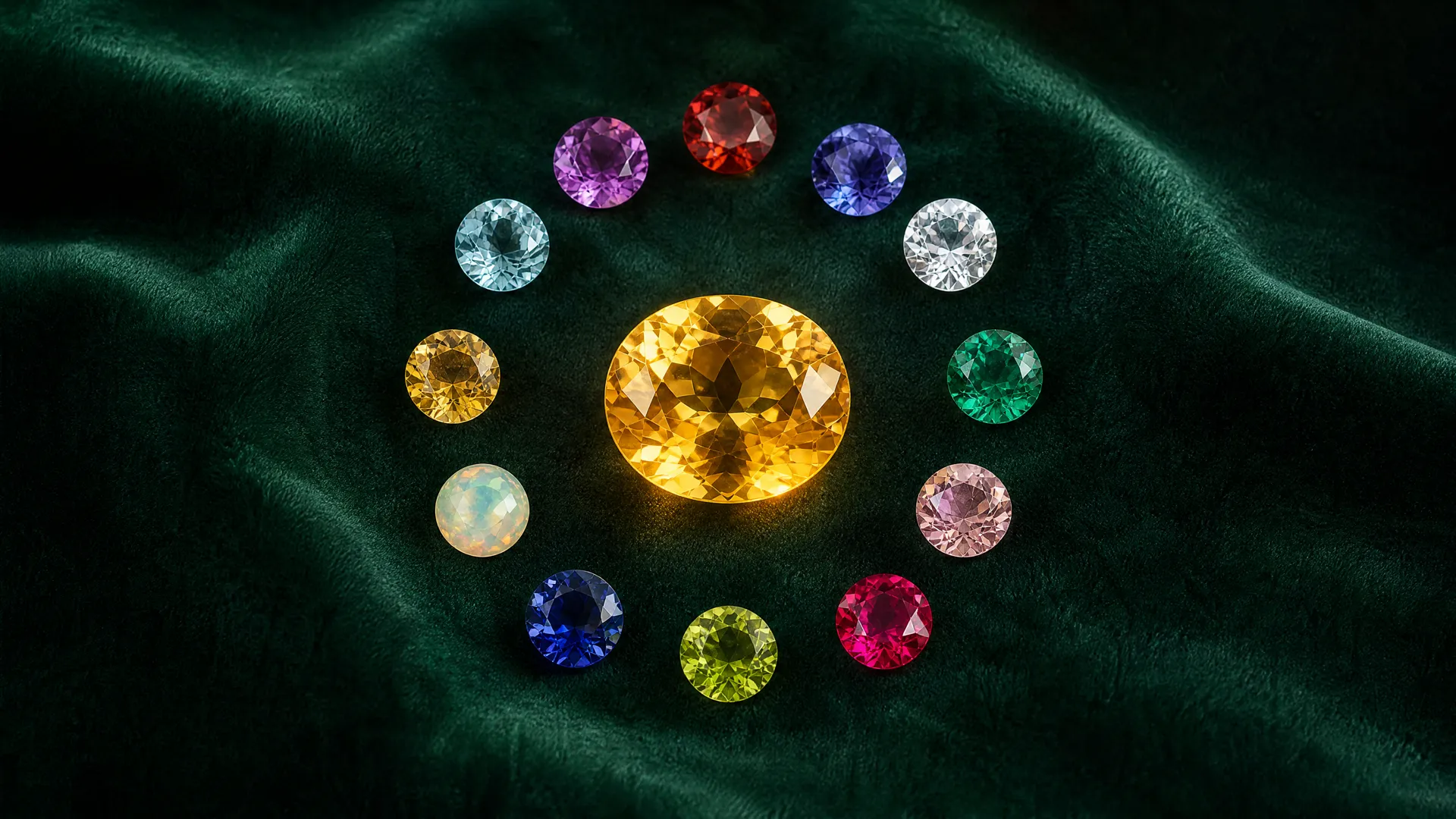
The luckiest birthstone depends on what kind of luck you are after: citrine (November) holds the strongest wealth claim as the Merchant's Stone, peridot (August) the strongest protection claim, and your own birthstone is the pick psychology comes closest to endorsing. Ask the internet and you will receive a shrug formatted as an article — seven stones, a paragraph of praise each, a closing line about how it depends on what you believe. That is a refusal to answer, and it leaves you no better off than the search box. This guide gives the verdict in tiers, then walks the complete twelve-month calendar of luck folklore with each stone's claim and where the claim actually comes from — including the one stone that got slandered by a novel, and the psychology experiment that explains why lucky charms work anyway.
Quick Answer: If you want one name: peridot is the stone most often crowned luckiest, and citrine holds the strongest single claim. The tiered verdict: |If you want luck with…|The stone|Why it holds the claim| |Wealth and business|Citrine (November)|The Merchant's Stone — the only named money folklore| |Protection from harm|Peridot (August)|Wards off evil; name tied to 'giving plenty'| |Measurable good fortune|Your own birthstone|The best charm study links charms to confidence| |Pure legend|Turquoise (December)|Tibet's good-fortune stone, protector of riders|
Every birthstone's lucky claim, month by month. What follows is the complete calendar — not the cherry-picked five most listicles manage — with each stone's fortune claim and where the claim comes from. Where the calendar holds more than one modern stone, the row lists the one with the richest luck folklore.
The twelve birthstones and their luck folklore |Month|Stone|Its lucky claim|Where the claim comes from| |January|Garnet|Safe travels|Roman parting gift; Noah's Ark lantern legend| |February|Amethyst|Clear-headedness|Greek amethystos, 'not drunk' — the sobriety stone| |March|Aquamarine|Protection at sea|The sailor's stone of Greek and Roman mariners| |April|Diamond|Invincibility|Greek adamas, 'unconquerable'; poison-ward talisman| |May|Emerald|True love, foresight|Rome's stone of Venus; said to reveal false oaths| |June|Pearl|Purity, moon-fortune|Aphrodite's tears; moonlight-grown in Chinese legend| |July|Ruby|Victory in battle|Burmese warriors' invincibility stone| |August|Peridot|Plenty, evil-warding|Egypt's 'gem of the sun'; Pele's tears in Hawaii| |September|Sapphire|Wisdom, divine favor|Royal and clerical stone against envy| |October|Opal|Hope — and slander|Rome's stone of hope; unlucky only since an 1829 novel| |November|Citrine|Wealth|The Merchant's Stone, said to be kept in tills| |December|Turquoise|Good fortune|Tibet's stone credited with fortune and protection|
Citrine: the one with a job title. Most stones are lucky in a general, atmospheric way; citrine is the only birthstone that was assigned a workplace. The Merchant's Stone — or Success Stone, in some tellings — is the gem traders kept in the cash box, a tradition described among Chinese shopkeepers for centuries and still practiced at modern retail counters. The claim is specific: citrine does not just attract wealth, it maintains it — increase in the cashbox, as the old formulation runs — which is a harder promise than most luck stones make. Two footnotes keep the folklore honest. First, the gemology one: most commercial citrine began life as amethyst, heated to permanent gold — a stable, legitimate treatment. Second, the historical one: November's modern list also carries topaz, whose own Renaissance-era claim was breaking magic spells and calming anger — November, it turns out, is the ambitious month.
Peridot: the protection pick, straight from a volcano. August's stone has the most dramatic origin story in the calendar: Hawaiian tradition calls peridot the tears of Pele, the volcano goddess — the physical facts are geologically subtler, but the image of green fire hardened from grief is the kind of lore that survives millennia. The old sources agree on the function: peridot warded off evil spirits, dissolved enchantments, and stopped nightmares, and the Egyptians mined it on a Red Sea island the Greeks called Topazios, naming it the gem of the sun. Even the name may be an accident of luck — one derivation ties it to the Greek peridona, giving plenty. Among the many luckiest-birthstone roundups, peridot is a recurring winner, which ratifies a tradition rather than starting one. It is also, conveniently, one of the more affordable stones in the calendar — which the historically minded will note is itself a small stroke of luck.
The opal paradox: how a lucky stone got framed. October deserves its own paragraph because opal is the calendar's cautionary tale about luck — a stone the Romans called the stone of hope, which spent the nineteenth century fighting a rumor. In 1829, Walter Scott published Anne of Geierstein, in which a heroine's enchanted opal loses its color at holy water — and she dies. The novel was a bestseller; opal sales were said to halve, and the superstition calcified within decades. Diamond dealers — opal's commercial rivals once Australian opals began flooding the market later in the century — have long been accused of feeding the story, though historians treat the accusation as unverified. Queen Victoria's counter-move was to give opals to her daughters. The lesson generalizes: a stone's luck is a story a culture tells, and stories can be told in either direction. The full opal saga — the novel, the rumor, the rehabilitation — is told in our opal meaning and history guide.
The psychology: why lucky birthstones work anyway. Here is the finding that elevates this from folklore trivia to something you can use. In a widely cited 2010 study from the University of Cologne, participants who kept their lucky charms with them performed better on memory and dexterity tasks — the researchers attributed the boost to self-efficacy, the confidence that keeps you persistent and focused. Hold the size of that effect loosely: a later registered replication did not reproduce it, so the honest summary is that the confidence logic survives even where the numbers do not. Around it sits a classic 1975 finding by the psychologist Ellen Langer, who named the illusion of control — our habit of overestimating how much we influence random events — and confirmation bias keeps the belief alive by faithfully remembering every win while wearing the stone and quietly filing every loss. Put honestly: a birthstone does not change your odds. It changes you on the day you wear it, and that is not nothing — it is the difference between walking into the interview already settled and walking in rattled. The tradition's own folk formulation — that wearing your own birthstone brings good luck and protection — turns out to be a pre-scientific description of exactly this effect. For the stones' other meanings, our gemstone meanings guide carries the full calendar, with the same honesty: these are beliefs with histories, not medicine.
Is luck cultural? Ask jade, the Navratna, and the rabbit's foot. The clearest evidence that luckiest has no universal answer is that the world's most confident luck stones are not birthstones at all. In Chinese culture the title belongs to jade — the stone of heaven, carved for fu, the character for blessing and fortune, given at weddings and New Years for millennia; no Western birthstone competes in the regions where jade's reputation lives. India's answer is the Navratna, the nine-gem arrangement that maps each stone to a celestial body — ruby for the sun, pearl for the moon — worn as a single coordinated talisman whose luck comes from planetary balance rather than any one stone. And the West's own rabbit's foot — a luck charm with a documented history in nineteenth-century American folk practice, complete with rules about which foot and which moon — proves the tradition needs no gemology at all. Luck, in short, is a cultural function: each tradition appoints its carrier. The birthstone calendar is simply the West's standardized answer, ratified by jewelers in 1912 and revised three times since — which is precisely why November can hold a money stone and August a protection stone without contradiction.
How to choose yours, if you are choosing on purpose. If the goal is fortune in work or money, November's citrine is the tradition's specialist. If it is protection — for travel, for a hard year, for a child going far away — August's peridot or January's garnet carry the oldest protective claims. If it is love and partnership, May's emerald holds the Venus inheritance. If you are choosing on looks alone, the deepest consensus clusters around two stones money cannot easily photograph: alexandrite for its color change and opal for its play-of-color — but that is another argument, and one our birthstones hub settles stone by stone. And if you want the luck that psychology comes closest to endorsing, wear your own month's stone, or the month of someone you carry with you — the charm you believe in is the one that works. That is the calendar's own secret: the luckiest birthstone is whichever you will actually never take off.
Which birthstone is luckiest for money, love, and protection?
Split the question by what luck you are asking for. **Money:** citrine, the merchant's stone kept in cash boxes for centuries — November's birthstone doubles as the trade's wealth charm. **Love:** rose quartz, the heart stone of every tradition from Greek to modern. **Protection:** black tourmaline and onyx, the threshold stones kept at doors and worn on wrists against harm. **The wildcard:** jade, which Chinese tradition rates above every Western stone for fortune generally rather than one category. The birthstone calendar adds your birth month to whichever category you pick — the luck is the tradition; the fit is yours.
Does your own birthstone count as lucky — or should you buy a different month's?
Your own birthstone is the tradition's default lucky charm: the stone assigned to your birth month was believed to carry its strongest influence for you specifically. Buying a different month's stone for its category luck (citrine for money in a July-born's case) is the newer layer, and there is no rule against stacking both. The practical answer: wear your own stone as the base layer and add the category stone when you need it — July's ruby for courage in a hard quarter, November's citrine for a launch, jade for everything at once.
Frequently asked.
What is the luckiest birthstone by month?
Within the calendar's own folklore: garnet protects travelers (January), aquamarine guards at sea (March), ruby grants battle-strength (July), peridot wards off evil (August), citrine builds wealth (November), and turquoise brings general good fortune (December). The stones most often crowned luckiest overall are peridot and citrine.
Is it bad luck to wear a birthstone that isn't yours?
No — that superstition has no basis in the tradition itself. Historical practice freely wore stones for their properties regardless of birth month; the modern 'never take off your own stone' custom is a positive belief about your own month, not a prohibition on others. Wear whichever stone's meaning you need.
Are opals really unlucky?
No. Opals were considered lucky stones from Rome through the nineteenth century; the bad-luck reputation traces to Walter Scott's 1829 novel Anne of Geierstein and was reportedly fed by competing diamond dealers once Australian opals entered the market — a story historians treat as unverified. Queen Victoria deliberately gave opals as gifts to reverse the superstition.
Do lucky birthstones actually work?
Not by changing your odds — but plausibly by changing you. In a 2010 University of Cologne study, people with their lucky charms performed better on memory and dexterity tasks, an effect the researchers attributed to confidence; a later replication failed to reproduce it, so the honest version is that the confidence mechanism is plausible and the size of the effect is unsettled. The charm you believe in helps either way.
Which birthstone is considered the most beautiful?
There is no official title, but the two most-cited candidates are alexandrite — prized for changing color between green and raspberry — and opal, whose play-of-color no photograph captures. Emerald's green and the blue sapphire round out most shortlists; beauty, like luck, is finally a matter of which stone you cannot stop looking at.
Related Articles
A Brief History of Birthstones
From the twelve tribes of Israel to the 1912 standard that rules the modern list — the 3,500-year origin story of why we wear our birth month.
Read MoreThe Ultimate Birthstone Cleaning Guide
Keep every piece in your collection gleaming. Step-by-step methods for gold, silver, and delicate birthstones — no harsh chemicals needed.
Read MoreBirthstone Energy: A Complete Crystal Healing Guide
From root chakra grounding to crown chakra clarity, discover how each birthstone carries healing energy. Learn to activate your crystal for meditation, sleep, and daily intention.
Read More