Birthstone Necklace Buying Guide: How to Choose the Perfect Pendant
From chain length to stone setting, learn everything you need to choose a birthstone necklace that lasts a lifetime. Includes style tips for every body type.
Yueounb Editorial
Jewelry Expert
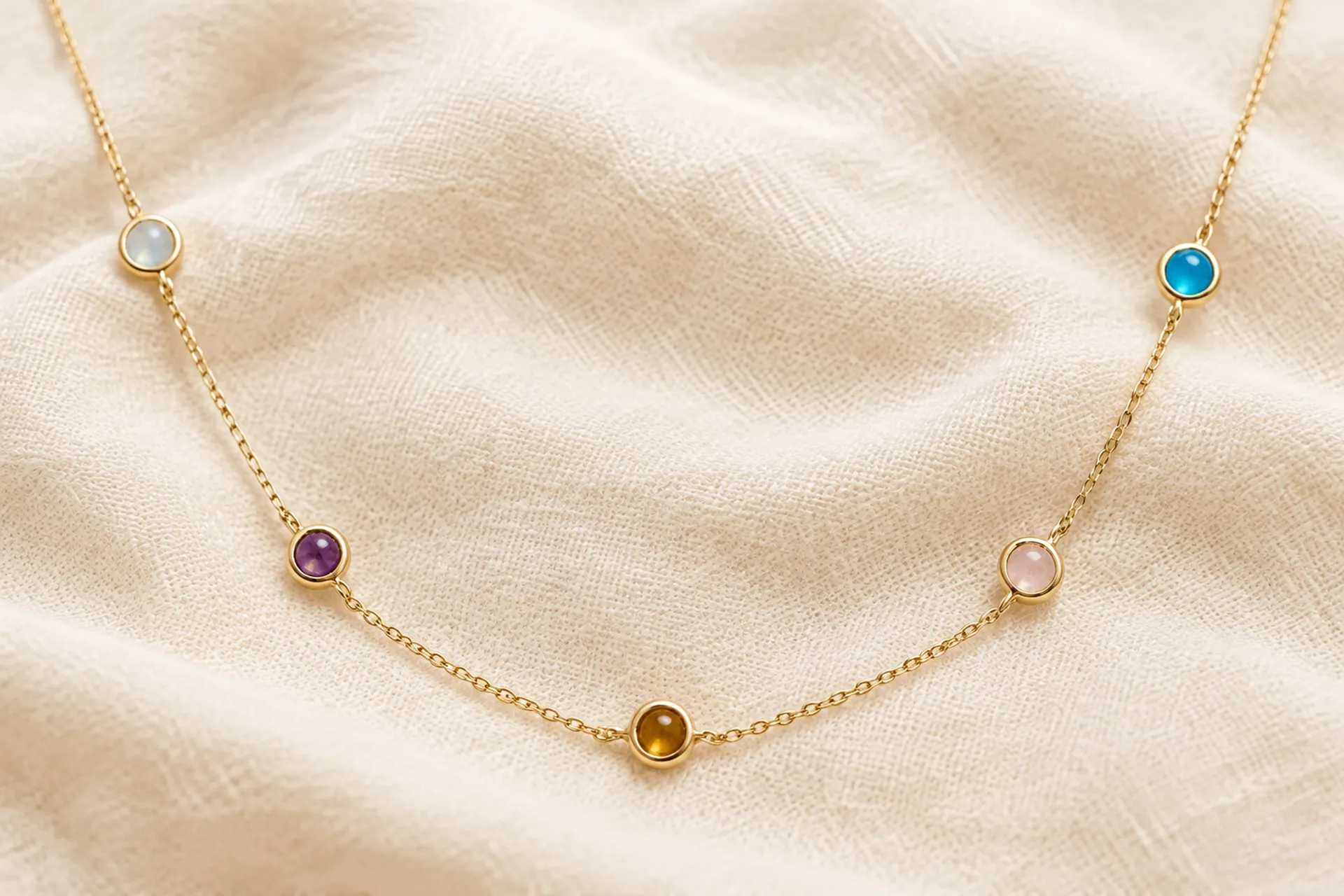
A birthstone necklace is chosen on three decisions: the stone (your birth month), the chain (16, 18 or 20 inches), and the metal (vermeil, silver, or solid gold). Get those three right and any style works; get one wrong and even an expensive pendant stays in the jewelry box. This guide walks each decision with the trade-offs, prices, and fit rules.
Decision one: the stone. Your month is the default — January garnet, February amethyst, March aquamarine, April diamond white, May emerald, June moonstone or pearl, July ruby, August peridot, September sapphire, October opal, November citrine, December turquoise. Two upgrades worth knowing: alternatives (every month has one — June alexandrite, December tanzanite) if you dislike your color, and multi-stone pendants that add children or partner months.
Decision two: chain length. This is where most gift-buyers guess wrong.
| Length | Where it sits | Best for |
| 16 inch | Collarbone | Minimal styles, open collars, smaller frames |
| 18 inch | Just below collarbone | The default — clears necklines, layers well |
| 20 inch | Upper sternum | Larger frames, pendant-heavy designs |
| 22-24 inch | Mid-chest | Statement pendants, high necklines |
If buying for someone whose length you do not know, 18 inches with a 2-inch extender is the answer that always fits.
Decision three: the metal. The durability ladder, honestly stated. Gold vermeil (18K over 925 silver) delivers the gold look at silver prices and survives daily wear for years when plated 2.5 microns or thicker. Solid 14K gold is the heirloom grade — resell value, zero plating concerns, three times the price. Sterling silver is the budget and cool-tone pick; it tarnishes but polishes back. Avoid unmarked base-metal gold colors unless the piece is explicitly fashion-grade.
Stone settings, ranked by everyday safety. Bezel (a metal rim around the stone) protects best — the choice for opal, moonstone, pearls and any soft stone. Prong shows more stone but snags; fine for harder gems like sapphire and garnet. Pavé (many tiny stones) sparkles maximally in halo styles; check that pavé is hand-set, not glued. For daily-wear pendants under $150, a bezel-set stone is the setting that survives.
Soft stones and daily wear — the honest warnings. Opal (Mohs 5.5-6.5) and pearl (2.5-4.5) scratch against harder gems: store separately in a pouch. Emeralds are often oiled; avoid ultrasonic cleaners. Amethyst and citrine fade in months of direct sunlight. None of these are dealbreakers — they are care rules, and every stone above lasts decades with them.
What you should pay (2026 market, Estimated): quality sterling silver birthstone pendants $40-80; gold vermeil $70-150; solid 14K with genuine stones from $250. Genuine does not mean expensive — garnet, amethyst, peridot and citrine are affordable natural stones; ruby, emerald and diamond carry the premium. Simulants (CZ, lab stones) at a tenth of the price are legitimate choices when honestly labeled, and honest labeling is exactly what separates a trustworthy shop.
Frequently asked.
What length birthstone necklace should I buy?
18 inches with a 2-inch extender is the universal answer — it clears most necklines and layers with everything. Choose 16 inches for collarbone minimal styles and 20 inches for larger frames or heavy pendants.
Is gold vermeil or sterling silver better for daily wear?
Vermeil (18K gold over 925 silver, 2.5+ microns) gives the gold look and lasts years daily. Sterling silver costs less and suits cool tones but tarnishes. For an heirloom, solid 14K gold is the only choice that never plates off.
Which birthstones are safe for everyday pendants?
Hard stones — garnet, amethyst, sapphire, peridot, citrine — handle daily wear in any setting. Soft stones like opal, pearl and moonstone belong in protective bezel settings and a pouch when not worn.
Related Articles
A Brief History of Birthstones
From the twelve tribes of Israel to the 1912 standard that rules the modern list — the 3,500-year origin story of why we wear our birth month.
Read MoreThe Ultimate Birthstone Cleaning Guide
Keep every piece in your collection gleaming. Step-by-step methods for gold, silver, and delicate birthstones — no harsh chemicals needed.
Read MoreBirthstone Energy: A Complete Crystal Healing Guide
From root chakra grounding to crown chakra clarity, discover how each birthstone carries healing energy. Learn to activate your crystal for meditation, sleep, and daily intention.
Read More