Best Gemstone Necklaces: A Durability × Beauty × Budget Ranking
Quick Answer: The best gemstone necklaces balance three factors: durability, beauty, and budget.
Yueounb Editorial
Jewelry Expert
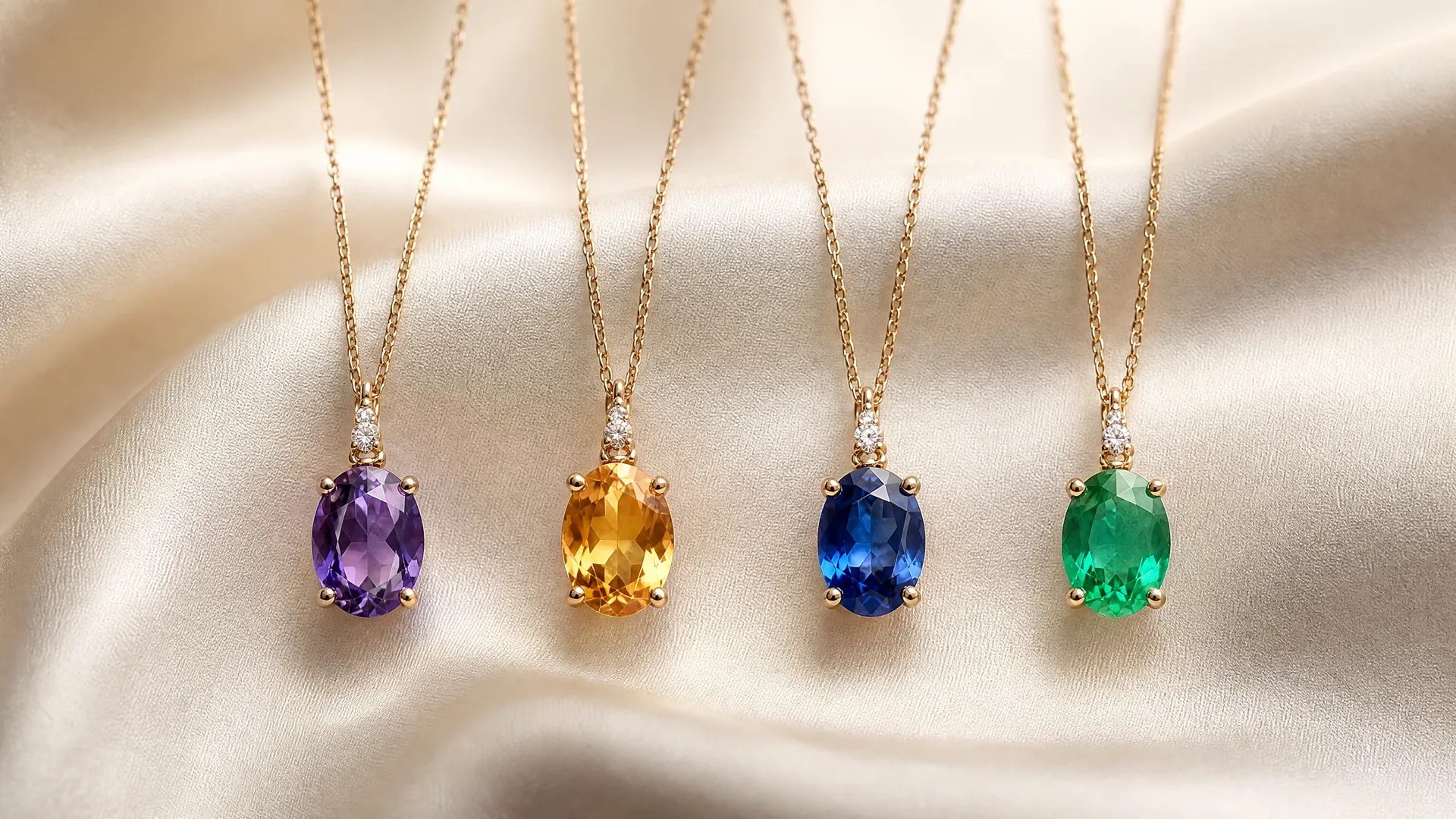
Quick Answer: The best gemstone necklaces balance three factors: durability, beauty, and budget. For everyday wear, sapphire and ruby (Mohs 9) top the ranking. For color variety on a mid budget, tourmaline and garnet excel. For affordable elegance, amethyst and citrine deliver — but require gentler care. Emerald, though stunning, ranks lower for daily necklaces due to its brittleness and typical oil treatment.
Necklaces live harder lives than rings — they swing, knock against buttons and zippers, and absorb perfume and sweat. So we evaluated each gem on three factors, not hardness alone:
1. Hardness — resistance to scratching (Mohs scale) 2. Toughness — resistance to chipping and cracking 3. Stability — resistance to heat, light, and chemicals
We also factor in treatment disclosure, because treatments (heat, dye, irradiation, oiling) affect both value and long-term care. A dyed stone can fade; an oiled emerald can be damaged by ordinary ultrasonic cleaning.
| Rank | Gemstone | Mohs | Toughness | Stability | Typical Treatment | Budget (1 ct, set) |
| ------ | ---------- | ------ | ----------- | ----------- | ------------------- | -------------------- |
| 1 | Sapphire | 9 | Excellent | Excellent | Commonly heat-treated | $$$–$$$$ |
| 2 | Ruby | 9 | Excellent | Excellent | Commonly heat-treated | $$$$ |
| 3 | Spinel | 8 | Good | Excellent | Usually untreated | $$$ |
| 4 | Garnet | 6.5–7.5 | Good | Good | Usually untreated | $$ |
| 5 | Tourmaline | 7–7.5 | Fair | Good | Occasionally heat-treated/irradiated | $$–$$$ |
| 6 | Aquamarine | 7.5 | Good | Good | Commonly heat-treated | $$–$$$ |
| 7 | Amethyst | 7 | Good | Good | Occasionally heat-treated | $ |
| 8 | Citrine | 7 | Good | Good | Often heat-treated | $ |
| 9 | Emerald | 7.5–8 | Poor | Fair | Almost always oiled/fracture-filled | $$$$ |
| 10 | Opal | 5.5–6.5 | Fair–Poor | Poor (heat-sensitive) | Occasionally dyed/smoke-treated | $$–$$$ |
*Price bands: $ under ~$100, $$ ~$100–500, $$$ ~$500–2,000, $$$$ $2,000+ (fine-quality 1 ct examples; wide variation by color, clarity, and origin).*
Sapphire is the most rational choice for a necklace you'll never take off. At Mohs 9 with excellent toughness, it shrugs off daily wear. Heat treatment is industry-standard and stable — it improves color without adding fragility — but ask for disclosure, as untreated fine sapphire commands a significant premium. Blue is classic, but pink, yellow, and padparadscha sapphires expand the palette.
Ruby shares sapphire's durability (both are corundum) but sits at a higher price point for fine material. A small ruby pendant is often a better value play than a large one — saturation matters more than size in this gem.
Spinel is the connoisseur's pick: Mohs 8, usually untreated, and historically mistaken for ruby. It delivers vivid reds, hot pinks, and cobalt blues at a fraction of corundum prices. Its "Good" toughness is a minor step down but more than adequate for pendants.
Garnet — the January birthstone — is chronically underrated. Most garnet on the market is untreated, its reds span orange (spessartite) to deep crimson (almandine), and prices are gentle. It's the rare "buy the big stone" category for necklaces.
Tourmaline offers the widest color range of any gem family, including the coveted bi-color and watermelon varieties. Caveat: some pink and red tourmaline is heat-treated or irradiated, and irradiated color stability should be disclosed. With only "Fair" toughness, choose protective bezel settings over exposed prongs.
Aquamarine is routinely heat-treated to remove greenish tones and achieve its signature pale blue — a stable, permanent treatment. Its pale color means larger stones look better, which conveniently suits necklace proportions.
Amethyst and citrine (both quartz) are the budget sweet spot — genuinely durable enough for daily pendants at prices that allow generous carat weights. The trade-off: their common mid-tones are less "precious" in the market's eye. Note that much citrine on the market is heat-treated amethyst or smoky quartz — permanent and stable, but worth knowing.
Emerald is the ranking's most controversial placement. Its color is unmatched, but its Poor toughness (from natural inclusions, or "jardin") and near-universal oiling make it fragile for anything that takes knocks. It belongs in occasional-wear pendants in protective settings — not a daily chain. Never ultrasonic-clean an oiled emerald.
Opal anchors the bottom for daily wear — heat sensitivity, water content, and fragility demand careful ownership — but remains a beloved choice for special-occasion pendants.
Daily-wear chains and tennis styles: sapphire, ruby, spinel - Statement pendants: garnet, tourmaline, aquamarine - Layering pieces on a budget: amethyst, citrine - Occasional heirloom pieces: emerald, opal
If your priority is a birth-month connection rather than pure performance, our birthstone necklace buying guide covers month-by-month specifics, and each month's page — from January through December — details that stone's care needs.
Frequently asked.
What gemstone necklace is best for everyday wear?
The daily-wear shortlist runs on hardness: quartz family stones (amethyst 7, citrine 7, rose quartz 7), garnet, aquamarine, topaz, and sapphire — all handle shower-adjacent real life in protected settings. Soft stones (pearl, opal, malachite) are occasion pieces by physics, not snobbery. Format matters as much as stone: bezel settings and short chains survive what prongs and long chains do not.
How much should I spend on a gemstone necklace?
Honest tiers: under $80 buys genuine-stone minimalist and beaded formats; $80-200 is the sweet spot — multi-stone designs, better metal, proper settings; $200-400 buys statement scale; beyond that you are buying rarity stones, which daily wearers rarely need. The tier that gets worn most is the middle one — buy construction quality there, not carat dreams.
Related Articles
A Brief History of Birthstones
From the twelve tribes of Israel to the 1912 standard that rules the modern list — the 3,500-year origin story of why we wear our birth month.
Read MoreThe Ultimate Birthstone Cleaning Guide
Keep every piece in your collection gleaming. Step-by-step methods for gold, silver, and delicate birthstones — no harsh chemicals needed.
Read MoreBirthstone Energy: A Complete Crystal Healing Guide
From root chakra grounding to crown chakra clarity, discover how each birthstone carries healing energy. Learn to activate your crystal for meditation, sleep, and daily intention.
Read More