10th Anniversary Diamond Gifts: A Practical Guide by Budget
The 10th anniversary is the diamond anniversary on the modern list — and a diamond gift doesn't have to mean a four-figure budget. Three spending tiers, the mineralogy behind diamond's durability, and two honest alternatives.
Yueounb Editorial
Gemologist
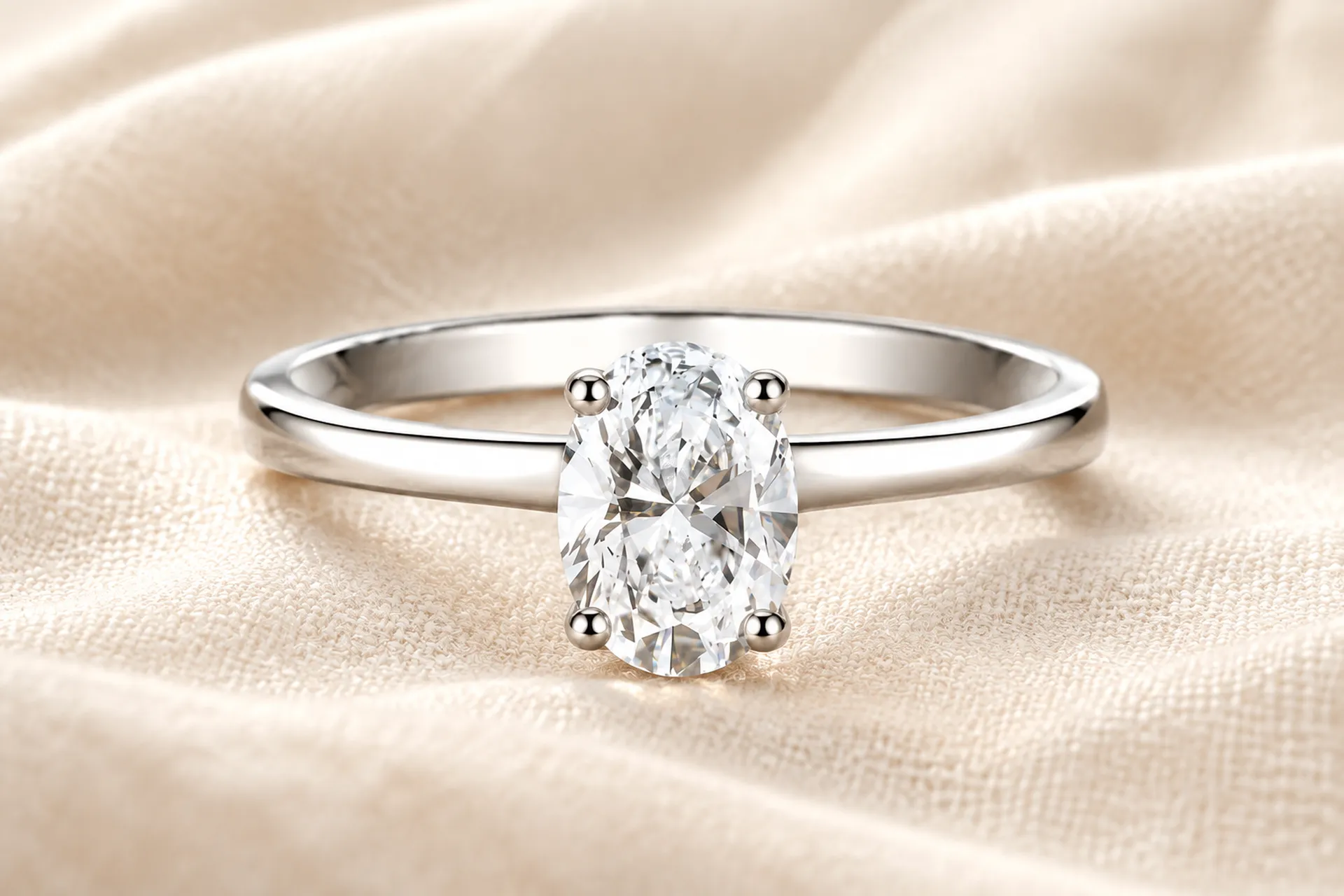
Reaching ten years of marriage is the diamond anniversary on the modern US list — the one jewelers and most gift guides follow today. (The older traditional list named tin or aluminum for the 10th: practical, durable, and distinctly unromantic, which is exactly why diamond took over.) That makes this milestone one of the most significant gift-giving occasions before the 25th (see our full anniversary stone list by year) that makes this milestone one of the most significant gift-giving occasions before the 25th. But a diamond gift doesn't have to mean a new engagement ring or a four-figure budget. This guide breaks down what to buy at three spending levels ($0–200, $200–500, $500+), explains the mineralogy behind diamond's famous durability, and offers two honest alternatives — white sapphire and zircon — if a diamond isn't the right fit this year. For a stone-by-stone hardness reference, the International Gem Society's Mohs chart orders the major gems.
Quick Answer: What Is the 10th Anniversary Stone?
| Question | Answer |
| --- | --- |
| What gemstone is the 10th anniversary? | Diamond — on both the traditional and modern U.S. anniversary gift lists. The 10th is often called the "diamond anniversary." |
| Can I give something other than diamond? | Yes. White sapphire and colorless zircon are the two closest lookalikes; blue sapphire and blue zircon are also historically tied to this milestone. |
| How much should I spend? | There's no rule. Meaningful diamond gifts exist at $150 (accent stones, earrings) and at $5,000+ ( eternity bands, solitaire upgrades). Budget tiers below. |
| Is a 10-year diamond different from other diamonds? | No. It's the same mineral (carbon, Mohs 10) — the anniversary tradition is what gives it meaning, not the stone itself. |
For the full milestone reference, see our 10th anniversary gemstone guide.
Why Is Diamond the 10th Anniversary Stone?
Here's a fact worth knowing before you shop: diamond's association with the 10th anniversary is largely a 20th-century convention. The older European tradition reserved "diamond" for the 60th year (popularized by Queen Victoria's Diamond Jubilee in 1897). The modern American anniversary list — the one that assigns diamond to year 10 — was standardized by the American National Retail Jeweler Association in 1937 and updated by the Library's "traditional/modern" pairings that most U.S. retailers use today. Both lists agree on diamond for the 10th, which is uncommon; most years the traditional and modern suggestions differ.
Why did retailers move diamond earlier? Commercially, ten years is when couples have typically established enough financial stability to consider a major jewelry purchase — and emotionally, it's the first double-digit milestone, when marriages have survived the statistically turbulent early years. The gift logic is sound: diamond's resistance to wear makes it a fitting metaphor for a relationship that has proven it can take daily life.
One honest caveat: some sources will tell you the 10th is also the "aluminum anniversary." That's true on certain European lists (notably in Germany, where aluminum or tin marks year 10). If your spouse has a European family background, a diamond-and-tungsten or aluminum-accented pairing can be a thoughtful nod — but for the U.S. market, diamond is unambiguous.
The Mineralology: What Makes Diamond a Smart Daily-Wear Gift
If you're choosing a piece meant to be worn every day for the next decade, diamond is arguably the safest colored-gem-adjacent choice in jewelry, and here's the three-factor breakdown that matters more than the famous "hardness" number:
Hardness (Mohs 10). Diamond is the hardest natural material — about 56 on the absolute (Rosival) scale that gemologists prefer, meaning it's roughly 3,500 times harder than corundum in absolute terms, not "one step harder" as the Mohs scale misleadingly implies. It cannot be scratched by ordinary wear. What can scratch a diamond is another diamond — which is why diamond setters store parcels separately. Durability, as GIA's guide to gem durability explains, is three properties working together — hardness, toughness, and stability — not one number.
Toughness (good, not perfect). This is where honesty matters. Hardness ≠ toughness. Diamond has perfect cleavage in four directions, meaning a sharp blow at the right angle can chip or split a stone — particularly at the girdle (the thin edge where the top and bottom of the cut meet). Thin girdles on budget-cut stones chip more easily. This is why bezel settings and thicker girdles are genuinely better choices for rings worn daily, not just stylistic preferences.
Stability (excellent). Diamond is stable to heat, light, and all common household chemicals. Unlike emerald (oiled, heat-sensitive) or opal (water-sensitive), a diamond needs no special care beyond occasional cleaning with warm water, mild soap, and a soft brush.
Treatment disclosure. Most gem-quality diamonds on the market are untreated, but two treatments you should know about at lower price points: HPHT annealing (improves color in some brownish stones — stable and permanent, but must be disclosed) and fracture filling (glass-like material injected into visible cracks — not stable, can be damaged by jeweler's torch or even ultrasonic cleaning; the FTC requires disclosure, and we recommend avoiding filled stones for anniversary gifts entirely). Lab-grown diamonds are chemically identical and fully legitimate — see the budget section below, because they've completely changed the sub-$1,000 diamond market.
Budget Tier 1: $0–200 — Small Diamonds, Done Right
You can buy real, natural diamonds under $200 — just not a big center stone. What works at this level:
Diamond accent jewelry. A pair of stud earrings with 0.10–0.25 ct total weight in 14k gold runs roughly $120–$250 for natural stones. Ten points of well-cut diamonds (SI clarity, G–H color) sparkle far beyond their carat weight because earrings sit in motion, catching light constantly.
Pavé and channel-set bands. A 14k white or yellow gold band with a dozen 1mm diamonds (0.10–0.15 ct total) typically lands at $150–$300. This is the classic "stacker" gift — designed to sit alongside an existing engagement ring, which makes it symbolically perfect: adding to, not replacing, the original.
Single-diamond necklaces. A bezel-set 0.05–0.10 ct pendant on a fine gold chain is quietly wearable every day. At this size, clarity differences are invisible to the naked eye — spend your budget on cut quality and the chain, not the grading report (stones under 0.15 ct rarely come with one, and that's fine).
The lab-grown wildcard. Lab-grown diamond prices have fallen dramatically in recent years: a 1-carat lab-grown stone now typically retails for a small fraction — commonly cited at less than a quarter — of a comparable natural diamond. If your recipient is comfortable with lab-grown, this tier can suddenly afford a full-carat look. Disclose what you're buying; don't let it be discovered later.
Budget Tier 2: $200–500 — The Sweet Spot for Earrings and Bands
Diamond studs, properly sized. 0.50 ct total weight (0.25 ct per ear) in SI1/G is the classic upgrade point, typically $350–$700 natural depending on the market. Look for matched-pair certification or at least a trustworthy grading statement, and prioritize cut above all — at this size, a well-cut SI stone outperforms a poorly cut VS.
Eternity and half-eternity bands. A 14k gold band with 0.25–0.50 ct of channel-set diamonds is the single most gifted 10th-anniversary item at this level, and for good reason: it's stackable, anniversary-symbolic (continuous diamonds = unbroken years), and doesn't compete with an existing engagement ring. Budget $300–$600 natural, $150–$300 lab-grown.
Pendants with presence. A halo-set 0.15–0.25 ct center diamond reads visually much larger than its carat weight. Halo settings add cost per visible millimeter more efficiently than carat weight does — a genuinely smart value play at this tier.
Budget Tier 3: $500+ — The Milestone Pieces
Full eternity bands ($800–$3,000+). Diamonds all the way around, 1.0–2.0 ct total weight. Note the practical tradeoff: full eternity bands can't easily be resized because of the stones circling the band — confirm ring size carefully, or choose a half-eternity.
Right-hand rings ($1,000–$4,000). A cluster or three-stone ring in white gold, 0.75–1.5 ct total weight. Three-stone designs carry their own symbolism (past, present, future) that layers nicely onto a decade milestone.
The solitaire upgrade ($2,500+). Many couples use the 10th to upgrade the original engagement diamond — often with a trade-in program. If you go this route, keep the original stone if the jeweler allows; resetting the first diamond into a pendant or a child's future piece preserves its story.
Fancy shapes note: at any tier above $500, consider oval, emerald, or pear cuts. They face up 8–15% larger per carat than rounds of the same weight, and carry less of the round-brilliant price premium per carat.
What If Diamond Isn't in the Budget This Year?
Not every 10th-anniversary budget or conscience points to diamond. Two lookalikes deserve serious consideration:
White sapphire (colorless corundum). Mohs 9, no cleavage planes in the way diamond has, excellent toughness, completely untreated in most cases. At $50–$200 for a 1-carat calibrated stone, it's a fraction of diamond's price. The honest tradeoff: sapphire's sparkle is different — lower dispersion means more white flashes and less of the rainbow "fire" diamond shows. Side by side, a trained eye notices immediately; worn alone, most people don't. If your partner values durability and symbolism over rarity, this is the responsible pick. Sapphire also has its own anniversary pedigree — it's the modern 5th-anniversary stone, so it's no stranger to milestones.
Zircon — the most underappreciated option. Not to be confused with cubic zirconia (a simulated stone with zero mineral relationship). Natural zircon is a genuine gemstone (zirconium silicate), and colorless zircon was actually used as a diamond simulant for centuries before modern synthetics. Its strong double refraction gives it a distinctive sparkling, almost "fuzzy" brilliance. Two honest disclosures: (1) most blue zircon on the market is heat-treated — standard, stable, and fully acceptable, but worth knowing; (2) zircon is Mohs 6–7.5 and brittle, with pronounced cleavage — it chips at facet junctions under rough wear. Choose protective settings (bezel, well-designed prongs) and it's a gorgeous, meaningful stone; treat it like a diamond and you'll be disappointed.
If you're also thinking about birthstone connections — April babies get diamond as their birthstone, making a diamond 10th-anniversary gift doubly resonant for April-born spouses — see our April birthstone guide.
Buying Checklist: Five Things to Verify Before You Check Out
1. Disclosure first. Ask explicitly: "Is this stone treated in any way, and is it natural or lab-grown?" Any hesitation on the answer is your answer. 2. Cut over clarity at small sizes. Below 0.50 ct per stone, cut drives 80% of what you see. SI clarity and G–H color are where value lives. 3. Setting for lifestyle. Bezel and channel settings protect girdles and are worth the modest premium for daily-wear pieces. Prong-set solitaires need prong checks every 12–18 months. 4. Certification only where it matters. A GIA or IGI report is worth having for any single stone over 0.30 ct. Under that, it adds cost without adding information you can use. 5. The 10-year story. Whatever you buy, tell her or him why this piece. A $200 stacker band with a note listing ten specific years and moments will outperform a $4,000 ring handed over in silence. Content matters; our editorial experience across thousands of anniversary gifts suggests the note is what gets remembered.
Frequently asked.
What is the traditional 10-year anniversary gift?
In the United States, the 10th anniversary gift is diamond on both the traditional and modern lists — one of the few years where they agree. It's commonly called the diamond anniversary. In parts of Europe, notably Germany, tin or aluminum marks year 10 instead, so aluminum accents can be a meaningful addition for couples with European heritage.
How much should I spend on a 10th-anniversary diamond?
There is no standard amount. Meaningful natural-diamond gifts start around $120–$200 (small studs or pavé bands), $300–$600 buys half-carat studs or eternity bands, and $1,000+ opens full eternity bands and right-hand rings. Lab-grown diamonds now offer full-carat looks under $600. Spend what your budget allows without strain — the milestone doesn't require a specific number.
Is white sapphire a good alternative to diamond for an anniversary gift?
Yes, if chosen knowingly. White sapphire is durable (Mohs 9), tough, usually untreated, and costs a fraction of diamond. Its honest limitation is lower dispersion — less rainbow fire than diamond. Worn on its own, most observers can't tell the difference; side by side with a diamond, the sparkle is noticeably softer. It's ideal for durability-focused, budget-conscious buyers.
Can a 10-year diamond ring be worn every day?
Yes — diamond is exceptionally suited to daily wear, with maximum hardness and excellent stability against heat, light, and household chemicals. The one vulnerability is its perfect cleavage: a sharp blow can chip a stone, especially at a thin girdle. Bezel or channel settings and an annual prong check essentially eliminate the practical risk for everyday rings. ---
Related Articles
A Brief History of Birthstones
From the twelve tribes of Israel to the 1912 standard that rules the modern list — the 3,500-year origin story of why we wear our birth month.
Read MoreThe Ultimate Birthstone Cleaning Guide
Keep every piece in your collection gleaming. Step-by-step methods for gold, silver, and delicate birthstones — no harsh chemicals needed.
Read MoreBirthstone Energy: A Complete Crystal Healing Guide
From root chakra grounding to crown chakra clarity, discover how each birthstone carries healing energy. Learn to activate your crystal for meditation, sleep, and daily intention.
Read More