Moissanite Guide: The Meteor Mineral That Outsparkles Diamond
Discovered in a meteor crater in 1893, moissanite has more fire than diamond at a tenth of the price — and today it is grown in labs by necessity, because nature barely makes any.
Yueounb Editorial
Gemology Researcher
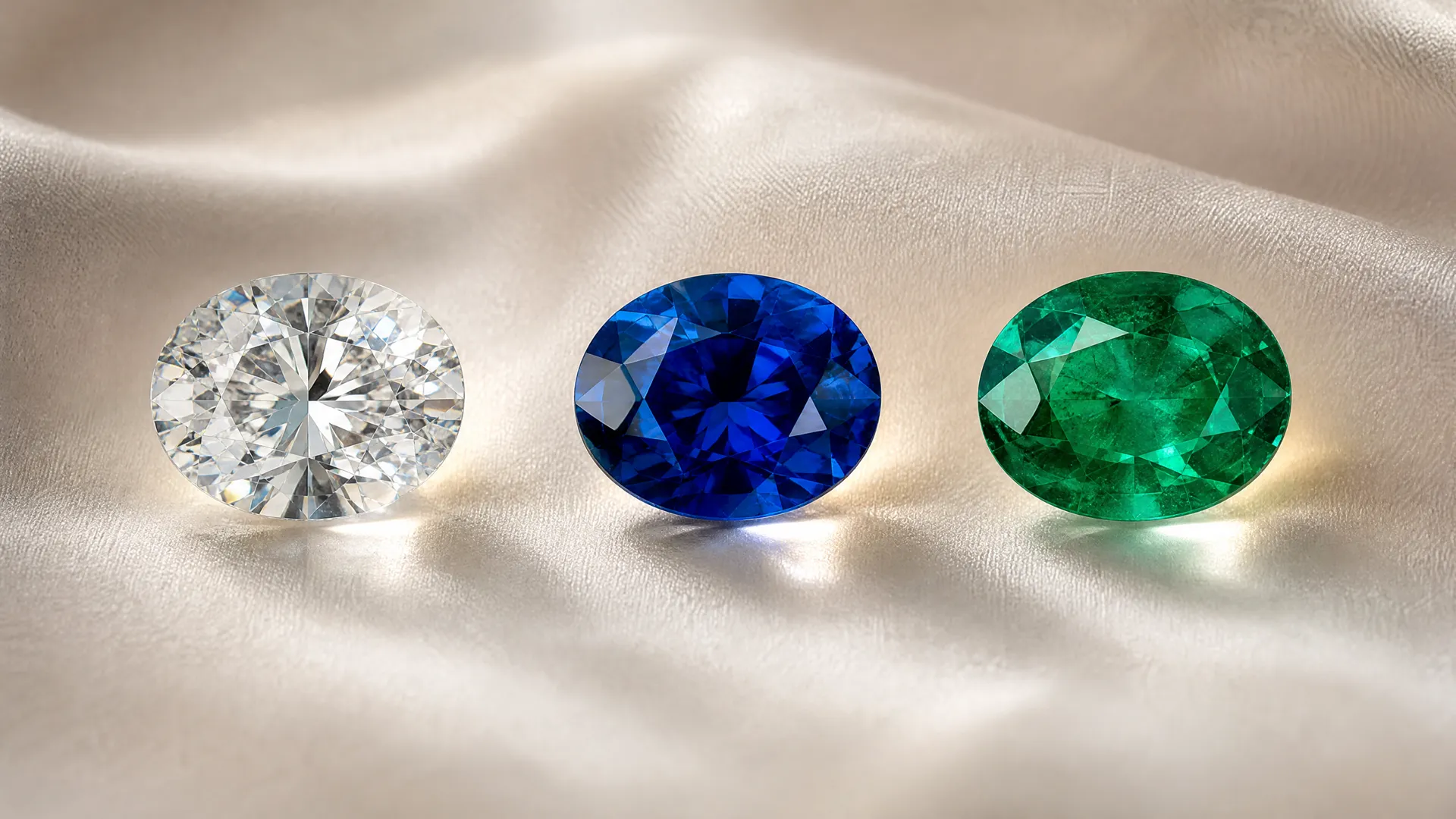
Moissanite's origin story is the best in jewelry: in 1893, Nobel-winning chemist Henri Moissan examined crystals from a meteor crater in Arizona and found a mineral new to science — silicon carbide, arriving from space. The gem world named it after him. Natural moissanite is so vanishingly rare that virtually every moissanite sold today is lab-grown silicon carbide, which is not a downgrade but the only supply that exists at scale.
Quick Answer: Why It Sparkles More Than Diamond
- **Fire (dispersion):** moissanite 0.104 vs diamond 0.044 — moissanite throws roughly **2.4x the rainbow flashes** - **Brilliance (refraction):** 2.65-2.69 vs diamond's 2.42 — more light returned per facet - **Hardness:** 9.25 on the Mohs scale — second only to diamond among gemstones, fully daily-wear - **Price:** typically a tenth of a comparable diamond
The look differs in one honest way: moissanite's extra fire reads slightly disco ball next to a diamond's whiter sparkle under direct sun — some prefer it, some notice it, most people at conversational distance cannot tell. Under restaurant and office lighting, moissanite's higher refraction simply reads as more sparkle. Color is graded separately: modern production achieves near-colorless grades that hold across the stone.
As a choice, moissanite answers three situations cleanly. Engagement-ring budgets that want maximum visual impact per dollar; ethical preferences for a stone with no mining footprint (it is created in furnaces, forever traceable); and travel/backup jewelry where losing the stone hurts the heart but not the savings. It pairs beautifully with sterling silver — the metal's cool white keeps the sparkle reading crisp — which is exactly the register our Starlight pavé collection works in: stones cut small and set dense so the sparkle multiplies.
The maintenance story is nearly perfect: 9.25 hardness means scratches are essentially a non-issue in daily life, and a soft brush with warm soapy water restores full fire. The one caution is shared by all set jewelry — protect the setting, not the stone. For how created stones are honestly disclosed on our listings, the about our materials page states the policy, and the full sparkle-per-dollar logic is laid out in best stone for jewelry.
Frequently asked.
Is moissanite a real gemstone or fake diamond?,
It is a real, distinct gemstone — silicon carbide — not a diamond simulant like cubic zirconia. Natural moissanite is astronomically rare (it arrived in meteors), so the commercial gem is lab-grown crystal of the same chemical composition. Calling it a fake diamond is like calling a ruby a fake sapphire: same family tree, different stone.
Does moissanite pass a diamond tester?,
Old thermal testers can be fooled because moissanite conducts heat similarly to diamond; modern testers check electrical conductivity too, and moissanite fails that channel — it is reliably distinguishable by any equipped jeweler. This is a feature, not a flaw: the stone has nothing to hide about what it is.
Will moissanite get cloudy or yellow over time?,
No. It is a single-crystal gem, not a coating or composite — there is nothing to cloud. Color-stable grades produced today stay that way; older or lower-grade stones could show warmth, which is a production-quality issue, not aging. Clean with warm soapy water and a soft brush.
Can moissanite be an engagement ring stone?,
Yes — it has become one of the most popular diamond alternatives for engagement rings, chosen for its higher sparkle, 9.25 hardness (daily-wear durable), ethical furnace origin, and roughly one-tenth the cost. The decision is aesthetic honesty: some buyers want diamond specifically, and that preference is legitimate too.
Which is harder, moissanite or sapphire?,
Moissanite. At 9.25 on the Mohs scale it sits between sapphire (9) and diamond (10) — harder than every conventional gemstone except diamond. In practice this means daily wear cannot scratch it; only a diamond or another moissanite can.
Related Articles
A Brief History of Birthstones
From the twelve tribes of Israel to the 1912 standard that rules the modern list — the 3,500-year origin story of why we wear our birth month.
Read MoreThe Ultimate Birthstone Cleaning Guide
Keep every piece in your collection gleaming. Step-by-step methods for gold, silver, and delicate birthstones — no harsh chemicals needed.
Read MoreBirthstone Energy: A Complete Crystal Healing Guide
From root chakra grounding to crown chakra clarity, discover how each birthstone carries healing energy. Learn to activate your crystal for meditation, sleep, and daily intention.
Read More