March Birthstone Jewelry: An Honest Aquamarine Guide
March birthstone jewelry is aquamarine — and it is routinely confused with blue topaz. The real difference, what you should pay, and why gentle is the right care word.
Yueounb Editorial
Gemologist
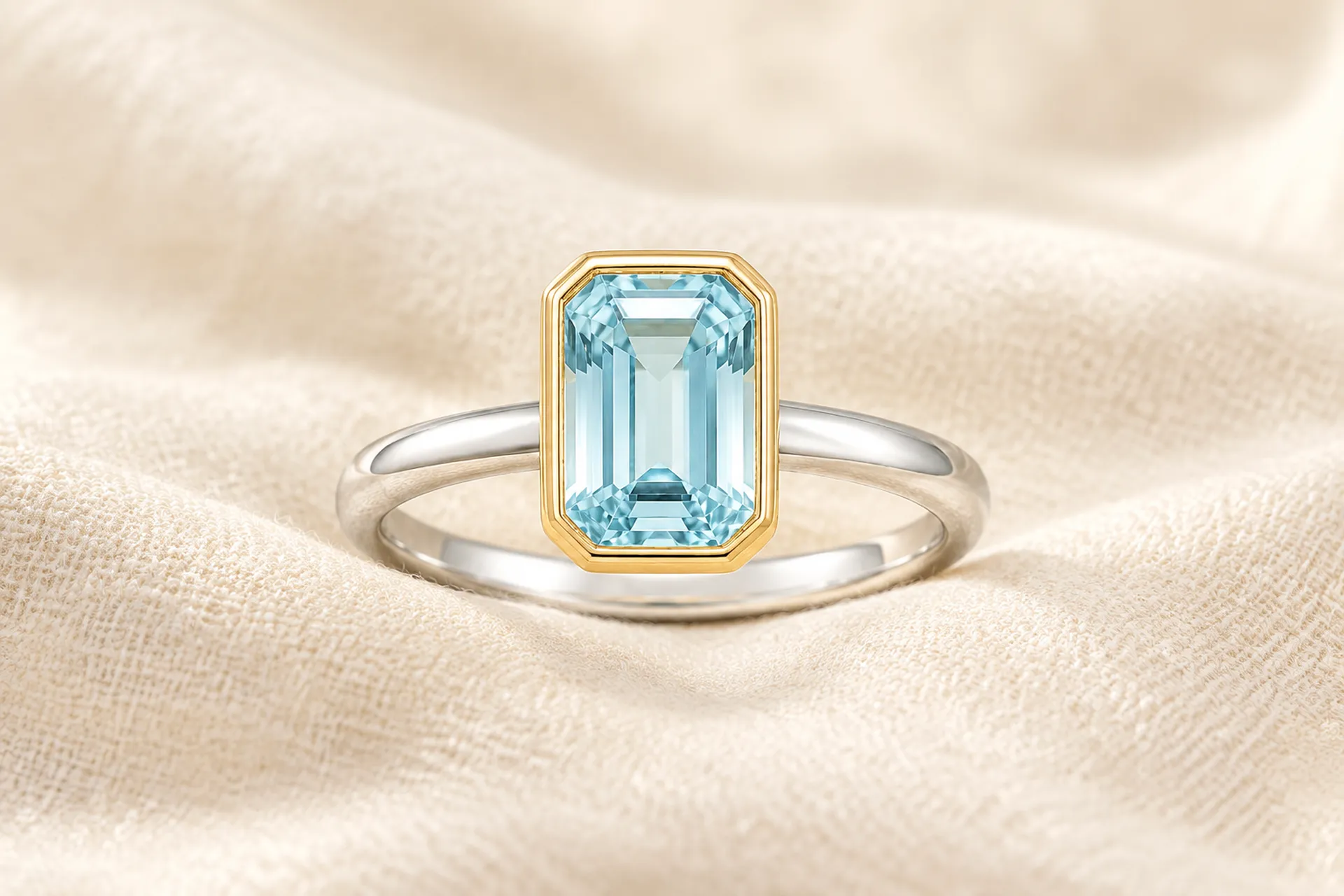
March birthstone jewelry is jewelry set with aquamarine, a blue-to-blue-green variety of the mineral beryl—the same mineral family as emerald and morganite. Aquamarine typically sells in pale-to-medium blue tones, ranks 7.5–8 on the Mohs scale, and is routinely heat-treated to remove greenish tints, a stable and widely accepted practice in the trade. Its most common look-alike, blue topaz, is usually darker, considerably cheaper, and almost always irradiated—a difference worth understanding before you spend gift money. the International Gem Society's Mohs chart orders both stones side by side
Quick Answer: March Birthstone Basics
| Question | Answer |
| --- | --- |
| What is March's birthstone? | Aquamarine, a blue variety of beryl (Be₃Al₂Si₆O₁₈) |
| How durable is it for daily wear? | Mohs 7.5–8, good hardness; tougher than many gems due to beryl's crystal structure, but avoid hard knocks and ultrasonic cleaners with fractures present |
| Is treatment common? | Yes—most gem-quality aquamarine is gently heated (roughly 400–carefully controlled heat treatment) to reduce green and intensify blue |
| Aquamarine vs. blue topaz? | Different minerals; topaz is typically more saturated blue, softer-feeling in price—often 5–10x cheaper per carat at comparable sizes |
What Is Aquamarine, Actually?
Aquamarine's name comes from the Latin aqua marina, "water of the sea," a name Roman writers were already applying to pale blue gems over two thousand years ago. The modern birthstone list formalized aquamarine as March's stone in 1912, when the American National Retail Jeweler's Association (later AGS) published the standard list that still largely governs the American market today. Before that, March's stone in older lists was sometimes bloodstone—a dark green jasper flecked with red—which is why you'll still occasionally see both mentioned.
Mineralogically, aquamarine is beryl colored by trace iron in its crystal structure (Fe²⁺ occupying aluminum sites, with Fe²⁺–Fe³⁺ charge transfer contributing the blue). This matters practically: because the color comes from iron substitution rather than inclusions or impurities you can see, aquamarine is almost always eye-clean. Unlike emerald—which is the same mineral but colored by chromium and famously fractured—inclusion-free aquamarine is the norm, not the exception. That means you can and should expect clarity when buying. aquamarine's species profile sits in GIA's Gem Encyclopedia
The color trade-off is real, though. Natural, unheated aquamarine frequently shows a greenish tint—this is simply what iron does at lower concentrations and lower oxidation states. The vivid pure-blue stones you see in retail settings are overwhelmingly heat-treated, and this is one of the most honest treatments in the industry: it's permanent, undetectable with standard lab equipment in most cases, and universally disclosed-or-accepted rather than concealed. GIA treats heat treatment in aquamarine as an assumed, stability-enhancing practice. You are not being cheated when you buy heated aquamarine; you are being cheated only if someone charges unheated-stone prices without documentation.
For the full monthly overview, see our March birthstone page.
Aquamarine or Blue Topaz — Which Should You Buy?
This is the single most consequential distinction for a March jewelry buyer, because blue topaz is routinely sold—sometimes innocently, sometimes not—as "looking just like aquamarine." The two can look superficially similar in photos, especially the lighter "Sky Blue" topaz grade. They are not the same thing, and the price gap is significant.
Different minerals, different durability profiles. Aquamarine is beryl (Mohs 7.5–8). Topaz is harder—Mohs 8—but hardness is not toughness, and this is a case where the mineralogy红线-worthy detail matters: topaz has a basal cleavage, meaning a single sharp blow in the right direction can split the stone cleanly in two. Aquamarine, like all beryl, lacks that pronounced cleavage plane. In practice, a topaz ring worn daily is more likely to break from a knock than an aquamarine ring, despite being harder. Any retailer telling you topaz is "more durable because it's harder" is telling you a half-truth.
Treatment difference. Natural blue topaz in commercial quantities barely exists. The blue topaz in nearly all retail jewelry—Sky Blue, Swiss Blue, London Blue—started as colorless or pale topaz that was irradiated (in nuclear facilities or linear accelerators) and then heated to produce the blue. This is legal, safe once released after decay monitoring, and permanent. But it means the color is entirely artificial in origin. Aquamarine's heat treatment merely refines a color the stone already has. If "how natural is this color?" matters to you or your recipient, the two treatments sit on very different points of that spectrum.
How to tell them apart visually. Blue topaz, especially Swiss and London Blue, is usually more saturated than aquamarine—darker, more electric. Aquamarine's signature is a watery, pastel, slightly greenish-leaning blue that topaz rarely mimics convincingly. London Blue topaz reads almost teal-gray. If a "March birthstone" stone is deeply, vividly blue at a suspiciously low price, it's almost certainly topaz. When in doubt, ask the seller directly; a reputable one will state the species without hesitation.
Price reality. At the time of writing, commercial-grade blue topaz in jewelry often retails at a small fraction of what comparable-size aquamarine commands. Large clean aquamarines (10+ carats) can reach four figures per stone in fine color; an equivalent London Blue topaz costs a small fraction of the price. Neither is "better"—topaz is a legitimate, attractive affordable option—but they should never be priced similarly.
Where Does the Money Go in Aquamarine?
Because aquamarine is abundant in large clean crystals, pricing follows color more than almost any other factor. A 2-carat stone with strong saturation can outprice a 5-carat washed-out one. Practical guidance:
- Prioritize tone and saturation over size. The commercial sweet spot is a medium blue sometimes labeled "Santa Maria" style (originally referring to the Santa Maria de Itabira mine in Brazil; note that "Santa Maria Africana" from Mozambique is a separate, looser designation now used in the trade). Brazilian stones historically set the benchmark; today Mozambique and Madagascar supply significant volumes. - Check for windowing. Pale aquamarine cut too shallow "windows"—you see through the stone rather than into it. A well-cut stone shows even color across the face. Tilt the piece under a light; if color flashes in zones and disappears elsewhere, the cut is cheating you. - Carat price steps are nonlinear. Fine aquamarine over 5 carats with strong color commands disproportionate premiums. For a gift under $300, a 1–2 carat stone in a thoughtful setting beats a big pale stone in a generic one. - Metals matter more than usual. Aquamarine's pastel color gains visible warmth or crispness from its mounting. Yellow gold pushes it toward vintage, slightly greener feel; white gold or platinum sharpens the blue. This is taste, not quality—but it changes how the same stone reads on the wrist.
For anniversary gifting contexts where blue stones come up, our anniversary gemstone guides cover how these stones fit longer-horizon gift traditions.
Why Is Gentle the Right Care Word?
Aquamarine is genuinely one of the easier gems to live with, but honest care advice runs on three factors, not one:
Hardness: 7.5–8 means it resists scratching from nearly everything in daily life except other gems (a diamond, sapphire, or topaz stored loose against it can scratch it). Store pieces separately.
Toughness: Good. Beryl has no strong cleavage, so aquamarine resists chipping reasonably well. However, stones with visible fractures or feather inclusions—less common but not impossible in aquamarine—are structurally weaker at those points.
Stability: Excellent for heat (the color won't fade from sunlight or normal wear; heat treatment is permanent). Vulnerable to nothing in ordinary life except hydrofluoric acid, which you will not encounter.
The practical care routine: warm water, mild dish soap, a soft toothbrush, and a pat dry. Skip ultrasonic cleaners if the stone has any visible fractures or if you don't know its inclusion situation—ultrasonic cavitation can extend existing fractures. Steam cleaning is likewise unnecessary for a stone this easy to clean by hand. Avoid having an aquamarine ring resized or repaired by a jeweler who won't remove the stone first; jeweler's torch heat far exceeds anything that affects worn jewelry, and thermal shock near inclusions is the realistic damage scenario.
One honest caution about the look-alike: blue topaz shares none of aquamarine's structural calm. Its cleavage means a hard knock on a countertop can split it. If you're choosing between the two for a ring worn daily, this durability nuance genuinely favors aquamarine.
A Buying Checklist You Can Use in Any Store
1. Ask the species by name: "Is this aquamarine or blue topaz?" Watch the answer's speed. 2. Ask about treatment. "Heat-treated" for aquamarine is normal and fine; be told, not surprised. 3. View the stone under daylight-equivalent light if possible—retail halogen flattens aquamarine's tone differences. 4. For rings: check that the stone sits protected in the setting (bezel or well-raised prongs), especially for daily-wear pieces. 5. Get the species and any treatments on the receipt or appraisal. This is standard practice and any seller who resists it is telling you something.
Frequently asked.
Is aquamarine a good stone for an everyday ring?
Yes, with framing. Aquamarine's Mohs hardness of 7.5–8 and beryl's good toughness make it suitable for daily wear in protective settings like bezels. It's more knock-resistant than blue topaz, which has strong cleavage. The main everyday risks are scratching from other gemstones during storage and thermal shock during jewelry repair—have the stone removed before any torch work. Clean with warm soapy water and a soft brush.
How can I tell aquamarine from blue topaz without equipment?
Color saturation is your best clue: aquamarine is characteristically pale-to-medium and slightly greenish-leaned, evoking seawater, while retail blue topaz (Swiss and London Blue grades) is typically darker and more electric. Price is a second signal—vivid blue "aquamarine" priced like costume jewelry is suspect. For certainty, a gemologist or a refractive index test distinguishes them instantly; the species should also appear on any receipt from a reputable seller.
Is heat-treated aquamarine less valuable?
Marginally at most, and often not at all in retail contexts. Gentle heating to reduce greenish tints is standard, permanent, and accepted across the trade—GIA treats it as an assumed practice for commercial aquamarine. Unheated stones with naturally fine blue color can carry collector premiums, but only with lab documentation. For gift purchases, heat treatment should not be a concern; non-disclosure would be.
What does "Santa Maria" aquamarine mean?
Originally, it named intense blue aquamarine from the Santa Maria de Itabira mine in Minas Gerais, Brazil—the historical benchmark color. The term is now used loosely in the trade, including "Santa Maria Africana" for comparable-color stones from Mozambique, and it is not a protected or consistently verified grade. Treat it as a color description rather than a guarantee of origin, and judge the stone's actual tone and saturation yourself.
Related Articles
A Brief History of Birthstones
From the twelve tribes of Israel to the 1912 standard that rules the modern list — the 3,500-year origin story of why we wear our birth month.
Read MoreThe Ultimate Birthstone Cleaning Guide
Keep every piece in your collection gleaming. Step-by-step methods for gold, silver, and delicate birthstones — no harsh chemicals needed.
Read MoreBirthstone Energy: A Complete Crystal Healing Guide
From root chakra grounding to crown chakra clarity, discover how each birthstone carries healing energy. Learn to activate your crystal for meditation, sleep, and daily intention.
Read More