40th Anniversary Ruby Gifts: A Practical Guide
The 40th anniversary is the ruby anniversary, and ruby's red is the whole point. Color grades, treatment questions, budget tiers, and honest alternatives.
Yueounb Editorial
Gemologist
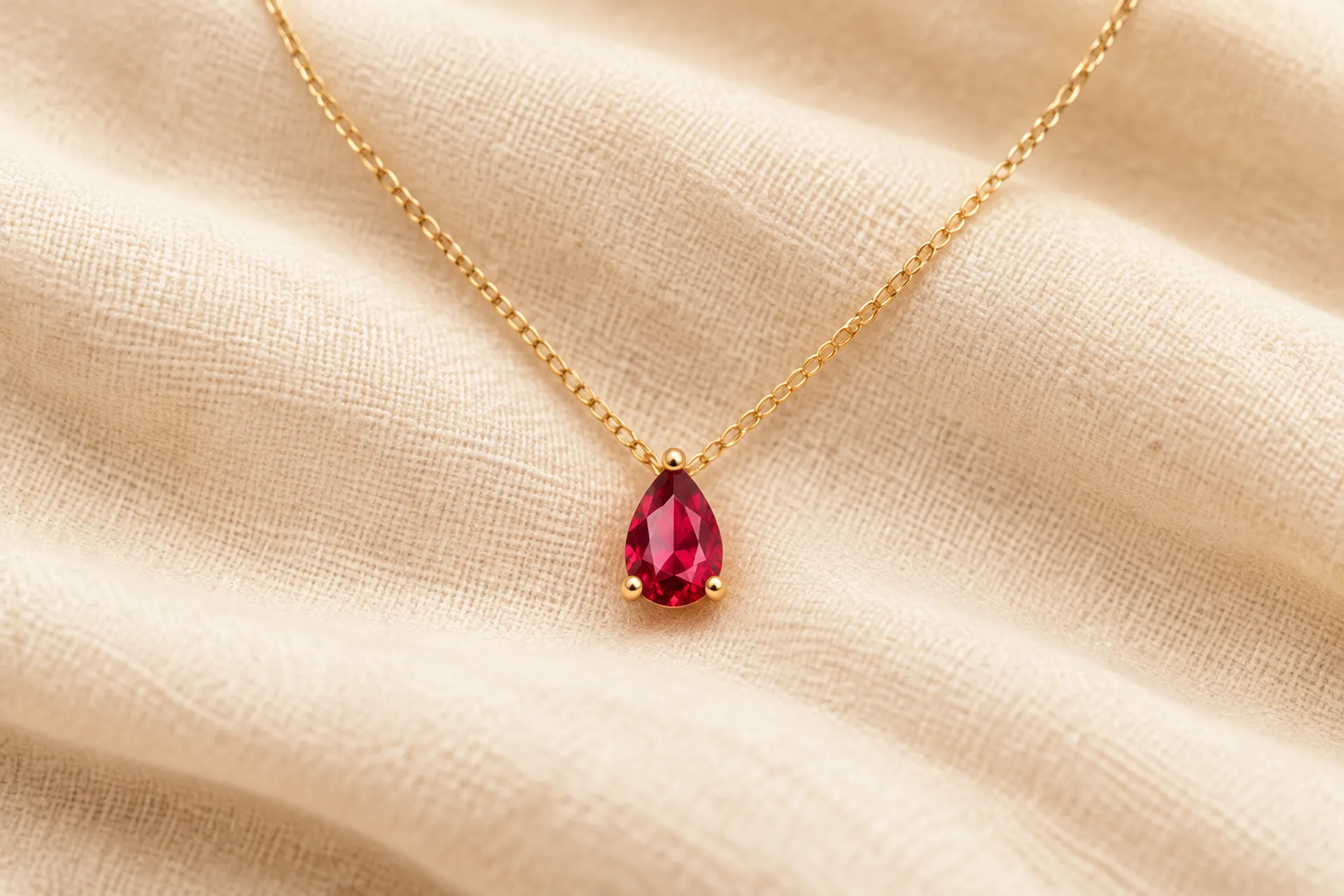
The 40th anniversary is the ruby anniversary, and ruby's red is the point of the gift: a saturated, fluorescent red that no other gem reproduces. But prices span an enormous range — a 1-carat heat-treated ruby of good commercial quality may run a few hundred dollars per carat, while fine unheated Burmese material at auction has reached seven figures per carat by lot and year]. This guide breaks down what actually drives ruby value (color grade first, then clarity, treatment, and origin), how to match a ruby gift to a realistic budget tier, and which alternative stones — from garnet to spinel to lab-grown ruby — let you honor the ruby theme honestly when a natural fine ruby isn't in range. GIA's Gem Encyclopedia documents heat-treatment norms for ruby
Quick Answer: 40th Anniversary Ruby Gifts at a Glance
| Question | Short Answer |
| --- | --- |
| What gem is the 40th anniversary? | Ruby — ruby has been the traditional 40th anniversary gem in American lists for decades, and it's one of the few milestone stones fixed across modern gift lists. |
| What color ruby should I buy? | Medium-dark to dark red with strong saturation; avoid overly dark "garnet-like" stones and pinkish low-saturation stones unless budget forces a trade-off. |
| What's the treatment disclosure to look for? | Ask specifically whether the stone is unheated, heat-only, or glass-filled/fracture-filled. Glass-filled rubies are a separate, much cheaper product and must be disclosed. |
| What if ruby is out of budget? | Red spinel and rhodolite/pyrope garnet are natural, untreated, and durable alternatives; lab-grown ruby is chemically identical and honest if disclosed. |
Why Is Ruby the 40th Anniversary Stone?
Ruby and sapphire are the same mineral: corundum, aluminum oxide (Al₂O₃), at 9 on the Mohs scale — second only to diamond in hardness. What makes ruby red is trace chromium substituting for aluminum in the crystal lattice. That chromium does something almost unique in the gem world: it makes the stone fluoresce red under ultraviolet light, including daylight. Fine rubies literally glow. This fluorescence is why top Burmese rubies are described as "pigeon's blood" — the term refers to a vivid red with a slightly warm, glowing quality, not a dark maroon. the International Gem Society's Mohs chart places ruby second only to diamond
This matters for a 40th anniversary gift specifically because the buyer is usually choosing one meaningful stone, not building a wardrobe. The glow is the visual payoff of four decades. A stone that reads as a flat, dark red under a jewelry counter's warm lights may look lifeless in daylight — and counter lighting is deliberately chosen to flatter. Ask to see the stone under both warm and white/neutral light, and ideally near a window.
One honest caveat on durability: hardness is not toughness. Corundum has no cleavage direction, which makes it genuinely tough, and it's stable to normal heat and chemicals — a genuinely excellent choice for a daily-wear ring, which many 40th anniversary gifts become. What it isn't, is scratch-proof; a ruby worn in the same hand as a diamond ring will eventually show wear at the facet junctions.
Which Ruby Color Grade Matters Most?
With diamond, buyers learn the 4Cs. With ruby, one C dominates: color. GIA grades colored stones along three axes — hue, tone, saturation — and in ruby, saturation and tone together account for most of the price separation between stones of equal size.
- Hue: You want red, ideally pure red to slightly purplish-red. Stones that lean orange (often Thai/Cambodian material) or strongly purple read as less "ruby-like" even when technically ruby. - Tone: Medium to medium-dark. Too light and it reads pink sapphire (which is cheaper, per carat, than ruby of comparable quality); too dark and the stone goes dead, absorbing light instead of returning it. - Saturation: This is the glow factor. Vivid, strong saturation at medium-dark tone is the sweet spot.
Size interacts with tone in a way many first-time buyers miss: a larger ruby holds more color depth, so a 3-carat stone often looks better at medium-dark tone than a 1-carat stone at the same tone, which can go dark. Conversely, small rubies need strong saturation to read as red at all — a 0.75-carat ruby in a pendant needs to be a genuinely vivid stone or it will look like a dark dot.
Clarity matters less than in diamond. Rubies almost never form eye-clean; minute silk (rutile needles) and small crystals are expected and, in moderate amounts, actually confirm natural origin. What you avoid is heavy silk that milks out the color, or eye-visible fractures that threaten durability.
What Should You Ask About Treatments?
This is where ruby buying punishes the unprepared. Treatment disclosure falls into roughly three tiers, and the price gaps between them are enormous:
1. Unheated (natural, untreated). The premium tier. Heat is so ubiquitous in ruby that stones certified as unheated by a major lab (GIA, Gübelin, SSEF) command steep premiums — often multiples of an equivalent heated stone. For a landmark 40th gift where budget allows, this is the collector's choice, but it is not a requirement for a beautiful gift. 2. Heat-only, no residue. The honest mainstream. Traditional heat treatment has been used on corundum for centuries and is stable and permanent; an honest retailer states "heat treated" plainly. Most fine ruby on the market, at most price points, is heated. There is nothing wrong with gifting a heated ruby — just as there's nothing wrong with gifting a heat-treated aquamarine or sapphire. 3. Glass-filled / fracture-filled (lead-glass). This is a different product category, not a treatment grade. Low-grade ruby rough is filled with high-refractive-index glass to seal fractures and improve apparent clarity. It can look striking at first but is damaged by everyday jewelers' tools, acids (even lemon juice in a kitchen), and ultrasonic cleaning. It must be disclosed, and it is sold at a tiny fraction of natural ruby prices. For a 40th anniversary piece meant to be worn and passed down, it's the wrong choice regardless of how attractive the price is.
The single best protection for any ruby purchase over a few hundred dollars: an independent lab report. GIA, Gübelin, and SSEF reports state treatment status; many also state geographic origin (Burmese origin adds premium; origin claims without a lab report are marketing, not fact). If a listing says "lab certified," check which lab — a report from a well-known international lab and one from an unknown local lab are not equivalent.
What Does Ruby Actually Cost at Each Tier?
Honest bracketing, using heat-treated natural ruby as the baseline (prices fluctuate; verify current market before publishing specific figures):
- Under $500–1,000. Small (under ~1 ct total) heat-treated rubies, often in clusters or with diamond accents. Can be genuinely pretty; color will be commercial grade, not vivid. This tier works best in pendants and cluster rings where design carries the piece. Rhodolite garnet and red spinel shine here as alternates. - $1,000–5,000. A 1–2 ct heat-treated ruby with good — not top — color, in a well-made gold setting. This is where most real 40th anniversary gifts land, and it's a defensible, wearable tier. - $5,000–25,000+. 2–4 ct heated stones approaching fine color, or smaller unheated stones with reports. Strong collector-adjacent territory. - Above that. Unheated, top-color, Burmese-origin stones with major-lab reports; this is the auction stratosphere. For most buyers, diminishing returns set in unless treatment status and origin are certified.
- Trade carat weight for color. A 1.2-carat vivid stone beats a 2.5-carat dark one in every photograph and in every room. For a 40th, "it glows" beats "it's big." - Consider the setting. Yellow gold warms up a slightly orange-leaning ruby; a bezel or halo adds apparent size and protects the girdle on a daily-wear ring.
What If Ruby Is Not in the Budget?
If natural fine ruby doesn't fit the budget, you can still give "red" with integrity. Ranked:
1. Red spinel. The connoisseur's answer. Historically confused with ruby (famous "rubies" in royal collections turned out to be spinel — the Black Prince's Ruby in the British Crown Jewels is spinel). Mohs 8, no cleavage, typically untreated, and at fine sizes it costs a fraction of equivalent-looking ruby. It doesn't fluoresce as strongly, so it lacks the glow, but its red is clean and true. 2. Rhodolite / pyrope garnet. Mohs 7–7.5, virtually always untreated, and dramatically cheaper. Rhodolite's raspberry-red is beautiful in its own right; just present it as garnet, never as a "ruby substitute" to the recipient without saying so. 3. Lab-grown ruby. Chemically identical corundum, made by flame-fusion or flux methods, fluorescent like natural ruby, at a small fraction of the price. It is a completely legitimate 40th gift if disclosed as lab-grown — and for a couple that values ethics, sustainability, or simply the look over the rarity, it's arguably the most rational choice. What it isn't, is rare; don't let a listing blur the line. 4. Rubellite tourmaline. Vivid red-pink, Mohs 7–7.5, but often heavily included and more brittle than it sounds — better for pendants than daily rings.
A note on the gem that gets suggested too often: red glass "synthetic ruby" simulants and dyed quartz sold as ruby are neither alternatives nor honest. Anything described as "ruby glass," "created ruby" without process disclosure, or priced at a few dollars per carat with ruby branding is a simulant. Skip.
Practical Buying Checklist for a 40th Anniversary Ruby
1. Buy the color in person or via high-resolution video under at least two lighting conditions, including daylight-equivalent light. 2. Ask the treatment question verbatim: "Is this stone unheated, heat-treated, or glass-filled — and is that stated on a report, and by which lab?" 3. Prefer medium-dark, vivid saturation over size at any budget tier. 4. For a daily-wear ring: corundum's toughness and stability make it suitable; still remove it for heavy gardening or gym work, and skip ultrasonic cleaners on any stone with visible fractures. 5. Set the expectation with the recipient if it's lab-grown or an alternative stone — a 40th anniversary gift built on accurate disclosure will age far better than a blurry one.
For the full milestone context and how ruby sits among the other major anniversary gems, see our 40th anniversary ruby guide; if your ruby anniversary falls near a birthday, our July birthstone page covers ruby's birthstone role in more depth.
Frequently asked.
Is a heat-treated ruby acceptable for a 40th anniversary gift?
Yes — completely. Heat treatment of ruby is centuries old, permanent, and stable, and the great majority of fine natural ruby on the market is heated. Only glass-filled ruby, a separate low-grade product, should be avoided for a keepsake piece. Unheated ruby carries a collector's premium but isn't a requirement for a meaningful gift.
How much should I spend on a 40th anniversary ruby?
There's no rule, but honest tiers exist: under $1,000 buys small heated rubies or cluster designs; $1,000–5,000 buys a 1–2 carat heated ruby with good color in a solid gold setting. Prioritize vivid, medium-dark color over carat weight — a glowing smaller stone photographs and wears better than a large dark one.
What's the best alternative to ruby for a ruby anniversary?
Red spinel is the strongest answer: Mohs 8, typically untreated, historically mistaken for ruby in royal jewelry, and far less expensive at fine sizes. Rhodolite garnet is a budget natural option, and lab-grown ruby — clearly disclosed — is chemically identical corundum with the same red fluorescence.
Does ruby last for everyday wear?
Yes, with normal care. Ruby is corundum (Mohs 9) with no cleavage, good toughness, and stability to heat and household chemicals — well-suited to a daily-wear ring. It isn't scratch-proof, though: remove it for abrasive activities, and avoid ultrasonic cleaning if the stone has visible fractures.
Related Articles
A Brief History of Birthstones
From the twelve tribes of Israel to the 1912 standard that rules the modern list — the 3,500-year origin story of why we wear our birth month.
Read MoreThe Ultimate Birthstone Cleaning Guide
Keep every piece in your collection gleaming. Step-by-step methods for gold, silver, and delicate birthstones — no harsh chemicals needed.
Read MoreBirthstone Energy: A Complete Crystal Healing Guide
From root chakra grounding to crown chakra clarity, discover how each birthstone carries healing energy. Learn to activate your crystal for meditation, sleep, and daily intention.
Read More