Chakra Stones: Which Birthstones Balance Each Energy Center
Every chakra has natural birthstone matches by color — garnet and ruby for the root, aquamarine for the throat, amethyst for the crown.
Yueounb Editorial
Jewelry Expert
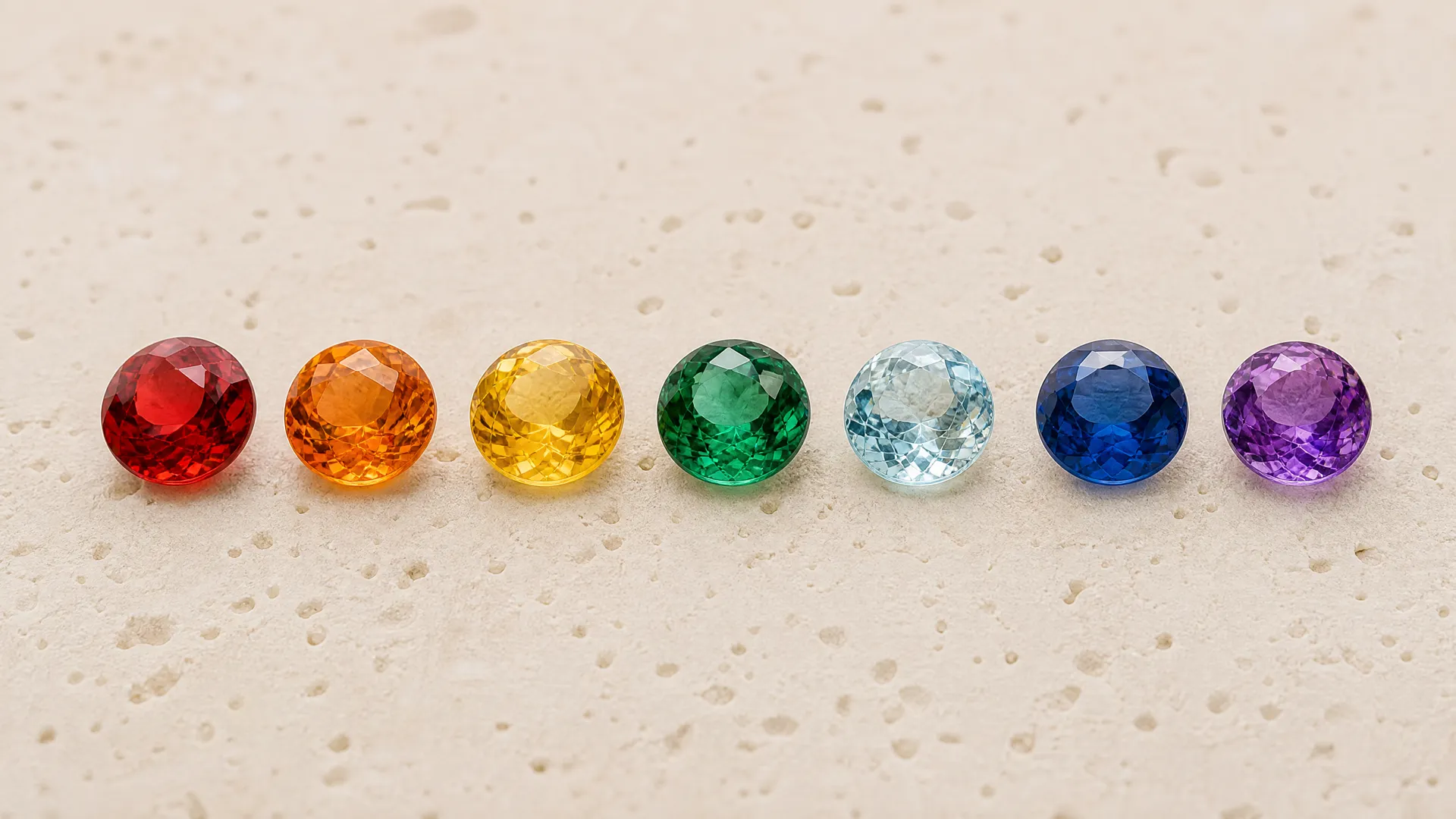
Chakra stones are gemstones matched to the seven energy centers of the body by color — and because birthstones already run the full color spectrum across twelve months, every chakra has natural birthstone matches. Root chakra red stones pair with January garnet and July ruby; the throat chakra pairs with March aquamarine and December turquoise; the crown pairs with February amethyst and June moonstone.
| Chakra | Location | Color | Birthstone matches |
| Root | Base of spine | Red | January garnet, July ruby |
| Sacral | Lower abdomen | Orange | November citrine (golden-orange) |
| Solar plexus | Upper abdomen | Yellow | November citrine, August peridot |
| Heart | Center chest | Green / pink | May emerald, October opal (pink flash) |
| Throat | Throat | Blue | March aquamarine, December turquoise |
| Third eye | Forehead | Indigo | September sapphire, February amethyst |
| Crown | Top of head | Violet / white | February amethyst, June moonstone, April diamond white |
The mapping logic is color sympathy — the oldest rule in lapidary tradition, older than the chakra system itself: red stones for blood and ground, blue for voice and calm, violet for the head and intuition. Indian tantric texts formalized the seven-chakra model between roughly 1500 and 500 BCE; Western crystal practitioners borrowed the color coding in the twentieth century. Neither tradition is clinically verified medicine — the honest frame is three thousand years of symbolic practice, worn because meaning is real even when energy fields are not.
How practitioners actually use the pairings. Meditation: the stone is held or placed at the chakra location — amethyst at the third eye is the classic meditation setup. Wearing: a pendant sits naturally at the heart and throat stones, which is why necklaces are the default chakra jewelry; earrings sit near the head centers. Layout: the full seven-stone session places one matched stone at each center, root to crown.
Your birth month gives you a head start. Everyone birthstone already belongs to one or two chakras, so the first chakra stone needs no buying — it is the one you may already wear. February babies hold a dual passport (third eye and crown); September babies hold the throat and the third eye; March and December babies share the throat. From there, add by what feels unbalanced rather than by completeness: the tradition adds stones for a need, never for a set.
Choosing real stones for chakra work: color depth beats size, because the tradition reads color as the active property — a saturated small garnet serves the root better than a pale large one. Check for dyes (bright fuchsia and neon blue do not occur naturally), and prefer matte or tumbled stones for holding in meditation, polished or set stones for wearing. Every birthstone above is available as both.
A closing honesty note, because this topic attracts both believers and debunkers: no peer-reviewed study demonstrates chakras as physical structures or stones as energy medicine. What is documented is the attention effect — a stone worn as an intention anchor works the way any mindfulness object works. Wear the tradition knowingly and it delivers everything it ever promised.
Frequently asked.
Which birthstones work on which chakras?
By color: root takes garnet and ruby; sacral and solar plexus take citrine and peridot; heart takes emerald; throat takes aquamarine and turquoise; third eye takes sapphire and amethyst; crown takes amethyst, moonstone and diamond white.
What is my chakra stone if I was born in February?
Amethyst — and it is a dual passport: violet reads for both the third eye and the crown. February babies get the classic meditation stone as their birthstone automatically.
Are chakra stones scientifically proven?
No — chakras are not demonstrated physical structures and no study shows stones emitting balancing energy. The documented benefit is attention and ritual: a stone used as an intention anchor works like any mindfulness object, which is how the tradition has used it for millennia.
Related Articles
A Brief History of Birthstones
From the twelve tribes of Israel to the 1912 standard that rules the modern list — the 3,500-year origin story of why we wear our birth month.
Read MoreThe Ultimate Birthstone Cleaning Guide
Keep every piece in your collection gleaming. Step-by-step methods for gold, silver, and delicate birthstones — no harsh chemicals needed.
Read MoreBirthstone Energy: A Complete Crystal Healing Guide
From root chakra grounding to crown chakra clarity, discover how each birthstone carries healing energy. Learn to activate your crystal for meditation, sleep, and daily intention.
Read More