Major Arcana · Card XI · Libra · Air
Justice Tarot Card Meaning
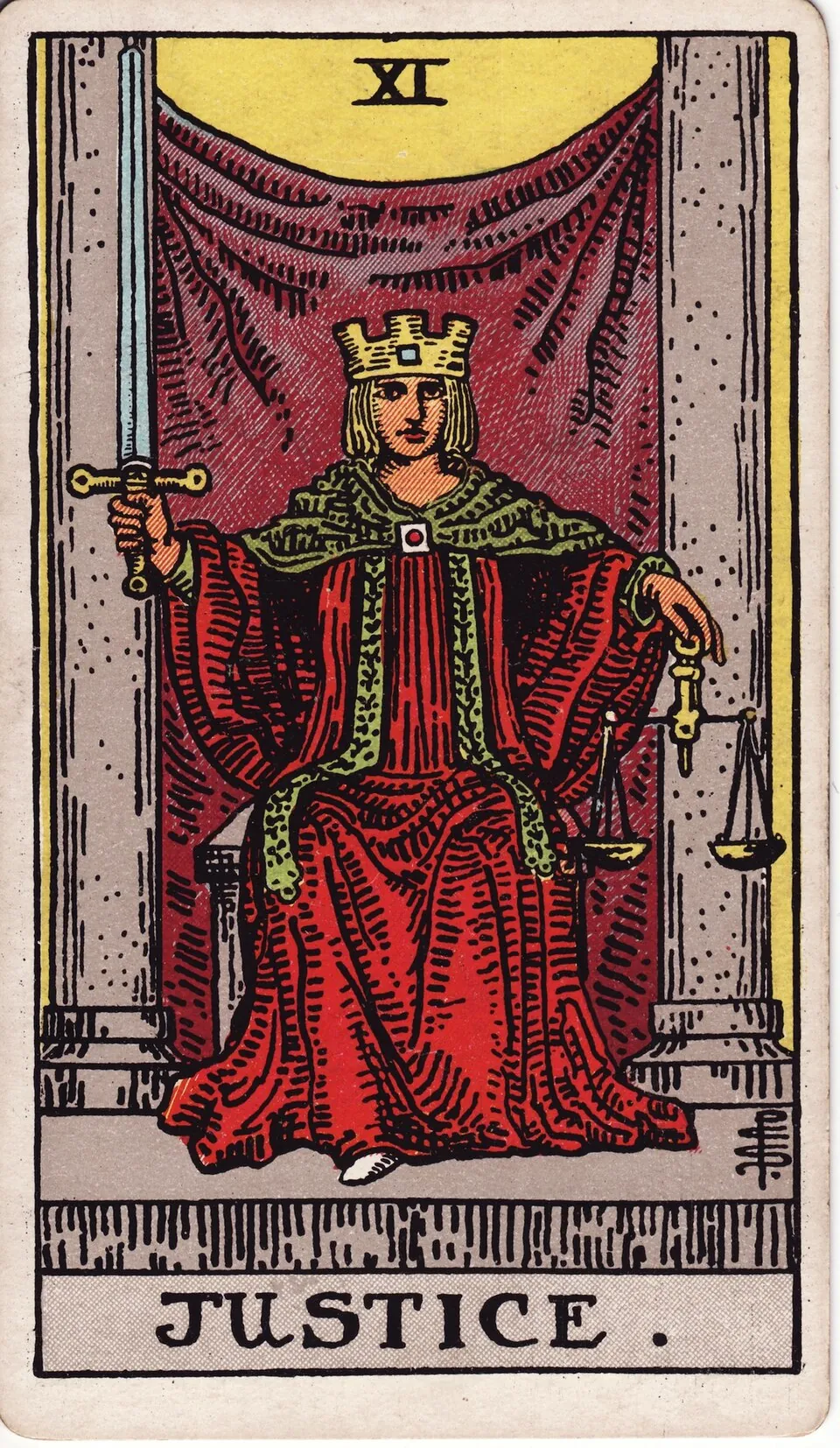
Justice is card eleven of the Rider–Waite Major Arcana. It means fairness, truth and consequence — a crowned figure between two pillars, scales in the left hand, sword raised in the right. Upright, the truth is surfacing and the balance is being set right; reversed, bias or avoided accountability is tilting the scales.
Last updated: 2026-08-25 · Rider–Waite tradition
Justice Keywords
Upright
- ✦ Fairness
- ✦ Truth
- ✦ Consequence
- ✦ Accountability
- ✦ Clear judgment
Reversed
- ✧ Bias
- ✧ Dishonesty
- ✧ Avoided accountability
- ✧ Unfairness
- ✧ Self-deception
Justice Upright Meaning
Between the same pillars the High Priestess veils, Justice sits in the open: crown, red robe, a green shoe just visible at the hem, scales steady in the left hand and a double-edged sword raised in the right. Everything about her posture is administration — this is not vengeance, it is bookkeeping. The sword points up (truth first) and is double-edged (it cuts both plaintiffs). The scales weigh. Justice is the deck's promise that accounts, eventually, get audited.
Drawn upright, the situation is coming to its honest weight: the truth surfacing, the decision that must simply be made, the settlement, the verdict, the reckoning deferred until now. The card reads legal matters literally and everything else structurally — fairness restored, consequences arriving on schedule, and your own judgment asked for in its clearest form. Her quiet instruction is in the hands: weigh before you cut. People who draw Justice are usually being asked to be just — to see the whole ledger, including their own line on it.
Justice Reversed Meaning
Reversed, the scales tilt — and the card wastes no sentiment on whose thumb is on them. Someone is being unfair: bias, favoritism, the story told with a thumb on the fact. In legal and contractual matters, the reversal counsels documentation and a second opinion; something in the paperwork has a slant.
The more intimate reversal is internal: the account you are refusing to audit. The apology owed, the receipt unpaid, the self-narrative that has been running on creative bookkeeping. Reversed Justice in personal readings is almost always one specific honest sentence away from turning upright — and the sword, note, is double-edged: the truth cuts free both parties.
Justice in Love & As Feelings
In love, Justice reads the relationship as a two-party ledger: is the care balanced, are the terms honest, does the story both of you tell match? Upright, it blesses the fair bond and prescribes direct dealing — the conversation where both scales are on the table. It is a strong card for formalizing: vows, terms, the defined thing.
Reversed in love, someone's thumb is on the scale — unequal effort dressed as equal, or a truth being managed. The card's counsel is not accusatory; it is forensic: audit gently, name what weighs what, and let the fair settlement (which may be repair, may be release) follow the facts.
Justice as feelings
As feelings, Justice reads as principled regard — the person feels about you in a way that includes their conscience. They want the fair version: you treated right, the truth told, the ledger clean. This makes for remarkably trustworthy feeling, if slightly unromantic phrasing — they will say "that's not fair to you" before they say "I miss you," and mean both. The reversal is the same conscience compromised: feeling that is arguing with its own evidence. Watch for the tell — people being unfair to themselves on your behalf are one honesty away from either direction.
Justice: Yes or No?
YesJustice is a yes when the truth is on your side — proceed, and proceed transparently: the card rewards the honest party. It is a no, firmly, for questions involving shortcuts, spin or avoided accountability. For legal and verdict questions specifically, it is the deck's most literal card: the fair outcome is the likely one.
Frequently Asked Questions
What does the Justice card mean in a reading?
Fairness and consequence — truth surfacing, accounts being balanced, clear judgment called for. It is the deck's most literal card for legal matters and its sternest friend for honesty.
What does a reversed Justice card mean?
Bias or dishonesty somewhere in the scales — someone being unfair, or your own accountability being deferred. One specific honest sentence usually turns it upright.
Why did Rider–Waite swap Justice and Strength?
Golden Dawn tradition placed Strength at eight and Justice at eleven, and Rider–Waite followed. Older decks (like Tarot de Marseille) number Justice eight. Same archetypes; different shelving — readers treat the swap as trivia, not doctrine.
Justice · ruled by Libra · Libra
The Stones of Justice
Justice weighs with clear eyes, and Libra’s stones are the scales’ materials. Sapphire cools bias out of judgment — it sits on scholars’ fingers for that reason; opal holds every color at once, seeing all sides before cutting. Balance worn, not just performed.
Curious what your own birth month says about you? Read the Libra zodiac stone story or explore the zodiac crystal kit.
Draw Justice in a free reading
Meanings come alive in context. Ask a real question and let the full 78-card Rider–Waite deck answer — free, no sign-up, one reading a day.