Chakra Bracelets: Seven Stones, Honest Claims
Chakra bracelets stack seven colored stones up the body energy map. What the tradition actually says, what stones cannot do, and wearing one without pretending.
Yueounb Editorial
Cultural Historian
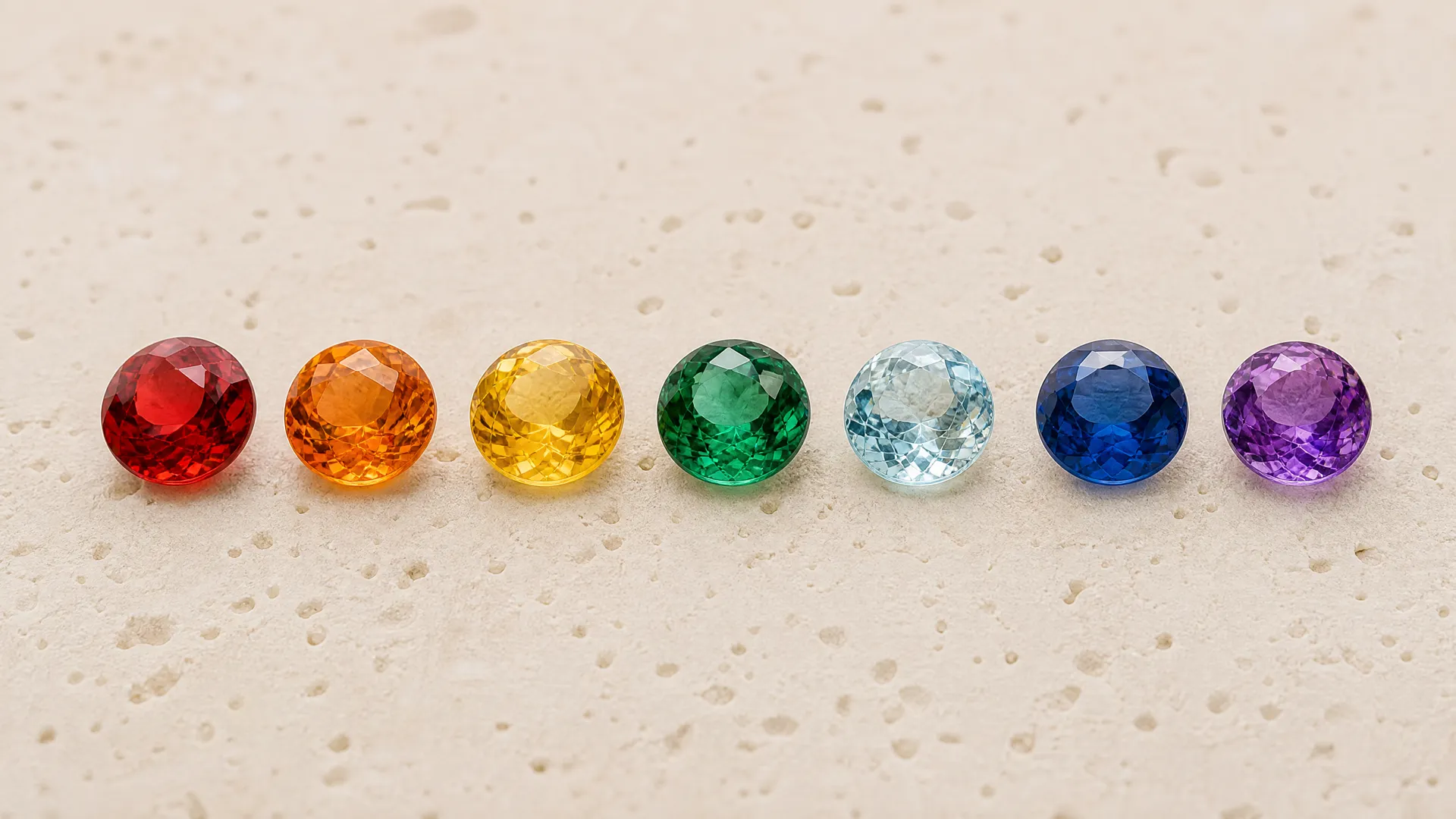
A chakra bracelet is a wearable map: seven stones, seven colors, seven centers running up the body from the base of the spine to the crown of the head, borrowed from Indian energetic traditions that mapped subtle anatomy millennia ago. The bracelet format is thoroughly modern — the tradition described meditation on the centers, not bracelets — but the object inherits the map honestly: each stone placed in sequence, red to violet, root to crown.
Quick Answer: The Seven Positions - **Root (red):** garnet or red jasper — grounding, stability, the foundation claim - **Sacral (orange):** carnelian or orange calcite — creativity and movement - **Solar plexus (yellow):** citrine or tiger eye — confidence, agency - **Heart (green):** green aventurine or green diopside — the bridge center, connection - **Throat (blue):** blue lace agate or aquamarine — expression - **Third eye (indigo):** lapis or sodalite — intuition, pattern-seeing - **Crown (violet/white):** amethyst or clear quartz — the top of the map
The honest-claims boundary, stated plainly because this category attracts the wildest marketing: the tradition describes these as meditation focal points — where attention goes during practice. No stone heals organs, treats disease, or physically changes energy fields; anyone selling a bracelet as medicine is selling false hope, and that includes sellers with the best intentions. What a seven-stone bracelet honestly carries: a mnemonic map of a contemplative framework, worn where you see it — a wearable reminder of an intention, exactly like a knot in a string, with better colors.
The design logic is genuinely good jewelry: seven colors in sequence is a gradient done by geology, and the map structure means every stone has a reason to be exactly where it is — no design slack. As an entry to stone jewelry it also teaches the palette: wearers learn which colors they actually reach for, and the single-stone pieces they buy afterward (birthstones included) follow from that. The sequence pairs naturally with month stones — the violet end of the chakra map is February amethyst territory, the red end is January garnet.
Wearing and gifting grammar: chakra bracelets are bought at thresholds — new jobs, new practices, recoveries — because they read as intention objects rather than decoration. Given, they say the giver noticed a person working on something. Our triple protection bracelet is the three-stone cousin of the same intention tradition, amethyst bracelet carries the crown-stone color in collector grade, and the month-stone system it overlaps with runs through the birthstones hub.
Frequently asked.
What are the seven stones in a chakra bracelet?
Seven stones in the body-map sequence, red to violet: root (red — garnet or red jasper), sacral (orange — carnelian), solar plexus (yellow — citrine or tiger eye), heart (green — aventurine), throat (blue — blue lace agate), third eye (indigo — lapis or sodalite), crown (violet or white — amethyst or clear quartz). Each position corresponds to a center in the traditional map.
Do chakra bracelets actually do anything?
Honest answer: they are wearable reminders, not medicine. The tradition describes the seven centers as meditation focal points; a bracelet carrying the map serves as a visible cue to an intention — like a knot in a string with better colors. No stone heals organs or treats disease, and any seller claiming otherwise is selling false hope. As intention objects and jewelry, they work; as therapy, they do not.
Which wrist should you wear a chakra bracelet on?
The tradition is silent on bracelets — it described meditation, not wearing — so practical answers rule: the non-dominant wrist takes less knocking and keeps the seven-stone strand intact longer. Right-hand wearers report the left placement as the receiving-hand convention borrowed from other bead traditions; either wrist is honest, consistency matters more than side.
Can a chakra bracelet be given as a gift?
It is one of the best threshold gifts — new practice, new job, recovery — because it reads as noticing a person working on something rather than as generic decoration. One sentence with the gift about which stone or center you chose them for converts the bracelet from ornament to message. Avoid gifting it as a health intervention; gift it as an intention companion.
How do chakra bracelets relate to birthstones?
They are parallel maps that share stones: the crown violet is amethyst — February birthstone; the root red is garnet — January. The chakra map is a body sequence; the birthstone map is a calendar month. A wearer can graduate from the seven-stone map to the single month stone that meant the most position — the bracelet becomes the palette lesson, the birthstone becomes the signature.
Related Articles
A Brief History of Birthstones
From the twelve tribes of Israel to the 1912 standard that rules the modern list — the 3,500-year origin story of why we wear our birth month.
Read MoreThe Ultimate Birthstone Cleaning Guide
Keep every piece in your collection gleaming. Step-by-step methods for gold, silver, and delicate birthstones — no harsh chemicals needed.
Read MoreBirthstone Energy: A Complete Crystal Healing Guide
From root chakra grounding to crown chakra clarity, discover how each birthstone carries healing energy. Learn to activate your crystal for meditation, sleep, and daily intention.
Read More