Major Arcana · Card V · Taurus · Earth
The Hierophant Tarot Card Meaning
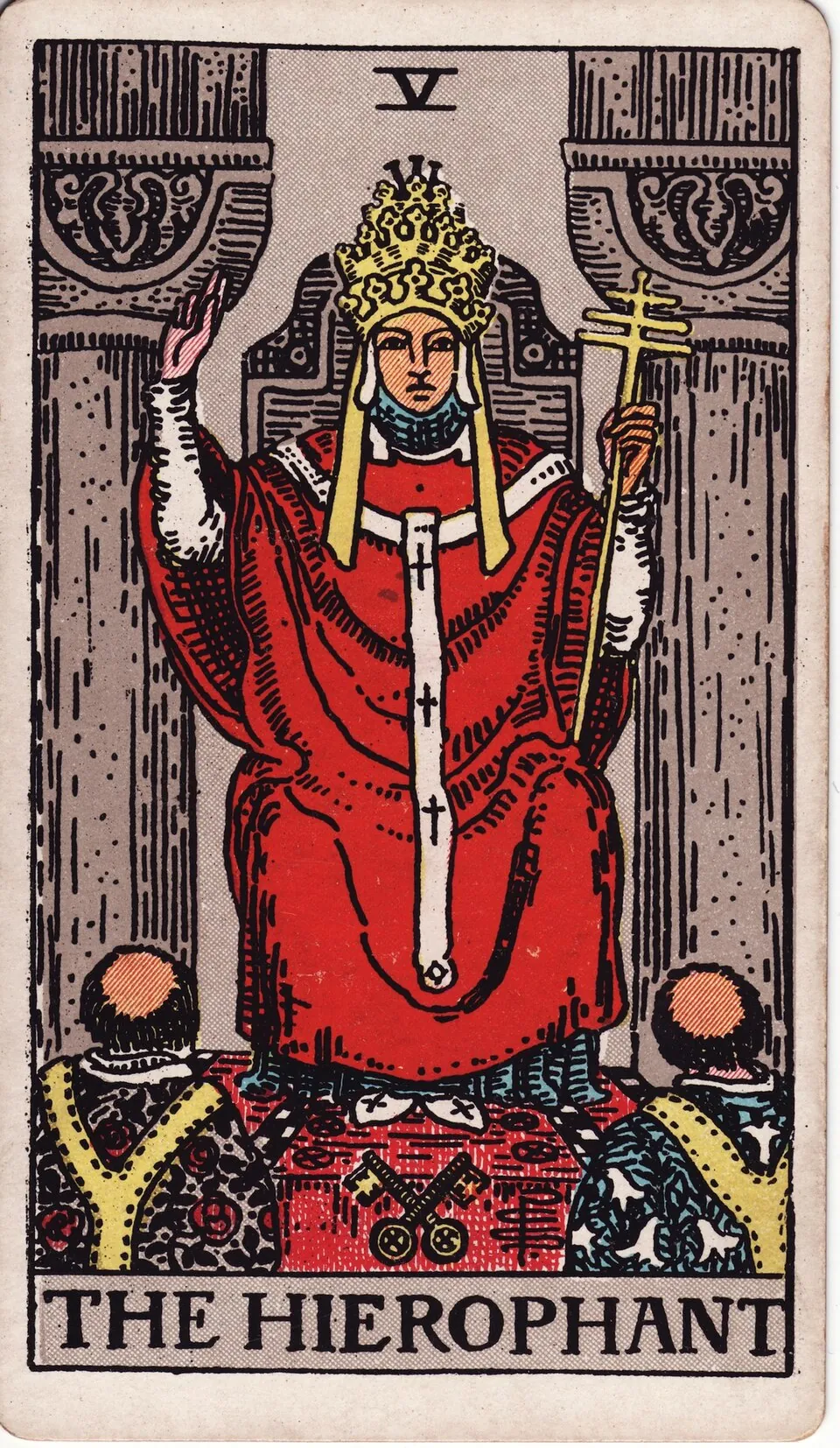
The Hierophant is card five of the Rider–Waite Major Arcana. He means tradition, institutional wisdom and teaching — raising a blessing between two pillars, with two keys crossed at his feet. Upright, he counsels learning from what has endured; reversed, he flags dogma worth questioning or conventions worth leaving.
Last updated: 2026-08-25 · Rider–Waite tradition
The Hierophant Keywords
Upright
- ✦ Tradition
- ✦ Teaching
- ✦ Institution
- ✦ Mentorship
- ✦ Rites of passage
Reversed
- ✧ Dogma
- ✧ Rebellion
- ✧ Outgrown rules
- ✧ Hollow ritual
- ✧ Convention questioned
The Hierophant Upright Meaning
The Hierophant is the deck's institution: a figure in triple-crowned vestments raising the sign of blessing, two tonsured initiates kneeling before him, and at his feet two crossed keys — the ones that open the doors knowledge was kept behind. He is tradition as technology: methods that survived because they worked, lineage as a shortcut through problems your ancestors already solved. Where the High Priestess guards the inner mystery, the Hierophant runs the outer school.
Drawn upright, he counsels apprenticeship: find the teacher, take the course, join the institution, learn the form before improvising on it. He governs weddings and funerals, ordinations and graduations — the rites that bind lives into meaning. In an era allergic to institutions, the card makes a countercultural point: some doors only open for members, and some knowledge only travels through relationship. He also asks a debt of received wisdom — someone taught you; the ledger wants balancing eventually.
The Hierophant Reversed Meaning
Reversed, the keys rust in two directions. First: dogma — the tradition has stopped being a teacher and become a warden, enforcing rules whose reasons have died. Reversed-Hierophant situations have a recognizable texture: answers before questions, conformity as admission price, caretakers of the method who forgot the method's purpose.
Second: your own departure in progress. The reversal often blesses the exit — the belief outgrown, the title declined, the ceremony declined. Not all leaving is rebellion-as-costume; some is graduation. The diagnostic question the card hands you: does walking away free something alive in you, or just fire a shot at something dead? The first is growth wearing the reversal; the second is merely noise, and the noise costs more.
The Hierophant in Love & As Feelings
In love, the Hierophant favors the sanctioned and the ceremonial: commitment formalized, families met, the relationship given a shape the community can hold. He reads well for engagements and vows — and honestly for the desire for them. For some, he flags the weight of expectation: the timeline inherited, the marriage performed for an audience of ancestors.
Reversed in love, either the convention does not fit (define the relationship on your own nouns) or the institution itself has gone hollow in your bond — ritual kept, meaning lost. Both readings agree on one thing: consecrate what is actually true.
The Hierophant as feelings
As feelings, the Hierophant reads as serious, formal intention. The person is not exploring you; they are considering you — for keeps, in front of witnesses. What they feel arrives structured: plans stated, introductions made, a preference for the defined over the ambiguous. This is wooing as covenant. Its shadow is approval-seeking — the feeling is real but over-collateralized by what family, faith or society will ratify. Reversed, the same energy turns clandestine or rebellious; read carefully which.
The Hierophant: Yes or No?
YesThe Hierophant is a yes for questions about joining, committing, marrying, certifying and studying — take the seat, sign the book, learn from the lineage. He is a no for questions about breaking rules purely to break them. If the question is "should I follow tradition here?", he answers yes with one clause appended: keep the keys, question the locks.
Frequently Asked Questions
What does The Hierophant mean in a tarot reading?
Tradition and teaching — learn from what has endured: take the class, find the mentor, honor the rite. He is the deck's advocate for institutional wisdom as a shortcut, not a cage.
Is a reversed Hierophant bad?
Not necessarily. It names dogma and hollow convention — and often blesses leaving them. The card distinguishes rebellion that frees something alive in you from rebellion that just performs.
What is the difference between The Hierophant and The Emperor?
The Emperor rules structures of power — law, boundaries, protection. The Hierophant keeps structures of meaning — teaching, ritual, lineage. One governs the kingdom; the other explains why the kingdom is sacred.
The Hierophant · ruled by Taurus · Taurus
The Stones of The Hierophant
The Hierophant keeps tradition, and Taurus stones are the tradition stones: emerald set in rings for a thousand years of vow-keeping, diamond for commitments meant to outlive the people who made them. His jewelry lesson is simple — choose pieces that carry meaning older than fashion.
Curious what your own birth month says about you? Read the Taurus zodiac stone story or explore the zodiac crystal kit.
Draw The Hierophant in a free reading
Meanings come alive in context. Ask a real question and let the full 78-card Rider–Waite deck answer — free, no sign-up, one reading a day.