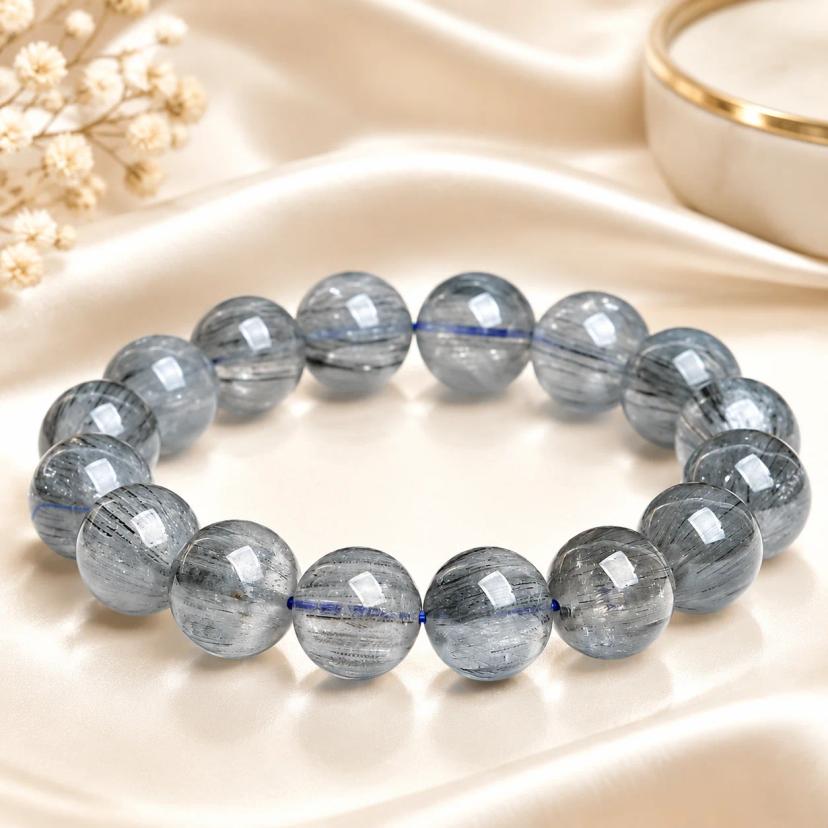
Natural Blue Rutilated Quartz (Timber Stone Family) on Elastic Cord
Blue Rutilated Quartz Bracelet
Featuring a genuine Blue Rutilated Quartz gemstone
Natural blue rutilated quartz bead bracelet, completely untreated — 8mm, 10mm or 12mm clear quartz beads with captured storm-strand inclusions on strong elastic. One-of-one patterns, unisex everyday wear. Each stone is ethically sourced and set by hand in our atelier, finished to a luminous shine that lasts.
Bracelet Size Guide
| Your Wrist (in) | Bracelet Length (in) | Bracelet Length (cm) |
|---|---|---|
| 5.0 – 5.5" | 6" | 15.2 cm |
| 5.5 – 6.0" | 6.5" | 16.5 cm |
| 6.0 – 6.5" | 7" | 17.8 cm |
| 6.5 – 7.0" | 7.5" | 19.1 cm |
| 7.0 – 7.5" | 8" | 20.3 cm |
Most women wear a 7" bracelet (6"–6.5" wrist). The bracelet should slide over the hand but not rotate freely on the wrist — when in doubt, go half an inch up.
How to measure at home
- 1. Wrap a soft measuring tape (or a thin strip of paper) snugly around your wrist, just above the wrist bone.
- 2. Read the length in inches — that's your wrist size. Mark the paper and measure it against a ruler if you used paper.
- 3. Add 0.5–1" for the perfect drape, then match it to the length column above. Available sizes: 6"–8".
Free Insured Shipping
On every order
Lifetime Warranty
Crafted to last
30-Day Returns
Hassle-free
Materials & Care
Crafted in Natural Blue Rutilated Quartz (Timber Stone Family) on Elastic Cord. To keep your piece looking its best, avoid contact with water, perfumes, and cosmetics. Store in the provided pouch away from direct sunlight, and gently wipe with a soft cloth after each wear.
Shipping & Returns
Enjoy free insured shipping worldwide on every order. Orders are dispatched within 1— business days and arrive in signature packaging. Not in love? Return any unworn piece within 30 days for a full refund.
Stone Guide
Blue Rutilated Quartz is chosen for its clarity and natural luminosity. Every stone is ethically sourced and uniquely cut, so subtle variations are a mark of its authentic origin.
What Is Blue Rutilated Quartz? Crystal With Captured Lightning
Blue rutilated quartz is clear quartz shot through with needle-fine strands of blue mineral — amphibole fibers that grew inside the crystal while it was forming, frozen there forever before the crystal finished closing. The trade sorts the family by inclusion color: **golden rutilated quartz** for the amber needles, **tourmalinated quartz** for the black strands, and this blue-gray storm pattern as the rarest colorway of the three. No two beads can ever match — each strand pattern is a one-of-one signature drawn over millions of years and sealed in stone.
The nickname collectors use tells you exactly what it looks like: captured lightning, or storm clouds behind glass. Against a white shirt the strands read as ink sketches; against black they glow like the last flash before rain. That dual personality — quiet in soft light, dramatic in direct sun — is why blue rutilated quartz photographs beautifully and rewards daily wear in a way flat-color stones cannot. The stone does not ask to be babied (quartz hardness, Mohs 7); it asks to be looked at.
As a gemological identity card: quartz family, Mohs 7 hardness, inclusions structural rather than surface-applied, and a specific gravity that reads noticeably heavier than glass imitations in the hand. If you are comparing stones across sellers, weight and strand depth are the two fastest tests — treated or simulated beads feel light and show their color at the surface only.
Rutilated Quartz Meaning: Storm Energy, Worn Calm
The traditional rutilated quartz meaning centers on illumination — the broken-record phrase in old gem texts is that it brings light to dark places. Golden rutilated quartz was read as sun-energy and worn for confidence; black tourmalinated quartz was read as protection and worn to absorb negativity; **blue rutilated quartz sits between the two, read as storm energy** — the charged, clearing kind of power that arrives before calm. Worn at the wrist, the tradition says: keep the storm where you can use it.
In modern crystal practice the metaphysical properties ascribed to blue rutilated quartz are the same family: mental clarity during chaos, communication that cuts through static, and the particular calm of knowing a storm is passing through rather than staying. We report that tradition as tradition — the verifiable part of this stone is geological, not magical, and it is impressive enough on its own: a gem that recorded weather from another age inside itself, strand by strand.
The meaning also lives in the format. A beaded bracelet of storm-pattern beads is a daily-wear object — the kind of stone you touch while thinking, the kind that catches light differently every time you raise a coffee cup. Collectors of rutilated quartz jewelry tend to own multiple colorways (gold, black, blue) precisely because each reads as a different mood on the same wrist; this blue is the mood people call composed.
Blue vs Gold vs Black Rutilated Quartz: The Full Family
The rutilated quartz family sorts by inclusion mineral and color, and the price ladder follows rarity. **Golden rutilated quartz** (rutile needles) is the classic — widely available, warm, photogenic. **Black rutilated quartz** and **tourmalinated quartz** (black tourmaline needles) are the dramatic darks — the highest-volume search category in the family and the strongest sellers in men jewelry. **Blue rutilated quartz** is the uncommon colorway: amphibole rather than rutile, storm-gray rather than amber or ink, and the hardest of the three to source in matched beads — which is exactly what this bracelet is.
Choosing between them is choosing a mood: gold for warmth, black for edge, blue for atmosphere. All three carry the same quartz body (Mohs 7, daily-wear durable, unfussy about weather) and the same one-of-one inclusion logic. Collectors almost never stop at one colorway — the family is designed to be assembled. If you are starting the set, our blue rutilated quartz is the hardest to find later; gold and black turn up every season.
One genuine care note across the whole family: rutilated quartz is **always natural in its inclusions** — the strands cannot be dyed in, painted on, or faked convincingly, because they sit inside the crystal. What varies between sellers is strand density (sparse needles versus dense feathering) and whether beads are matched for tone. Judge a rutilated quartz bracelet by its own photos: if the strands look thin and scattered, that is what arrives.
Rutilated Quartz Value: What You Are Paying For
Rutilated quartz value runs on three factors, in order: **strand density** (dense feathering costs multiples of sparse needles), **pattern quality** (an even storm across the bead versus clumps), and **tone matching** across the strand of beads. Color comes next — golden is the baseline, black trades higher, blue is the scarcity premium. Cut and polish matter at the margin; the inclusions are the whole story.
Against that ladder, this bracelet sits deliberately: dense strand grading, tone-matched across every bead, untreated from mine to cord. **Untreated matters more in this family than most** — clear quartz with visible inclusions is a favorite target for resin fills and coatings that even out the look cheaply, and those treatments age badly. Ours ships exactly as mined: your bead will look like the photos but with its own unrepeatable strand map, which is the point of the stone, not a flaw in it.
The everyday-wear math closes the case: quartz at Mohs 7 takes desk work, workouts, commuting, and the occasional drop; multi-strand crystal elastic survives years of roll-on wear; cleaning is thirty seconds of warm soapy water and a soft brush. Skip ultrasonic if the strand density is high, store it flat, and the bracelet outlasts several wardrobes. For the birth-month version of meaningful wrist stones, the twelve-month system runs alongside this one; for the stacking format at the same wrist, our birthstone stack ring set is the companion piece.
From Our Customers
Blue Rutilated Quartz Bracelet FAQ
The most-asked questions about this piece, answered.
What is blue rutilated quartz?
Clear quartz containing needle-fine strands of blue mineral — amphibole fibers that grew inside the crystal during formation and were frozen there permanently. It is the rarest colorway of the rutilated quartz family: golden (rutile needles) is the classic, black (tourmalinated) is the dramatic dark, and blue is the storm-pattern collector colorway.
What is the meaning of rutilated quartz?
The traditional rutilated quartz meaning is illumination — bringing light to dark places, said across five centuries of gem texts. Golden rutilated quartz is read as sun-energy and confidence; black tourmalinated as protection; blue as storm energy that clears before it calms. We report that tradition as tradition — the geological fact behind it (weather from another age, sealed in stone) is impressive on its own.
Is the blue color natural or dyed?
Natural and completely untreated. The blue strands are amphibole needles inside the crystal — structural, not surface-applied, so there is nothing to fade, rub off, or fade in sunlight. Dye cannot reproduce strands inside a solid bead; that is the simplest authenticity check. Ours ships exactly as mined, each bead pattern unrepeatable.
What are the properties of rutilated quartz?
The measurable properties: quartz family, Mohs 7 hardness, amphibole or rutile needle inclusions structural inside the crystal, specific gravity noticeably heavier than glass. The metaphysical properties traditionally ascribed: illumination, clarity during chaos, and protection. One list survives a lab; the other has centuries of wearers behind it.
What are the benefits of wearing rutilated quartz?
The traditional benefits: mental clarity during chaos, communication that cuts through static, and calm that arrives after a storm passes. The practical benefits: Mohs 7 daily-wear durability, elastic sizing that makes gifting foolproof, and a one-of-one pattern that makes every bracelet unrepeatable. We stand behind the practical list completely and report the traditional one as the reason people have worn this stone since antiquity.
How is blue rutilated quartz different from tourmalinated quartz?
The inclusion mineral: blue rutilated quartz carries blue amphibole needles; tourmalinated quartz carries black tourmaline needles. Everything else is presentation — blue reads as storm clouds and atmosphere, black reads as ink and edge. Same quartz body, same durability, same one-of-one logic; the choice is purely which mood you want at the wrist.
Is blue rutilated quartz rare?
Yes — within the family it is the uncommon colorway. Golden rutilated quartz is widely available, black tourmalinated is well known, and blue amphibole-included quartz in matched-bead bracelet quality is the hardest of the three to source. Rarity shows in the price ladder at the top grades and in how rarely matched blue strands reach the market at all.
How hard is rutilated quartz for daily wear?
Mohs 7 — quartz hardness, the reference standard for everyday gems. It handles desk work, workouts, commuting, and the occasional drop; the inclusions sit inside the crystal and cannot wear away. The only maintenance is warm soapy water and a soft brush, plus skipping ultrasonic cleaners if the strand density is high.
What does rutilated quartz value depend on?
Three factors in order: strand density (dense feathering costs multiples of sparse needles), pattern quality (an even storm versus clumps), and tone matching across the beads. Color follows — golden is the baseline, black trades higher, blue is the scarcity premium. Untreated status is assumed at the top grades; any treatment should be disclosed and usually signals a lower grade.
You May Also Like
More bracelets to adore

18K Gold Vermeil
Star Birthstone Necklace — All 12 Months
✦ Choose your birth month stone — all 12 months available
S925 Sterling Silver
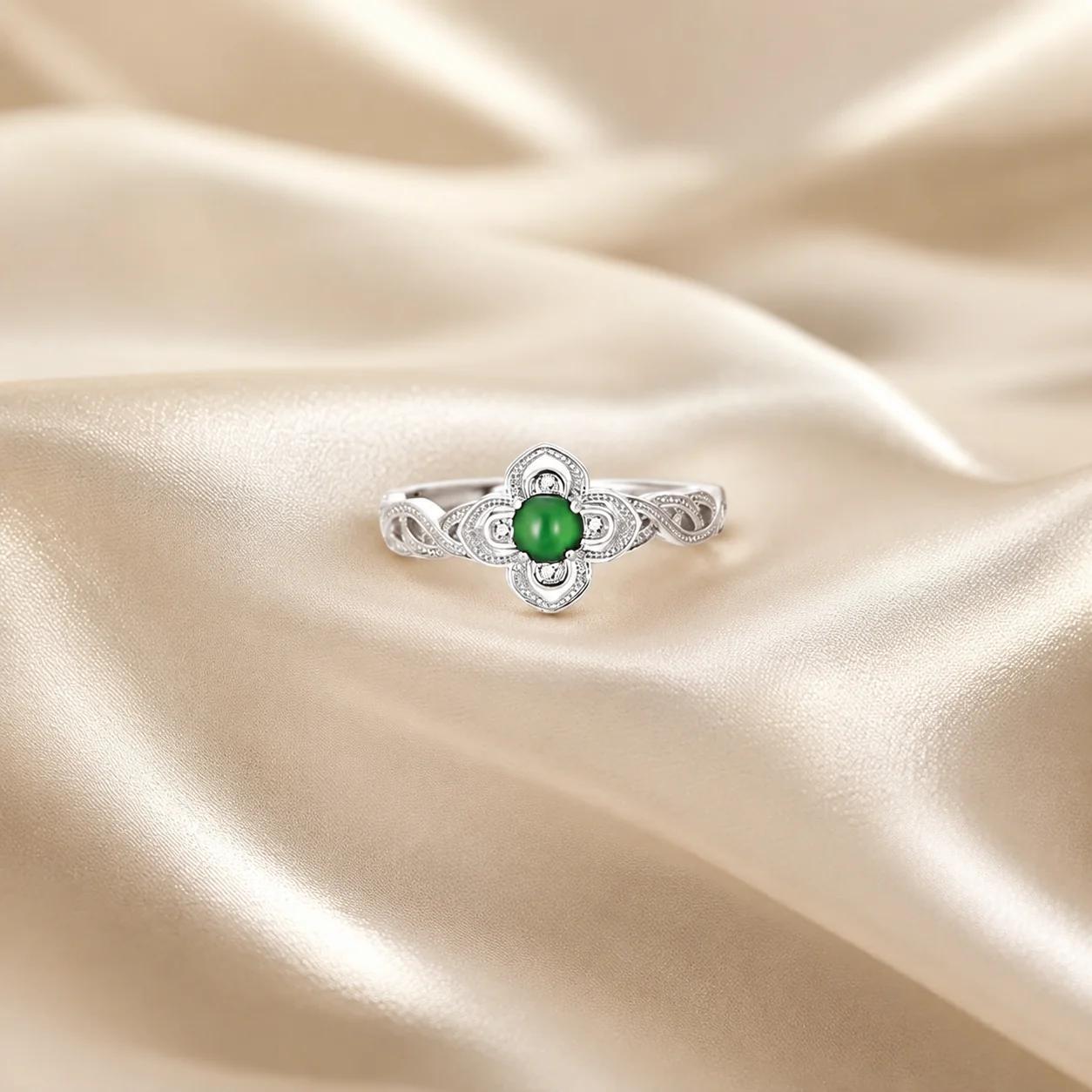
Emerald Clover Ring — Four Leaf Luck, Sterling Silver
925 Sterling Silver
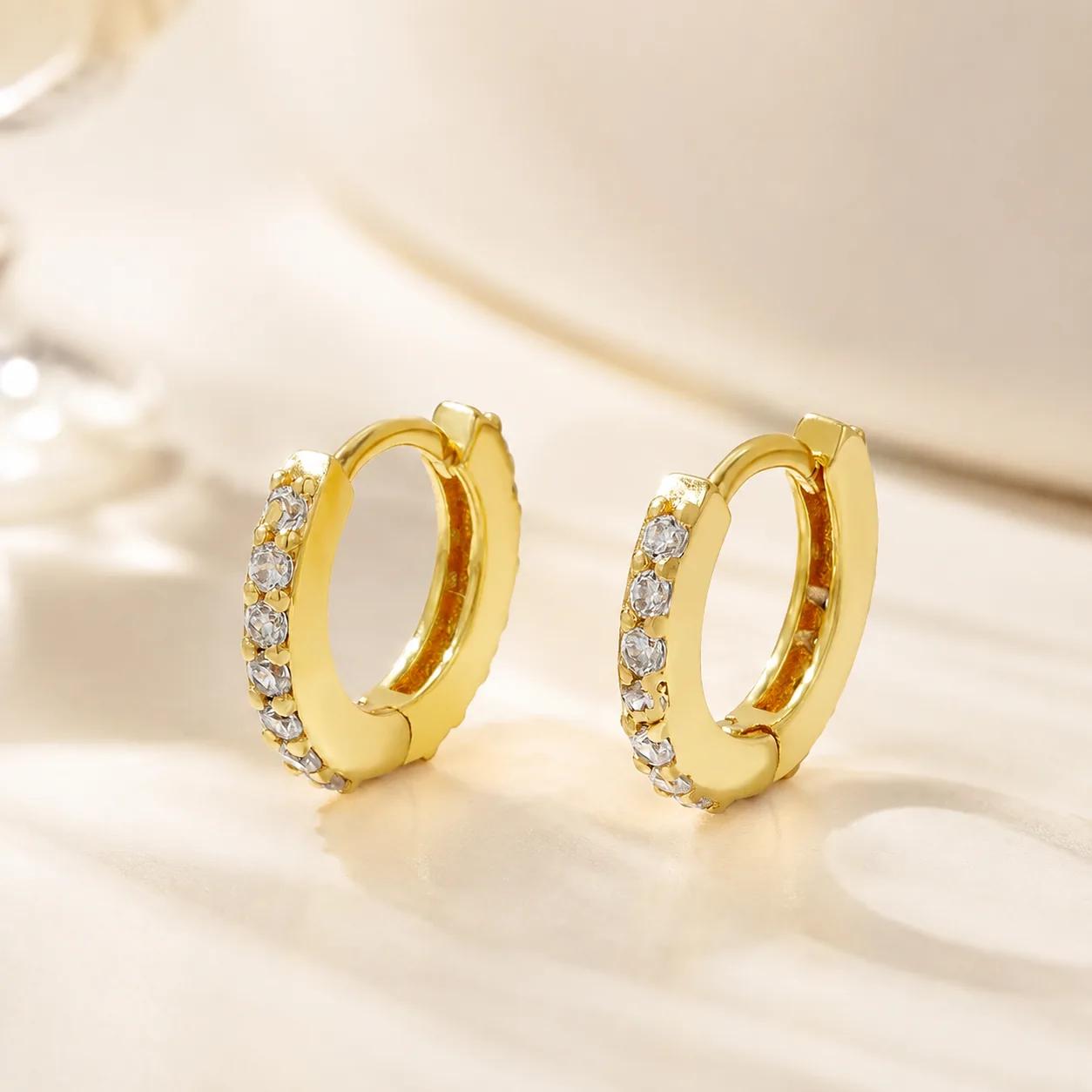
Pavé Star Stud Earrings
18K Gold Vermeil